San Elizario in El Paso County, Texas — The American South (West South Central)
San Elizario Presidio Chapel
⎯⎯⎯
Capilla del Presidio de San Elizario
Photographed by Mansfieldphoto.com, October 4, 2025
1. San Elizario Presidio Chapel / Capilla del Presidio de San Elizario Marker
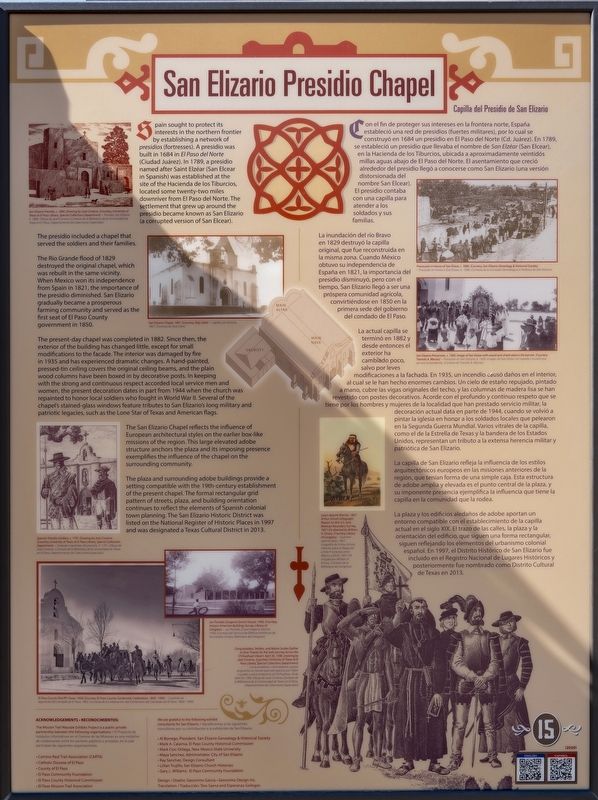
 Spain sought to protect its interests in the northern frontier by establishing a network of presidios (fortresses). A presidio was built in 1684 in El Paso del Norte (Ciudad Juárez). In 1789, a presidio named after Saint Elzéar (San Elcear in Spanish) was established at the site of the Hacienda de los Tiburcios, located some twenty-two miles downriver from El Paso del Norte. The settlement that grew up around the presidio became known as San Elizario (a corrupted version of San Elcear).
The presidio included a chapel that served the soldiers and their families.
The Rio Grande flood of 1829 destroyed the original chapel, which was rebuilt in the same vicinity. When Mexico won its independence from Spain in 1821, the importance of the presidio diminished. San Elizario gradually became a prosperous farming community and served as the first seat of El Paso County government in 1850.
The present-day chapel was completed in 1882. Since then, the exterior of the building has changed little, except for small modifications to the facade. The interior was damaged by fire in 1935 and has experienced dramatic changes.
this page online
The San Elizario Chapel reflects the influence of European architectural styles on the earlier box-like missions of the region. This large elevated adobe structure anchors the plaza and its imposing presence exemplifies the influence of the chapel on the surrounding community.
The plaza and surrounding adobe buildings provide a setting compatible with the 19th-century establishment of the present chapel. The formal rectangular grid pattern of streets, plaza, and building orientation continues to reflect the elements of Spanish colonial town planning. The San Elizario Historic District was listed on the National

Photographed by Mansfieldphoto.com, October 4, 2025
2. San Elizario Presidio Chapel / Capilla del Presidio de San Elizario Marker
Captions
(Photo #1) San Elizario Presidio, c. 1800. Drawing by José Cisneros. (Courtesy University of Texas at El Paso Library, Special Collections Department).
(Photo #2) San Elizario Chapel, 1907. (Courtesy Skip Clark)
(Photo #3) Spanish Presidio Soldiers, c. 1791. Drawing by José Cisneros. (Courtesy University of Texas at El Paso Library, Special Collections Department).
(Photo #4) El Paso County Sheriff's Posse, 1950. (Courtesy El Paso County Centennial Celebration, 1850-1950)
(Photo #5) Los Portales (Gregorio García House), 1936. (Courtesy Historic American Buildings Survey, Library of Congress)
(Photo #6) Conquistadors, Settlers, and Native Guides Gather to Give Thanks for the Safe Journey Across the Chihuahuan Desert, April 30, 1598. Drawing by José Cisneros. (Courtesy University of Texas at El Paso Library, Special Collections Department)
(Photo #7) Procession in Honor of San Elcear, c. 1890. (Courtesy San Elizario Genealogy & Historical Society)
(Photo #8) San Elizario Procession, c. 1920. Image of San Elcear with sword and shield adorns the banner. (Courtesy Transito A. Macías)
(Photo #9) Lipan Apache Warrior, 1857. Arthur Schott Lithograph. Report on the U.S. and Mexican Boundary Survey, 1857-59, directed by William H. Emory. (Courtesy Library of Congress)
Con el fin de proteger sus intereses en la frontera norte, España estableció una red de presidios (fuertes militares), por lo cual se construyó en 1684 un presidio en El Paso del Norte (Cd. Juárez). En 1789, se estableció un presidio que llevaba el nombre de San Elzéar (San Elcear), en la Hacienda de los Tiburcios, ubicada a aproximadamente veintidós millas aguas abajo de El Paso del Norte. El asentamiento que creció alrededor del presidio llegó a conocerse como San Elizario (una versión distorsionada del nombre San Elcear). El presidio contaba con una capilla para atender a los soldados y sus familias.
La inundación del río Bravo en 1829 destruyó la capilla original, que fue reconstruida en la misma zona. Cuando México obtuvo su independencia de España en 1821, la importancia del presidio disminuyó, pero con el tiempo, San Elizario llegó a ser una próspera comunidad agrícola, convirtiéndose en 1850 en la primera sede del gobierno del condado de El Paso.
La actual capilla se terminó en 1882 y desde entonces el exterior ha cambiado poco, salvo por leves modificaciones a la fachada. En 1935, un incendio causó daños en el interior, al cual se le han hecho enormes cambios. Un cielo de estaño repujado, pintado a mano, cubre las vigas originales del techo, y las columnas de madera lisa se han revestido con postes decorativos. Acorde con el profundo y continuo respeto que se tiene por los hombres y mujeres de la localidad que han prestado servicio militar, la decoración actual data en parte de 1944, cuando se volvió a pintar la iglesia en honor a los soldados locales que pelearon en la Segunda Guerra Mundial. Varios vitrales de la capilla, como el de la Estrella de Texas y la bandera de los Estados Unidos, representan un tributo a la extensa herencia militar y patriótica de San Elizario.
La capilla de San Elizario refleja la influencia de los estilos arquitectónicos europeos en las misiones anteriores de la región, que tenían forma de una simple caja. Esta estructura de adobe amplia y elevada es el punto central de la plaza, y su imponente presencia ejemplifica la influencia que tiene la capilla en la comunidad que la rodea.
La plaza y los edificios aledaños de adobe aportan un entorno compatible con el establecimiento de la capilla actual en el siglo XIX. El trazo de las calles, la plaza y la orientación del edificio, que siguen una forma rectangular, siguen reflejando los elementos del urbanismo colonial español. En 1997, el Distrito Histórico de San Elizario fue incluido en el Registro Nacional de Lugares Históricos y posteriormente fue nombrado como Distrito Cultural de Texas en 2013.
Subtítulos
(Foto #1) Presidio San Elizario h. 1800. Dibujo de José Cisneros (Cortesía de la Biblioteca de la Universidad de Texas en El Paso, Departamento de Colecciones Especiales)
(Foto #2) Capilla San Elizario, 1907. (Cortesía de Skip Clark)
(Foto #3) Soldados españoles del presidio, h. 1791. Dibujo de José Cisneros. (Cortesía de la Biblioteca de la Universidad de Texas en El Paso, Departamento de Colecciones Especiales)
(Foto #4) Cuadrilla de alguaciles del condado de El Paso, 1950. (Cortesía de la Celebración del Centenario del Condado de El Paso, 1850-1950)
(Foto #5) Los Portales (Casa Gregorio García), 1936. (Cortesía del Servicio de Edificios Históricos de los Estados Unidos, Biblioteca del Congreso)
(Foto #6) Conquistadores, colonizadores y guías originarios se reúnen para dar gracias por haber cruzado a salvo el desierto de Chihuahua, 30 de abril de 1598. Dibujo de José Cisneros (Cortesía de la Biblioteca de la Universidad de Texas en El Paso, Departamento de Colecciones Especiales)
(Foto #7) Procesión en honor a San Elcear, h. 1890. (Cortesía de la Sociedad Genealógica e Histórica de San Elizario)
(Foto #8) Procesión en San Elizario, h. 1920. Imagen de San Elcear con espada y escudo que adorna la banderola. (Cortesía de Tránsito A. Macías)
(Foto #9) Guerrero apache lipán, 1857. Litografía de Arthur Schott. Informe sobre el Mapa del Límite Fronterizo entre México y EEUU, 1857-59, dirigido por William H. Emory. (Cortesía de la Biblioteca del Congreso)
Erected 2020 by Camino Real Trail Association (CARTA), Catholic Diocese of El Paso, County of El Paso, El Paso Community Foundation, El Paso County Historical Commission and El Paso Mission Trail Association. (Marker Number 15.)
Topics. This historical marker is listed in these topic lists: Colonial Era • Hispanic Americans • Indigenous Peoples and Communities • Religion & Religious Structures. A significant historical year for this entry is 1789.
Location. 31° 35.097′ N, 106° 16.389′ W. Marker is in San Elizario, Texas, in El Paso County. It is at the intersection of San Elizario Road and Church Street, on the left when traveling west on San Elizario Road. Touch for map. Marker is at or near this postal address: 1556 San Elizario Rd, San Elizario TX 79849, United States of America. Touch for directions.

Regionally, this marker is in Texas’ Trans-Pecos & Big Bend Region. It is also in the American Borderlands and in the Southwest. Globally, it is in North America, a Gulf of Mexico state, the Western Hemisphere, the Western World, and the Anglosphere. Historically, it finds itself in what was once New Spain, the Republic of Texas, and one of the Confederate States of America.
Other nearby markers. At least 8 other markers are within walking distance of this marker: San Elizario Chapel (here, next to this marker); San Elizario (a few steps from this marker); Salt War (a few steps from this marker); Los Portales (within shouting distance of this marker); San Elizario Memorial Plaza (within shouting distance of this marker); a different marker also named San Elizario (within shouting distance of this marker); The First Thanksgiving (within shouting distance of this marker); Juan de Onate Expedition - 1598 (within shouting distance of this marker). Touch for a list and map of all markers in San Elizario.
Credits. This page was last revised on December 11, 2025. It was originally submitted on December 10, 2025, by James Hulse of Medina, Texas. This page has been viewed 122 times since then and 89 times this year. Photos: 1, 2. submitted on December 11, 2025, by James Hulse of Medina, Texas.
