Riverton in Barkhamsted in Northwest Hills Region, Connecticut — The American Northeast (New England)
Church Pool
| — | Wild & Scenic Farmington River | — |
Photographed by Conrad Ward, March 11, 2025
1. Church Pool Marker
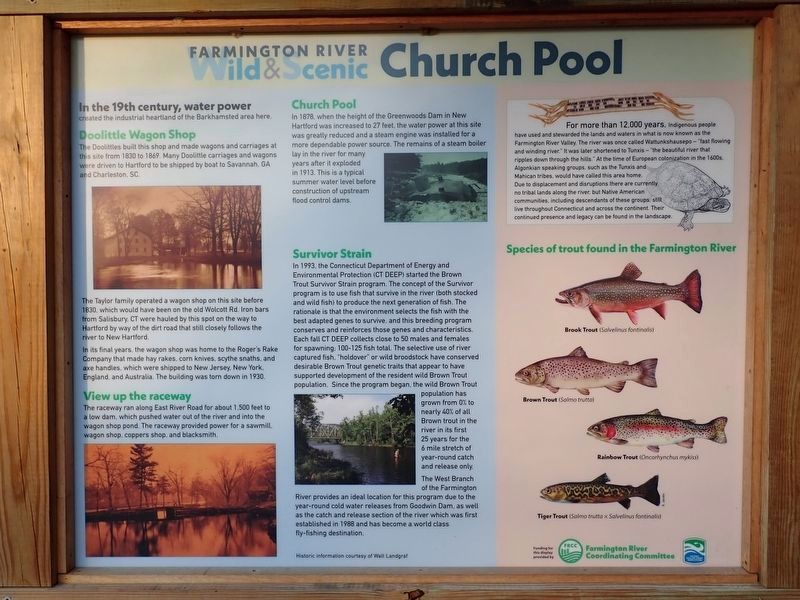
In the 19th century, water power created the industrial heartland of the Barkhamsted area here.
Doolittle Wagon Shop
The Doolittles built this shop and made wagons and carriages at this site from 1830 to 1869. Many Doolittle carriages and wagons were driven to Hartford to be shipped by boat to Savannah, GA and Charleston, SC.
The Taylor family operated a wagon shop on this site before 1830, which would have been on the old Wolcott Rd. Iron bars from Salisbury, CT were hauled by this spot on the way to Hartford by way of the dirt road that still closely follows the river to New Hartford.
In its final years, the wagon shop was home to the Roger's Rake Company that made hay rakes, corn knives, scythe snaths, and axe handles, which were shipped to New Jersey, New York, England, and Australia. The building was torn down in 1930.
View up the raceway
The raceway ran along East River Road for about 1,500 feet to a low dam, which pushed water out of the river and into the wagon shop pond. The raceway provided power for a sawmill, wagon shop, coppers shop, and blacksmith.
Church Pool
In 1878, when the height of
this page online
Survivor Strain
In 1993, the Connecticut Department of Energy and Environmental Protection (CT DEEP) started the Brown Trout Survivor Strain program. The concept of the Survivor program is to use fish that survive in the river (both stocked and wild fish) to produce the next generation of fish. The rationale is that the environment selects the fish with the best adapted genes to survive, and this breeding program conserves and reinforces those genes and characteristics. Each fall CT DEEP collects close to 50 males and females for spawning: 100-125 fish total. The selective use of river captured fish, "holdover" or wild broodstock have conserved desirable Brown Trout genetic traits that appear to have supported development of the resident wild Brown Trout population. Since the program
Photographed by Conrad Ward, March 11, 2025
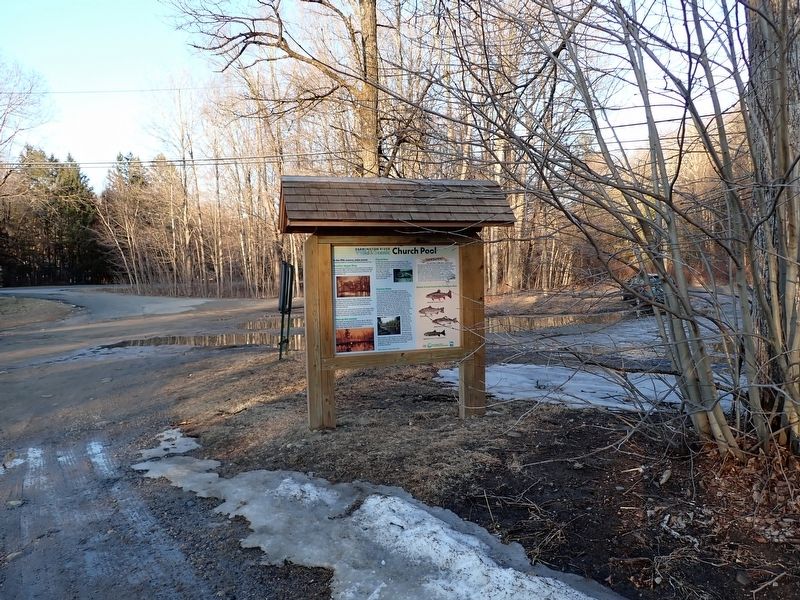
2. Church Pool Marker
The West Branch of the Farmington
River provides an ideal location for this program due to the year-round cold water releases from Goodwin Dam, as well as the catch and release section of the river which was first established in 1988 and has become a world class fly-fishing destination.
Historic information courtesy of Walt Landgraf
(Inset)
For more than 12,000 years, Indigenous people have used and stewarded the lands and waters in what is now known as the Farmington River Valley. The river was once called Wattunkshausepo - "fast flowing and winding river." It was later shortened to Tunxis - "the beautiful river that ripples down through the hills." At the time of European colonization in the 1600s, Algonkian speaking groups, such as the Tunxis and Mahican tribes, would have called this area home. Due to displacement and disruptions there are currently no tribal lands along the river, but Native American communities, including descendants of these groups, still live throughout Connecticut and across the continent. Their continued presence and legacy can be found in the landscape.
Erected by Farmington River Coordinating Committee & National Wild and Scenic Rivers System.
Topics. This historical marker is listed in these topic lists: Anthropology & Archaeology • Indigenous Peoples and Communities • Industry & Commerce • Waterways & Vessels. A significant historical year for this entry is 1830.
Location. 41° 54.777′ N, 72° 59.211′ W. Marker is in Barkhamsted in Northwest Hills Region, Connecticut. It is in Riverton. It is at the intersection of Pleasant Valley Road (Connecticut Route 318) and East River Road, on the right when traveling east on Pleasant Valley Road. Touch for map. Marker is at or near this postal address: 1 E River Rd, Riverton CT 06065, United States of America. Touch for directions.

Regionally, this marker is in the Berkshire Foothills and in the Litchfield Hills. It is also in the American Northeast and in New England. Globally, it is in North America, the Western Hemisphere, the Western World, and the Anglosphere. Historically, it finds itself in what was once Litchfield County and also one of the original Thirteen Colonies.
Other nearby markers. At least 8 other markers are within 2 miles of this marker, measured as the crow flies: William Wallace Lee (approx. ¼ mile away); The Bronson Legacy with Connecticut's Parks and Forests (approx. 0.9 miles away); Squire's Tavern (approx. 0.9 miles away); The Charcoal Industry (approx. one mile away); Demonstration Charcoal Mound (approx. one mile away); Matthies Grove-Peoples Forest / Wild & Scenic Farmington River (approx. 1.1 miles away); Barkhamsted Center Cemetery (approx. 1.3 miles away); Barkhamsted Soldiers Memorial (approx. 1.4 miles away). Touch for a list and map of all markers in Barkhamsted.
Credits. This page was last revised on May 19, 2026. It was originally submitted on December 14, 2025, by Conrad Ward of Guilford, Connecticut. This page has been viewed 87 times since then and 59 times this year. Photos: 1, 2. submitted on December 14, 2025, by Conrad Ward of Guilford, Connecticut. • Devry Becker Jones was the editor who published this page.
