Near Dolores in Montezuma County, Colorado — The American Mountains (Southwest)
Big Sagebrush
Photographed by Cosmos Mariner, July 17, 2025
1. Big Sagebrush Marker
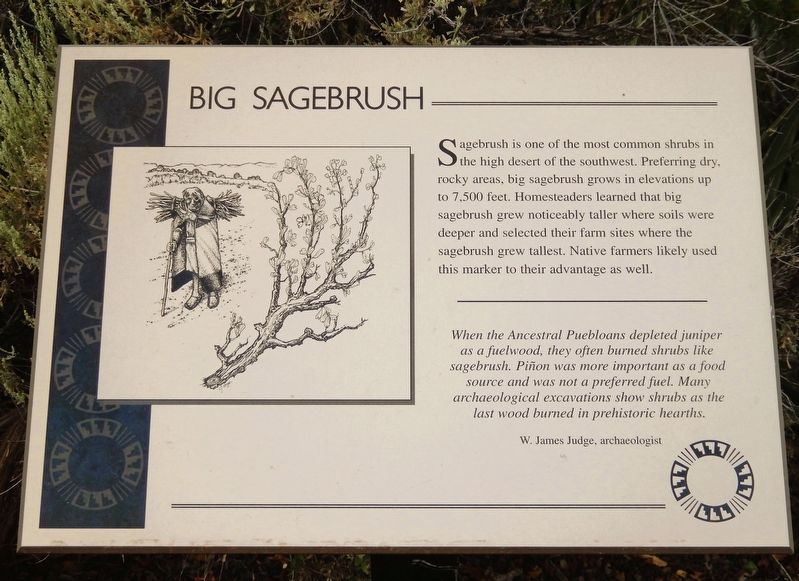
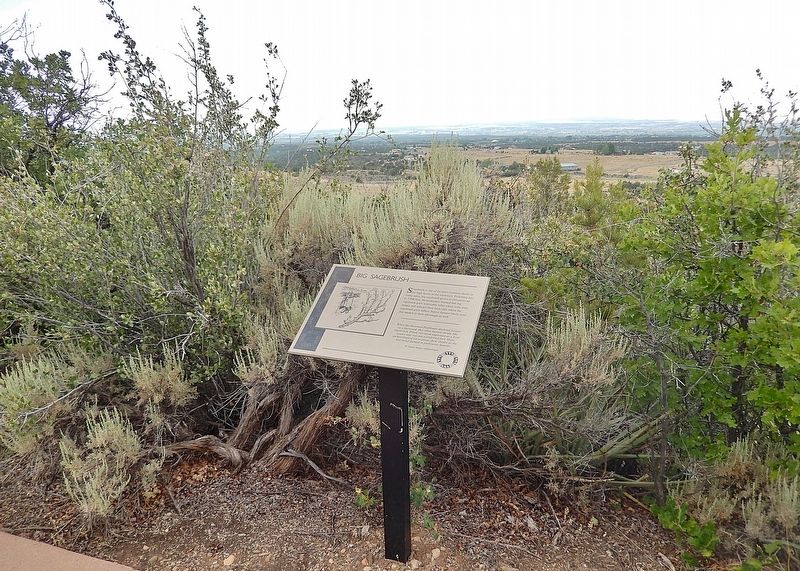
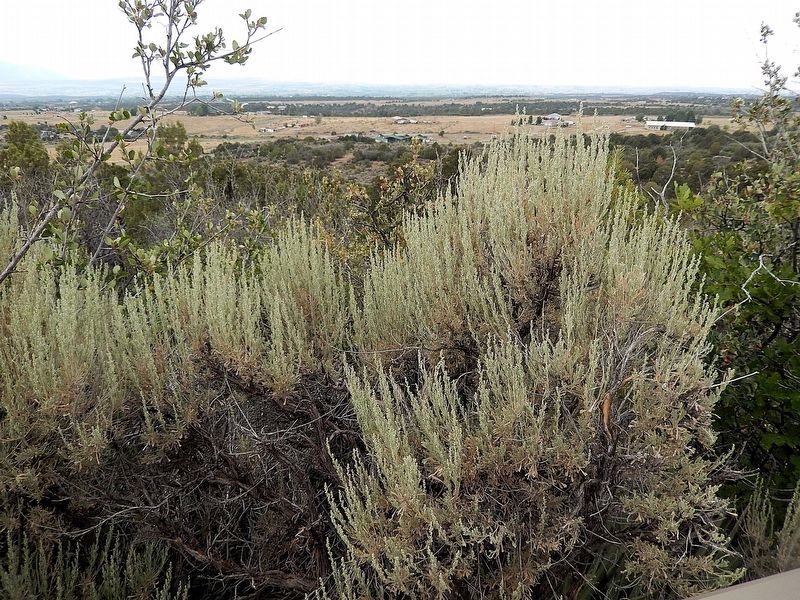
Sagebrush is one of the most common shrubs in the high desert of the southwest. Preferring dry, rocky areas, big sagebrush grows in elevations up to 7,500 feet. Homesteaders learned that big sagebrush grew noticeably taller where soils were deeper and selected their farm sites where the sagebrush grew tallest. Native farmers likely used this marker to their advantage as well.
When the Ancestral Puebloans depleted juniper as a fuelwood, they often burned shrubs like sagebrush. Piñon was more important as a food source and was not a preferred fuel. Many archaeological excavations show shrubs as the last wood burned in prehistoric hearths.
—W. James Judge, archaeologist
Erected by The Colorado Historical Society, the Bureau of Land Management, the Family of Nellie Mulnix Joy and the Frankston Family.
Topics. This historical marker is listed in these topic lists: Anthropology & Archaeology • Indigenous Peoples and Communities • Science & Medicine • Settlements & Settlers.
Location. 37° 28.697′ N, 108° 32.77′ W. Marker is near Dolores, Colorado, in Montezuma
this page online

Regionally, this marker is in the American Mountain West, on the Colorado Plateau, and at the Four Corners. Globally, it is in North America, the Rocky Mountains, the Western Hemisphere, the Western World, and the Anglosphere. Historically, it finds itself in what was once the territory of the Ancestral Puebloans and also Mexico’s Alta California.
Other nearby markers. At least 8 other markers are within walking distance of this marker: Prickly Pear Cactus (here, next to this marker); Wildlife or Relatives? (a few steps from this marker); Piñon (within shouting distance of this marker); Dolores / McPhee Reservoir (within shouting distance of this marker); Big Bend & McPhee (within shouting distance of this marker); Juniper (within shouting distance of this marker); Rabbitbrush
Photographed by Cosmos Mariner, July 17, 2025
2. Big Sagebrush Marker
Also see . . . Artemisia tridentata (Wikipedia).
Excerpt: Artemisia tridentata, commonly called big sagebrush, Great Basin sagebrush or simply sagebrush (one of several related species of this name), is an aromatic shrub from the family Asteraceae. It grows in arid and semi-arid conditions, throughout a range of cold desert, steppe, and mountain habitats in the Intermountain West of North America. Big sagebrush and other Artemisia shrubs are the dominant plant species across large portions of the Great Basin.(Submitted on December 23, 2025, by Cosmos Mariner of Cape Canaveral, Florida.)
The plant's active medicinal constituents include camphor, terpenoids, and tannins. It is used as a herbal medicine by Native Americans throughout the Intermountain West of North America, most notably as a smudging herb. It is also used for preventing infection in wounds, stopping internal bleeding, and treating headaches and colds. The Navajo use the vapors of sagebrush as a treatment for headache. Among the Zuni people, an infusion of the leaves is used externallyfor body aches. The infusion is also taken as a cold medicine. It is also placed in shoes to treat athlete's foot, fissures between toes, and as a foot deodorant.Photographed by Cosmos Mariner, July 17, 20253. Big Sagebrush
Credits. This page was last revised on December 23, 2025. It was originally submitted on December 21, 2025, by Cosmos Mariner of Cape Canaveral, Florida. This page has been viewed 116 times since then and 89 times this year. Photos: 1, 2, 3. submitted on December 23, 2025, by Cosmos Mariner of Cape Canaveral, Florida.
