Near Dolores in Montezuma County, Colorado — The American Mountains (Southwest)
Prickly Pear Cactus
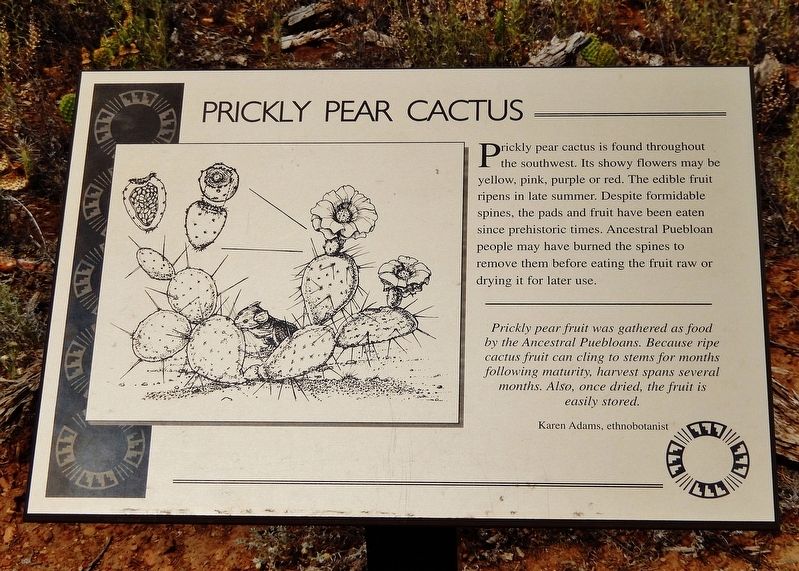
Photographed by Cosmos Mariner, July 17, 2025
1. Prickly Pear Cactus Marker
Prickly pear cactus is found throughout the southwest. Its showy flowers may be yellow, pink, purple or red. The edible fruit ripens in late summer. Despite formidable spines, the pads and fruit have been eaten since prehistoric times. Ancestral Puebloan people may have burned the spines to remove them before eating the fruit raw or drying it for later use.
Prickly pear fruit was gathered as food by the Ancestral Puebloans. Because ripe cactus fruit can cling to stems for months following maturity, harvest spans several months. Also, once dried, the fruit is easily stored.
—Karen Adams, ethnobotanist
Erected by The Colorado Historical Society, the Bureau of Land Management, the Family of Nellie Mulnix Joy and the Frankston Family.
Topics. This historical marker is listed in these topic lists: Anthropology & Archaeology • Indigenous Peoples and Communities • Science & Medicine.
Location. 37° 28.7′ N, 108° 32.771′ W. Marker is near Dolores, Colorado, in Montezuma County. It can be reached from Highway 184 at milepost 7, on the right when traveling west. The
this page online

Regionally, this marker is in the American Mountain West, on the Colorado Plateau, and at the Four Corners. Globally, it is in North America, the Rocky Mountains, the Western Hemisphere, the Western World, and the Anglosphere. Historically, it finds itself in what was once the territory of the Ancestral Puebloans and also Mexico’s Alta California.
Other nearby markers. At least 8 other markers are within walking distance of this marker: Big Sagebrush (here, next to this marker); Wildlife or Relatives? (here, next to this marker); Piñon (within shouting distance of this marker); Dolores / McPhee Reservoir (within shouting distance of this marker); Big Bend & McPhee (within shouting distance of this marker); Juniper (within shouting distance of this marker); Rabbitbrush (within shouting distance of this marker); Escalante Pueblo (within shouting distance of this marker).
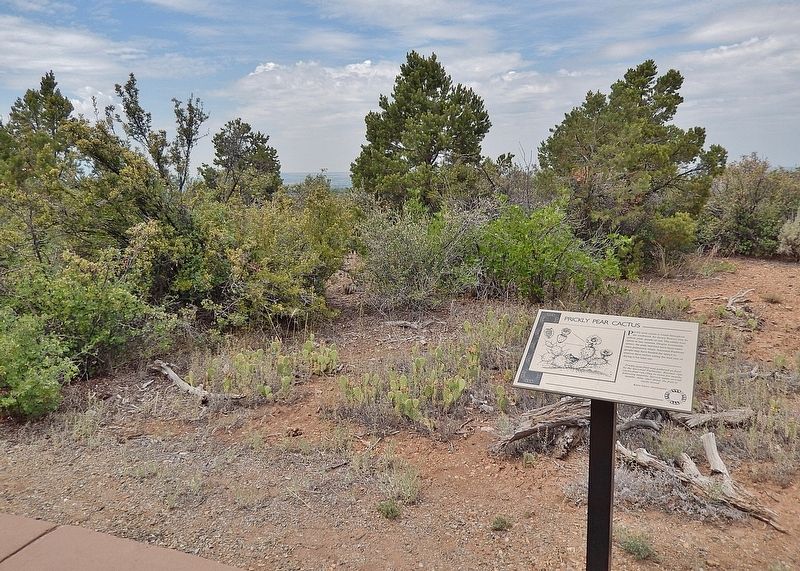
Photographed by Cosmos Mariner, July 17, 2025
2. Prickly Pear Cactus Marker
Also see . . . Opuntia (Wikipedia).
Excerpt: Opuntia, commonly called the Prickly Pear Cactus, is a genus of flowering plants in the cactus family Cactaceae, many known for their flavorful fruit and showy flowers. Cacti are native to the Americas and are well adapted to arid climates.(Submitted on December 25, 2025, by Cosmos Mariner of Cape Canaveral, Florida.)
Prior to modern medicine, Native Americans and Mexicans primarily used Opuntia as a coagulant for open wounds, using the pulp of the stem either by splitting the stem or scraping out the pulp. In Mexican folk medicine, its pulp and juice are considered treatments for wounds and inflammation of the digestive and urinary tracts, although there is no high-quality evidence for any clinical benefit of using opuntia for these purposes.

Photographed by Cosmos Mariner, July 17, 2025
3. Prickly Pear Cactus
Credits. This page was last revised on December 25, 2025. It was originally submitted on December 23, 2025, by Cosmos Mariner of Cape Canaveral, Florida. This page has been viewed 96 times since then and 62 times this year. Photos: 1, 2, 3. submitted on December 25, 2025, by Cosmos Mariner of Cape Canaveral, Florida.
