Grant Park in Chicago in Cook County, Illinois — The American Midwest (Great Lakes)
Re-SPLAM
Reclaimed — Spatial Laminated Timber Pavilion
Photographed by Sean P. Flynn, December 31, 2025
1. Re-SPLAM Marker
Rethinking Timber
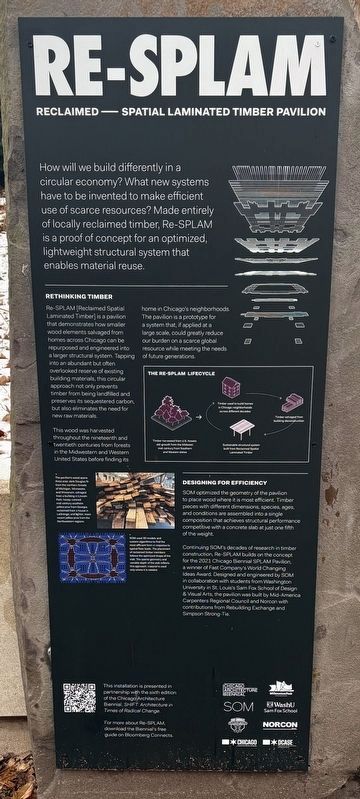
Re-SPLAM [Reclaimed Spatial Laminated Timber] is a pavilion that demonstrates how smaller wood elements salvaged from homes across Chicago can be repurposed and engineered into a larger structural system. Tapping into an abundant but often overlooked reserve of existing building materials, this circular approach not only prevents timber from being landfilled and preserves its sequestered carbon, but also eliminates the need for new raw materials.
This wood was harvested throughout the nineteenth and twentieth centuries from forests in the Midwestern and Western United States before finding its home in Chicago's neighborhoods. The pavilion is a prototype for a system that, if applied at a large scale, could greatly reduce our burden on a scarce global resource while meeting the needs of future generations.
Designing for Efficiency
SOM optimized the geometry of the pavilion to place wood where it is most efficient. Timber pieces with different dimensions, species, ages, and conditions are assembled into a single composition that achieves structural performance competitive with a concrete slab at just one fifth of the weight.
Continuing SOM's decades of research in timber construction, Re-SPLAM builds on the concept for the 2021 Chicago Biennial SPLAM Pavilion, a winner of Fast Company's World Changing Ideas Award. Designed and engineered by SOM in collaboration with students from Washington University in St. Louis's Sam Fox School of Design & Visual Arts, the pavilion was built by Mid-America Carpenters
this page online
[Box with graphics:]
The Re-SPLAM Lifecycle
Timber harvested from U.S. forests: old-growth from the Midwest; mid-century from Southern and Western states
Sustainable structural system built form Reclaimed Spatial Laminated Timber
Timber salvaged from building deconstruction
Timber used to build homes in Chicago neighborhoods across different decades
[Captions beside photos:]
The pavilion's wood spans three eras: dark Douglas fir from the northern forests of Michigan, Minnesota, and Wisconsin, salvaged from a building in Lincoln Park; honey-colored mid-century southern yellow pine from Georgia, reclaimed from a house in LaGrange; and lighter, more recent yellow pine from the Northwestern regions.
SOM used 3D models and custom algorithms to find the most efficient form in response to typical floor loads. The placement of reclaimed timber members follows the optimized shape of the slab. The sparse geometry and variable depth of the slab reflects this approach: material is used only where it is needed.
Erected 2025.

Photographed by Sean P. Flynn, December 31, 2025
2. Re-SPLAM Marker
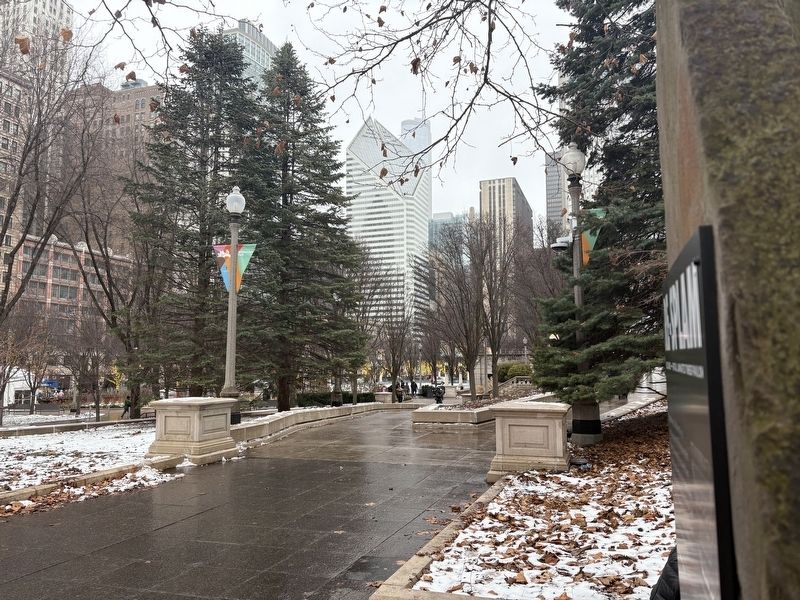
The pavilion described by this sign is visible in the background.
Topics. This historical marker is listed in these topic lists: Environment • Horticulture & Forestry • Parks & Recreational Areas • Science & Medicine. A significant historical year for this entry is 2021.
Location. 41° 52.903′ N, 87° 37.4′ W. Marker is in Chicago, Illinois, in Cook County. It is in Grant Park. It is on South Michigan Avenue south of East Madison Street, on the right when traveling north. The marker is in Millennium Park, on an embankment overlooking the Crown Fountain. Touch for map. Marker is in this post office area: Chicago IL 60602, United States of America. Touch for directions.

Regionally, this marker is in Chicago’s Loop. It is also in the American Midwest. Globally, it is in North America, on the Great Lakes, in the Western Hemisphere, in the Western World, and in the Anglosphere. Historically, it finds itself in what was once the Viceroyalty of New France, the territory of the Mississippian Culture, and the Northwest Territory.
Other nearby markers. At least 8 other markers are within walking distance of this marker: Yvette Mayorga (within shouting distance of this marker); Faheem Majeed
Photographed by Sean P. Flynn, December 31, 2025
3. Re-SPLAM Marker looking north
Another marker is no longer nearby. Franz West (was here, next to this marker but has been replaced with another marker now near it).
Also see . . . Re-SPLAM. From the Chicago Architecture Biennial (Submitted on January 2, 2026, by Sean P. Flynn of Oak Park, Illinois.)
Credits. This page was last revised on January 2, 2026. It was originally submitted on January 2, 2026, by Sean P. Flynn of Oak Park, Illinois. This page has been viewed 50 times since then. Photos: 1, 2, 3. submitted on January 2, 2026, by Sean P. Flynn of Oak Park, Illinois.
