Kipahulu in Hana in Maui County, Hawaii — Hawaiian Island Archipelago (Pacific Ocean)
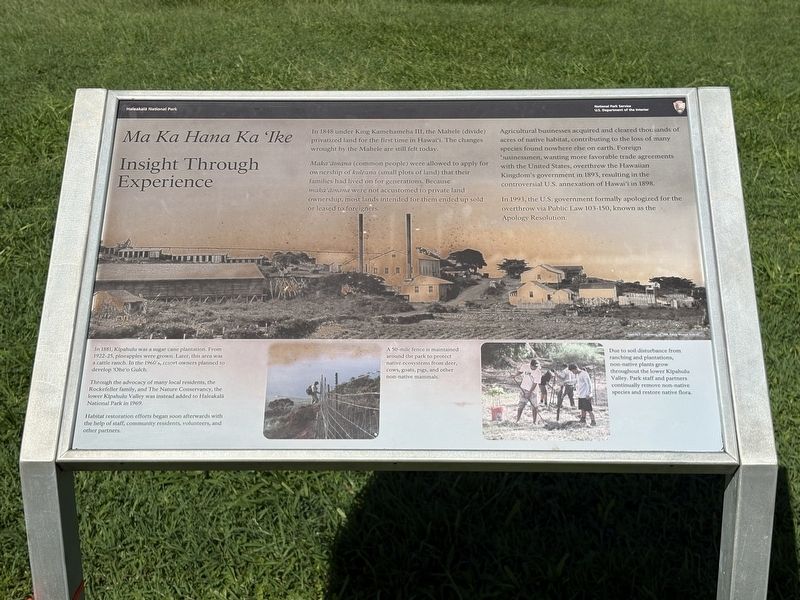
Ma Ka Hana Ka 'Ike
⎯⎯⎯
Insight Through Experience
Photographed by Darren Jefferson Clay, December 8, 2025
1. Ma Ka Hana Ka 'Ike or Insight Through Experience Marker
In 1848 under Kang Kamehameha III, the Mahele (divide) privatized land for the first time in Hawai'i. The changes wrought by the Mahele are still felt today.
Maka'aiana (common people) were allowed to apply for ownership of kuleana (small plots of land) that their families had lived on for generations. Because maka'aiana were not accustomed to private land ownership, most lands intended for them ended up sold or leased to foreigners.
Agricultural businesses acquired and cleared thousands of acres of native habitat, contributing to the loss of many species found nowhere else on earth. Foreign businessmen, wanting more favorable trade agreements with the United States, overthrew the Hawaiian. Kingdom's government in 1893, resulting in the controversial US. annexation of Hawai'i in 1898.
In 1993, the US government formally apologized for the overthrow via Public Law 103-150, known as the Apology Resolution.
[Captions:]
In 1881, Kipahulu was a sugar cane plantation. From 1922-25, pineapples were grown. Later, this area was a cattle ranch. In the 1960's, resort owners planned to develop 'Ohe'o Gulch.
Through the advocacy of many local residents, the Rockefeller family, and The Nature Conservancy, the lower Kipahulu Valley was instead added to Haleakala National Park in 1969.
Habitat restoration efforts began soon afterwards with the help of staff, community residents, volunteers, and pther partners.
A 50-mile fence is maintained around the park to protect native ecosystems from deer, cows, goats, pigs, and other non-native mammals.
Due to soil disturbance from ranching and plantations, non-native plants grow throughout the lower Kipahulu Valley. Park staff and partners continually remove non-native species and restore native flora.
Erected by National
this page online
Topics. This historical marker is listed in these topic lists: Agriculture • Indigenous Peoples and Communities • Industry & Commerce • Natural Features. A significant historical year for this entry is 1848.
Location. 20° 39.706′ N, 156° 2.682′ W. Marker is in Hana, Hawaii, in Maui County. It is in Kipahulu. It can be reached from Kuloa Point Loop Trail. Marker can be found along the Kuloa Point Loop Trail. Touch for map. Marker is at or near this postal address: 42215 Kuloa Pt Lp Trl, Hana HI 96713, United States of America. Touch for directions.

Regionally, it is in North America, in Polynesia, in the Pacific Ocean, in North Pacific, on the Pacific Rim, in the Western Hemisphere, in the Western World, and in the Anglosphere.
Other nearby markers. At least 8 other markers are within walking distance of this marker: 'Ike Aku, 'Ike Mai, Kokua Aku, Kokua Mai, Pela Ka Nohona 'Ohana (here, next to this marker); The 1967 Kipahulu Expedition (a few steps from this marker); Hale Halawai - A House for Meeting, Eating, and Exchanging (within shouting distance of this marker);
Photographed by Darren Jefferson Clay, December 8, 2025
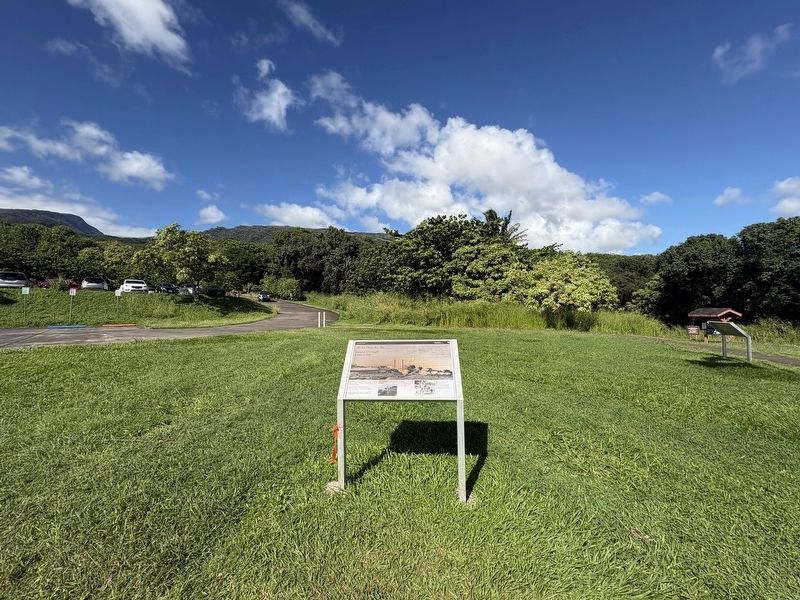
2. Ma Ka Hana Ka 'Ike or Insight Through Experience Marker
Credits. This page was last revised on February 2, 2026. It was originally submitted on January 28, 2026, by Darren Jefferson Clay of Duluth, Georgia. This page has been viewed 76 times since then. Photos: 1, 2. submitted on January 31, 2026, by Darren Jefferson Clay of Duluth, Georgia. • Devry Becker Jones was the editor who published this page.
