Near Homestead in Miami-Dade County, Florida — The American South (South Atlantic)
His Majesty's Ship Fowey
| — | Biscayne National Park | — |
Photographed by James Hulse, January 9, 2026
1. His Majesty's Ship Fowey Marker
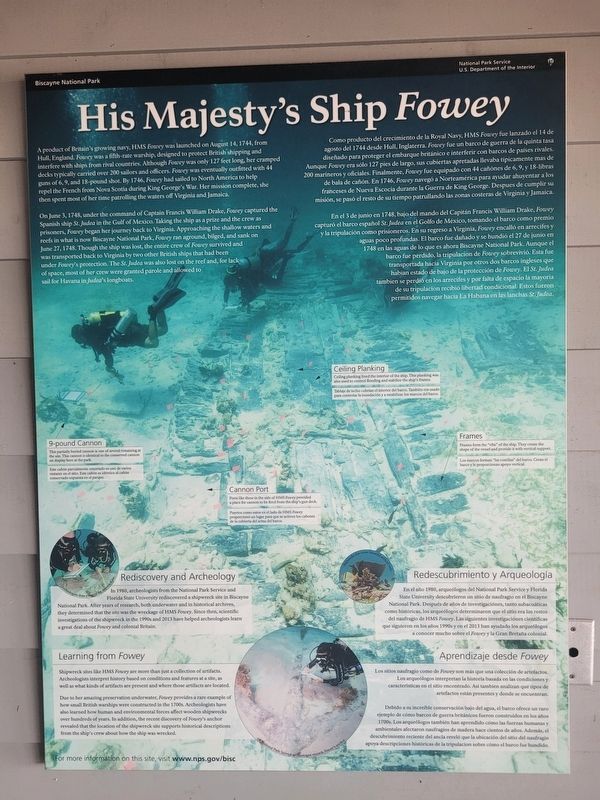
 A product of Britain's growing navy, HMS Fowey was launched on August 14, 1744, from Hull, England. Fowey was a fifth-rate warship, designed to protect British shipping and interfere with ships from rival countries. Although Fowey was only 127 feet long, her cramped decks typically carried over 200 sailors and officers. Fowey was eventually outfitted with 44 guns of 6, 9, and 18-pound shot. By 1746, Fowey had sailed to North America to help repel the French from Nova Scotia during King George's War. Her mission complete, she then spent most of her time patrolling the waters off Virginia and Jamaica.
On June 3, 1748, under the command of Captain Francis William Drake, Fowey captured the Spanish ship St. Judea in the Gulf of Mexico. Taking the ship as a prize and the crew as prisoners, Fowey began her journey back to Virginia. Approaching the shallow waters and reefs in what is now Biscayne National Park, Fowey ran aground, bilged, and sank on June 27, 1748. Though the ship was lost, the entire crew of Fowey survived and was transported back to Virginia by two other British ships that had been under Fowey's protection. The St. Judea was also lost on the reef and, for lack of space, most of her crew were granted parole and allowed to sail for Havana in Judea's longboats.
Rediscovery and Archeology
In 1980, archeologists from the National Park Service and Florida State University rediscovered a shipwreck site in Biscayne National Park. After years of research, both underwater and in historical archives, they determined that the site was the wreckage of HMS Fowey. Since then, scientific investigations
this page online
Learning from Fowey
Shipwreck sites like HMS Fowey are more than just a collection of artifacts. Archeologists interpret history based on conditions and features at a site, as well as what kinds of artifacts are present and where those artifacts are located.
Due to her amazing preservation underwater, Fowey provides a rare example of how small British warships were constructed in the 1700s. Archeologists have also learned how human and environmental forces affect wooden shipwrecks over hundreds of years. In addition, the recent discovery of Fowey's anchor revealed that the location of the shipwreck site supports historical descriptions from the ship's crew about how the ship was wrecked.
9-pound Cannon
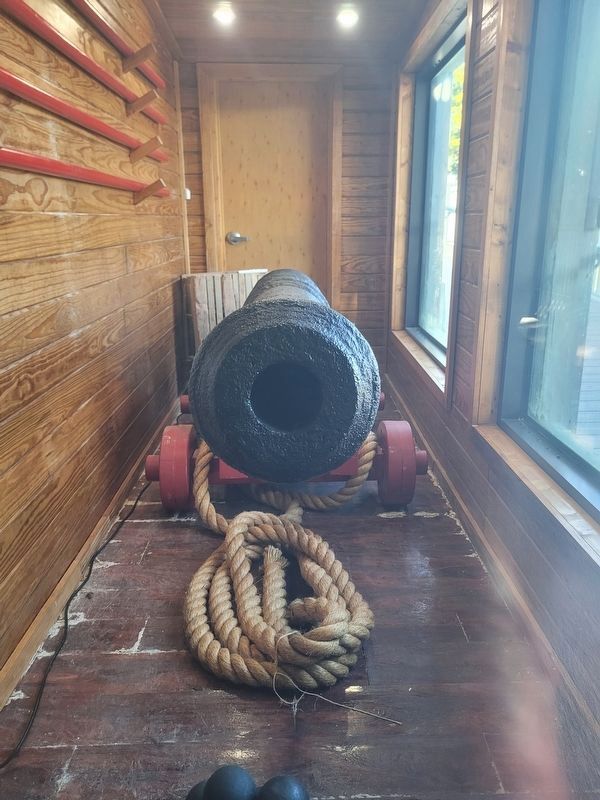
This partially buried cannon is one of several remaining at the site. This cannon is identical to the conserved cannon on display here at the park.
Cannon Port
Ports like these in the side of HMS Fowey provided a place for cannon to be fired from the ship's gun deck.
Ceiling Planking
Ceiling planking lined the interior of the ship. This planking was also used to control flooding and stabilize the ship's frames.
Frames
Frames form the "ribs" of the ship. They create the shape of the vessel and provide it with vertical support.
Como producto del crecimiento de la Royal Navy, HMS Fowey fue lanzado el 14 de agosto del 1744 desde Hull, Inglaterra. Fowey fue un barco de guerra de la quinta tasa diseñado para proteger el embarque británico e interferir con barcos de países rivales.
Photographed by James Hulse, January 9, 2026
2. His Majesty's Ship Fowey Marker
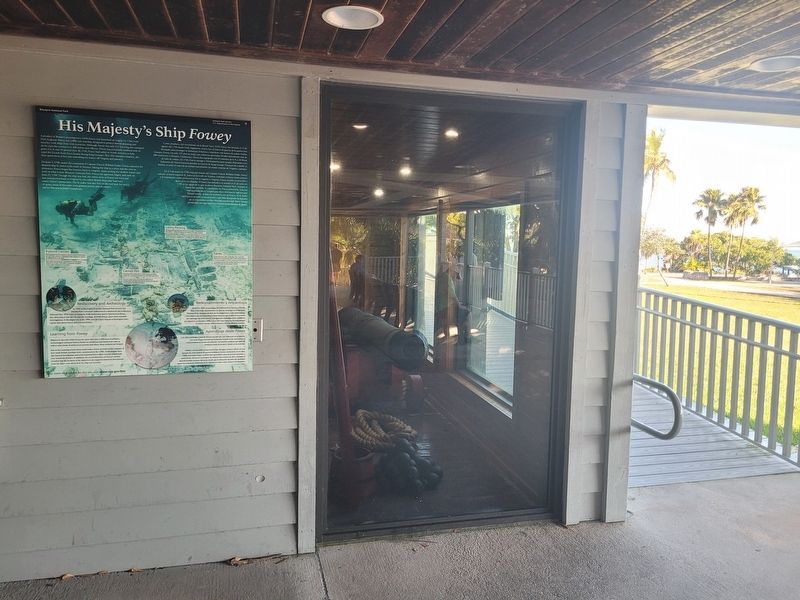
The view of the marker next to the canon.
En el 3 de junio en 1748, bajo del mando del Capitán Francis William Drake, Fowey capturó el barco español St. Judea en el Golfo de México, tomando el barco como premio y la tripulación como prisioneros. En su regreso a Virginia, Fowey encalló en arrecifes y aguas poco profundas. El barco fue dañado y se hundió el 27 de junio en 1748 en las aguas de lo que es ahora Biscayne National Park. Aunque el barco fue perdido, la tripulacion de Fowey sobrevivió. Esta fue transportada hacia Virginia por otros dos barcos ingleses que habian estado de bajo de la protección de Fowey. El St. Judea tambien se perdió en los arrecifes y por falta de espacio la mayoria de su tripulacion recibió libertad condicional. Estos fueron permitidos navegar hacia La Habana en las lanchas St. Judea.
Redescubrimiento y Arqueología
En el año 1980, arqueólogos del National Park Service y Florida State University descubrieron un sitio de naufragio en el Biscayne National Park. Después de años de investigaciónes, tanto subacuáticas como históricas, los arqueólogos determinaron que el sitio era los restos del naufragio de HMS Fowey. Las siguientes investigaciónes científicas que siguieron en los años 1990s y en el 2013
Photographed by James Hulse, January 9, 2026
3. His Majesty's Ship Fowey Marker
The view of the marker under the visitor’s center breezeway.
Aprendizaje desde Fowey
Los sitios naufragio como de Fowey son más que una colección de artefactos. Los arqueólogos interpretan la historia basada en las condiciones y características en el sitio encontrado. Asi tambien analizan qué tipos de artefactos están presentes y donde se encuentran.
Debido a su increíble conservación bajo del agua, el barco ofrece un raro ejemplo de cómo barcos de guerra británicos fueron construidos en los años 1700s. Los arqueólogos también han aprendido cómo las fuerzas humanas y ambientales afectaron naufragios de madera hace cientos de años. Además, el descubrimiento reciente del ancla reveló que la ubicación del sitio del naufragio apoya descripciones históricas de la tripulacion sobre cómo el barco fue hundido.
Este cañón parcialmente enterrado es uno de varios restante en el sitio. Este cañón es idéntico al cañón conservado expuesta en el parque.
Puertos como estos en el lado de HMS Fowey proporcionó un lugar para que se activen los cañones de la cubierta del arma del barco.
Tablaje de techo cubrían el interior del barco. También era usado para controlar la inundación y a estabilizar los marcos del barco.
Los marcos forman "las costillas" del barco. Crean el barco y le proporcionan apoyo vertical.
Erected by Biscayne National Park, National Park Service, U.S. Department of the Interior.
Topics. This historical marker is listed in these topic lists: Anthropology & Archaeology • Parks & Recreational Areas • Waterways & Vessels. A significant historical date for this entry is June 3, 1748.
Location. 25° 27.869′ N,
Photographed by James Hulse, January 9, 2026
4. His Majesty's Ship Fowey Marker
Closeup view of the canon from the wreck HMS Fowey.

Regionally, this marker is in South Florida, on the Gold Coast, and in Greater Miami. It is also in the American South and on the Eastern Seaboard. Globally, it is in the North Atlantic Region, North America, a Gulf of Mexico state, the Western Hemisphere, the Western World, and the Anglosphere. Historically, it finds itself in what was once New Spain, the territory of the Mississippian Culture, one of the Confederate States of America, and the Antebellum South.
Other nearby markers. At least 8 other markers are within walking distance of this marker: Maritime Heritage Trail (here, next to this marker); HMS Fowey Cannon (here, next to this marker); Dante B. Fascell (a few steps from this marker); Hurricane Andrew (within shouting distance of this marker); The Jones Family of Biscayne (within shouting distance of this marker); Two Parks, Divided (within shouting distance of this marker); Ring the Biscayne Channel Sea Bell! (within shouting distance of this marker); A Sudden Squall (within shouting distance of this marker). Touch for a list and map of all markers in Homestead.
Credits. This page was last revised on February 3, 2026. It was originally submitted on February 2, 2026, by James Hulse of Medina, Texas. This page has been viewed 62 times since then. Photos: 1, 2, 3, 4. submitted on February 3, 2026, by James Hulse of Medina, Texas.
