
Islamorada in Monroe County, Florida — The American South (South Atlantic)
Indian Key
Heritage Monument Trail, Matacumbe Historical Trust
Photographed by James Hulse, January 10, 2026
1. Indian Key Marker
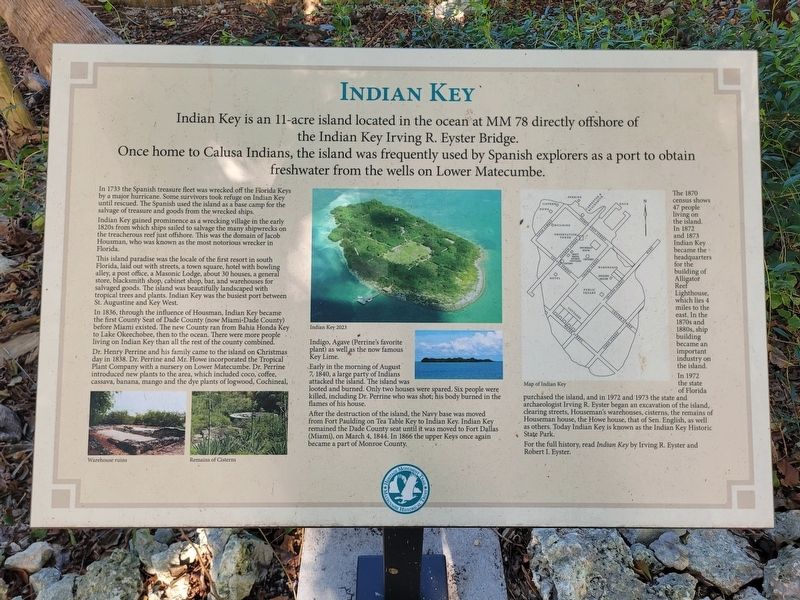
Indian Key is an 11-acre island located in the ocean at MM 78 directly offshore of the Indian Key Irving R. Eyster Bridge. Once home to Calusa Indians, the island was frequently used by Spanish explorers as a port to obtain freshwater from the wells on Lower Matecumbe.
In 1733 the Spanish treasure fleet was wrecked off the Florida Keys by a major hurricane. Some survivors took refuge on Indian Key until rescued. The Spanish used the island as a base camp for the salvage of treasure and goods from the wrecked ships. Indian Key gained prominence as a wrecking village in the early 1820s from which ships sailed to salvage the many shipwrecks on the treacherous reef just offshore. This was the domain of Jacob Housman, who was known as the most notorious wrecker in Florida.
This island paradise was the locale of the first resort in south Florida, laid out with streets, a town square, hotel with bowling alley, a post office, a Masonic Lodge, about 30 houses, a general store, blacksmith shop, cabinet shop, bar, and warehouses for salvaged goods. The island was beautifully landscaped with tropical trees and plants. Indian
this page online
In 1836, through the influence of Housman, Indian Key became the first County Seat of Dade County (now Miami-Dade County) before Miami existed. The new County ran from Bahia Honda Key to Lake Okeechobee, then to the ocean. There were more people living on Indian Key than all the rest of the county combined.
Dr. Henry Perrine and his family came to the island on Christmas day in 1838. Dr. Perrine and Mr. Howe incorporated the Tropical Plant Company with a nursery on Lower Matecumbe. Dr. Perrine introduced new plants to the area, which included coco, coffee, cassava, banana, mango and the dye plants of logwood, Cochineal, Indigo, Agave (Perrine's favorite plant) as well as the now famous Key Lime.
Early in the morning of August 7, 1840, a large party of Indians attacked the island. The island was looted and burned. Only two houses were spared. Six people were killed, including Dr. Perrine who was shot; his body burned in the flames of his house.
After the destruction of the island, the Navy base was moved from Fort Paulding on Tea Table Key to Indian Key. Indian
Photographed by James Hulse, January 10, 2026
2. Indian Key Marker
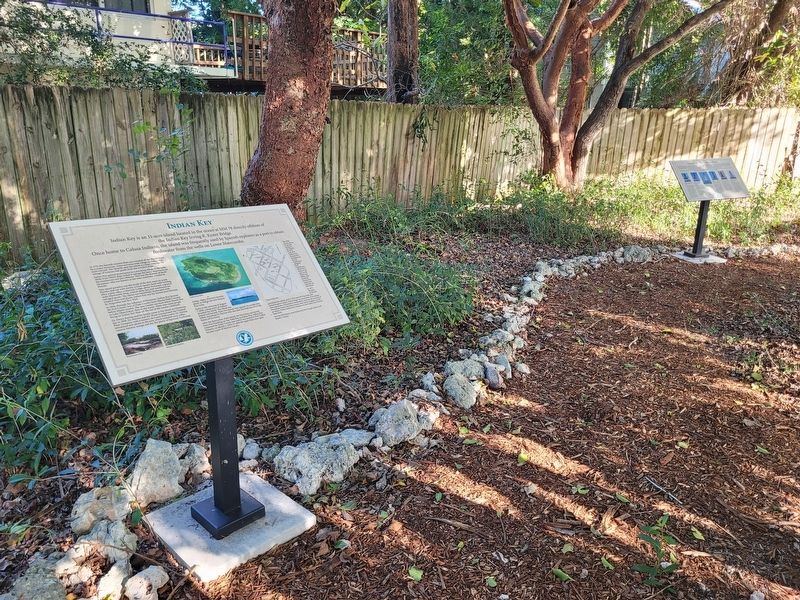
The view of the marker along the short trail at the park.
The 1870 census shows 47 people living on the island. In 1872 and 1873 Indian Key became the headquarters for the building of Alligator Reef Lighthouse, which lies 4 miles to the east. In the 1870s and 1880s, ship building became an important industry on the island. In 1972 the state of Florida purchased the island, and in 1972 and 1973 the state and archaeologist Irving R. Eyster began an excavation of the island, clearing streets, Houseman's warehouses, cisterns, the remains of Houseman house, the Howe house, that of Sen. English, as well as others. Today Indian Key is known as the Indian Key Historic State Park.
For the full history, read Indian Key by Irving R. Eyster and Robert I. Eyster.
Captions
(Photo #1) Warehouse ruins
(Photo #2) Remains of Cisterns
(Photo #3) Indian Key 2023
(Diagram) Map of Indian Key
Erected by Heritage Monument Trail, Matacumbe Historical Trust.
Topics. This historical marker is listed in these topic lists: Colonial Era • Indigenous Peoples and Communities • Waterways & Vessels. A significant historical date for this entry is March 4, 1844.
Location. 24° 55.583′ N, 80° 37.58′ W. Marker is in Islamorada, Florida, in Monroe County. It is on Overseas Highway (U.S. 1) 0.1 miles south of Osprey Bay Road, on the right when traveling south. Touch for map. Marker is at or near this postal address: 82672 Overseas Hwy, Islamorada FL 33036, United States of America. Touch for directions.

Regionally, this marker is on the Florida Keys. It is also in the American South and on the Gulf Coast. Globally, it is in the North Atlantic Region, North America, a Gulf of Mexico state, the Western Hemisphere, the Western World, and the Anglosphere. Historically, it finds itself in what was once New Spain, the territory of the Mississippian Culture, one of the Confederate States of America, and the Antebellum South.
Other nearby markers. At least 8 other markers are within walking distance of this marker: Industry in the Florida Keys (here, next to this marker); Lights of the Florida Keys (here, next to this marker); The Spanish Treasure Fleets (a few steps from this marker); Early Trade in the Florida Keys (a few steps from this marker); The Early Settlers of Upper Matecumbe Key (a few steps from this marker); Native Americans (a few steps from this marker); Geological History of the Florida Keys (a few steps from this marker); The Railway That Went To Sea (within shouting distance of this marker). Touch for a list and map of all markers in Islamorada.
Credits. This page was last revised on February 6, 2026. It was originally submitted on February 5, 2026, by James Hulse of Medina, Texas. This page has been viewed 96 times since then. Photos: 1, 2. submitted on February 6, 2026, by James Hulse of Medina, Texas.
