Norfolk Naval Shipyard in Portsmouth, Virginia — The American South (Mid-Atlantic)
The U.S. Shipyard
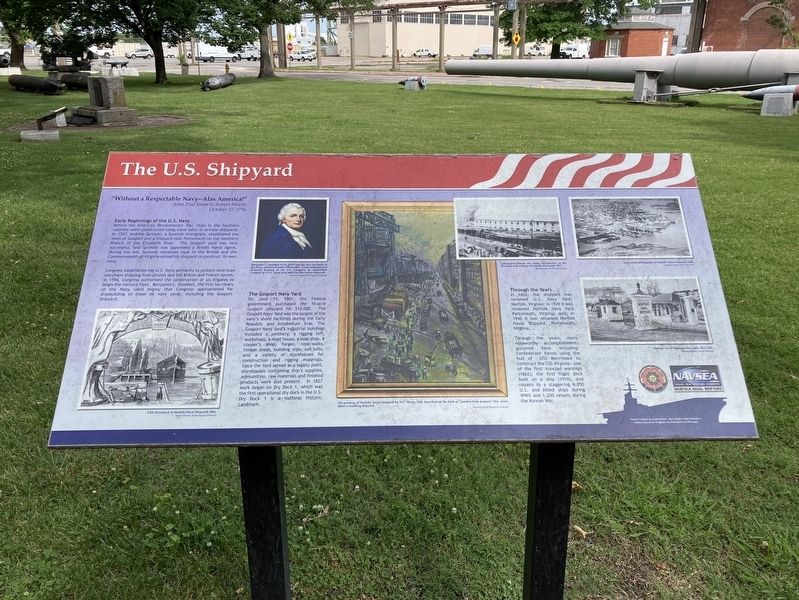
Photographed by Evan Dwyer, June 2, 2024
1. The U.S. Shipyard Marker
--John Paul Jones to Robert Morris
October 17, 1776
Early Beginnings of the U.S. Navy
Before the American Revolutionary War, ships in the Southern colonies were constructed using slave labor in private shipyards. In 1767, Andrew Sprowle, a Scottish immigrant, established the town of Gosport and a shipyard near Portsmouth on the Southern Branch of the Elizabeth River. The Gosport yard was very successful, and Sprowle was appointed a British Naval Agent. During the war, Sprowle remained loyal to the British and the Commonwealth of Virginia seized his shipyard to construct its own navy.
Congress established the U.S. Navy primarily to protect American merchant shipping from pirates and the British and French navies. In 1794, Congress authorized the construction of six frigates to begin the nation's fleet. Benjamin L. Stoddert, the first Secretary of the Navy, used money that Congress appropriated for shipbuilding to lease six navy yards, including the Gosport shipyard.
The Gosport Navy Yard
On June 15, 1801, the Federal government purchased the 16-acre Gosport shipyard
this page online
Through the Years
In 1862, the shipyard was renamed U.S. Navy Yard, Norfolk, Virginia; in 1929 it was renamed Norfolk Navy Yard Portsmouth, Virginia; and, in 1945 it was renamed Norfolk Naval Shipyard, Portsmouth, Virginia.
Through the years, many noteworthy accomplishments occurred here including: Confederate forces using the hull of USS Merrimack to construct the CSS Virginia - one of the first ironclad wardships (1862); the first flight deck built on a ship (1910), and repairs to a staggering 6,850 U.S. and Allied ships during WWII and 1,250 vessels during the Korean War.
(Photo Captions)
Benjamin L. Stoddert (1751-1813) was the first Secretary of the Navy and served from 1798 to 1801. Under authority and financial backing of the U.S. Congress he established Gosport as a U.S. naval yard and five other navy shipyards. Naval History & Heritage Command
USS Merrimack at Norfolk Naval Shipyard, 1861. Naval History & Heritage Command
Oil painting of Norfolk Naval Shipyard by A.C. Muser, 1945. Inscribed on the back as "painted from memory" this scene shows a bustling shipyard. Naval History & Heritage Command
Submarine Chasers are under construction in the dry dock with a flurry of activity all around, 1917. Hampton Roads Naval Museum
Early aerial photograph of Norfolk Naval Shipyard, 1923. Hampton Roads Naval Museum
Norfolk Naval Shipyard main gate, circa 1945. Hampton Roads Naval Museum
Erected by Commander, Navy Region Mid-Atlantic.
Topics. This historical marker is listed in these topic lists: Colonial Era • Industry & Commerce • War, Korean • War, US Civil • War, World II • Waterways & Vessels. A significant historical date for this entry is June 15, 1801.
Location. 36° 49.6′ N, 76° 17.733′ W. Marker is in Portsmouth, Virginia. It is in Norfolk Naval Shipyard. It is at the intersection of Barron Street and Warington Avenue, on the left when traveling east on Barron Street. The Norfolk Naval Shipyard is an active military installation and access is restricted to authorized personnel and their escorted guests. Touch for map. Marker is at or near this postal address: 610 Barron St, Portsmouth VA 23709, United States of America. Touch for directions.

Regionally, this marker is in Hampton Roads, specifically in Coastal Virginia, and in the Hampton Roads Metropolitan Area. It is also in the American South, specifically in the Upper South, in the Tidewater, and on the Eastern Seaboard. Globally, it is in the North Atlantic Region, North America, the Western Hemisphere, the Western World, and the Anglosphere. Historically, it finds itself in what was once the territory of the Mississippian Culture, one of the original Thirteen Colonies, one of the Confederate States of America, and the Antebellum South.
Other nearby markers. At least 8 other markers are within walking distance of this marker: Drydock Number One (a few steps from this marker); Commemorating 200th Anniversary Norfolk Naval Shipyard (a few steps from this marker); The Labor Force (a few steps from this marker); Norfolk Naval Shipyard's Trophy Park (circa 1870) (within shouting distance of this marker); Norfolk Naval Shipyard (about 400 feet away, measured in a direct line); a different marker also named Norfolk Naval Shipyard (about 400 feet away); a different marker also named Norfolk Naval Shipyard (about 400 feet away); a different marker also named Norfolk Naval Shipyard (about 500 feet away). Touch for a list and map of all markers in Portsmouth.
More about this marker. This marker is a duplicate of another marker, HMDB # 293256, that is in a different part of the shipyard.
Related marker. Click here for another marker that is related to this marker. This is a duplicate marker in a different location.
Credits. This page was last revised on February 15, 2026. It was originally submitted on February 13, 2026, by Evan Dwyer of Richmond, Virginia. This page has been viewed 72 times since then. Photo 1. submitted on February 13, 2026, by Evan Dwyer of Richmond, Virginia. • Bernard Fisher was the editor who published this page.
