Near Lasauses in Conejos County, Colorado — The American Mountains (Southwest)
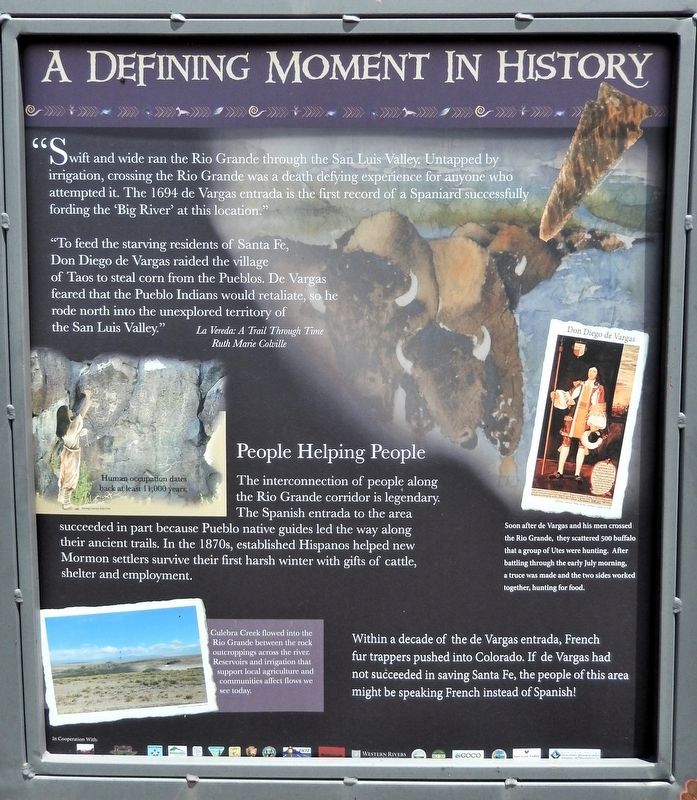
A Defining Moment in History
Photographed by Cosmos Mariner, July 12, 2025
1. A Defining Moment in History Marker
“Swift and wide ran the Rio Grande through the San Luis Valley. Untapped by irrigation, crossing the Rio Grande was a death defying experience for anyone who attempted it. The 1694 de Vargas entrada is the first record of a Spaniard successfully fording the ‘Big River’ at this location.”
“To feed the starving residents of Santa Fe, Don Diego de Vargas raided the village of Taos to steal corn from the Pueblos. De Vargas feared that the Pueblo Indians would retaliate, so he rode north into the unexplored territory of the San Luis Valley.”
La Vereda; A Trail Through Time
Ruth Marie Colville
People Helping People
The interconnection of people along the Rio Grande corridor is legendary. The Spanish entrada to the area succeeded in part because Pueblo native guides led the way along their ancient trails. In the 1870s, established Hispanos helped new Mormon settlers survive their first harsh winter with gifts of cattle, shelter and employment.
Within a decade of the de Vargas entrada, French fur trappers pushed into Colorado. If de Vargas had not succeeded in saving Santa Fe, the people of this area might be speaking French instead
this page online
[photo captions]
• Human occupation dates back at least 11,000 years.
• Don Diego de Vargas. Soon after de Vargas and his men crossed the Rio Grande, they scattered 500 buffalo that a group of Utes were hunting. After battling through the early July morning, a truce was made and the two sides worked together, hunting for food.
• Culebra Creek flowed into the Rio Grande between the rock outcroppings across the river. Reservoirs and irrigation that support local agriculture and communities affect flows we see today.
Erected by Colorado Scenic and Historic Byways Commission, Colorado Historical Society, Colorado Department of Transportation, and The Nature Conservancy.
Topics. This historical marker is listed in these topic lists: Colonial Era • Exploration • Hispanic Americans • Indigenous Peoples and Communities. A significant historical year for this entry is 1694.
Location. 37° 10.833′ N, 105° 43.888′ W. Marker is near Lasauses, Colorado, in Conejos County. It is on State Highway 142 at milepost 14.2, 14.2 miles east of U.S. 285, on the right when traveling east. The marker is in the Rio Grande Natural

Photographed by Cosmos Mariner, July 12, 2025
2. Rio Grande Natural Area Interpretive Kiosk
Looking north; Colorado Highway 142 crosses in the background. This marker is the rightmost of two interpretive panels on the south side of the Rio Grande Natural Area kiosk.

Regionally, this marker is in the San Juan Mountains and in the San Luis Valley. It is also in the American Mountain West. Globally, it is in North America, the Rocky Mountains, the Western Hemisphere, the Western World, and the Anglosphere. Historically, it finds itself in what was once New Spain and also the Republic of Texas.
Other nearby markers. At least 4 other markers are within 12 miles of this marker, measured as the crow flies: Why a Natural Area? (here, next to this marker); Río Grande del Norte — Big River of the North (a few steps from this marker); Pike's Stockade (approx. 9 miles away); Morman Pioneers (approx. 11.2 miles away).
Related markers. Click here for a list of markers that are related to this marker.
Also see . . . Diego de Vargas (Wikipedia).
Excerpt: Diego de Vargas Zapata y Luján Ponce de León y Contreras (1643–1704), commonly known as Don Diego de Vargas, was a Spanish Governor of the New Spain territory of Santa Fe de Nuevo México (currently covering the modern US states of New Mexico and Arizona). He is known for leading the reconquest of the territory in 1692 following the Pueblo Revolt of 1680.(Submitted on March 6, 2026, by Cosmos Mariner of Cape Canaveral, Florida.)
In July 1692, de Vargas and a small contingent of soldiers returned to Santa Fe [from within present-day Colorado]. They surrounded the city and called on the Pueblo people to surrender, promising clemency if they would swear allegiance to the King of Spain (at the time, Charles II of Spain) and return to the Christian faith. After meeting with de Vargas, the Pueblo leaders agreed to surrender, and on 12 September 1692 de Vargas proclaimed a formal act of repossession.
Credits. This page was last revised on March 6, 2026. It was originally submitted on March 2, 2026, by Cosmos Mariner of Cape Canaveral, Florida. This page has been viewed 50 times since then. Photos: 1, 2. submitted on March 6, 2026, by Cosmos Mariner of Cape Canaveral, Florida.
