Cuba in Sumter County, Alabama — The American South (East South Central)
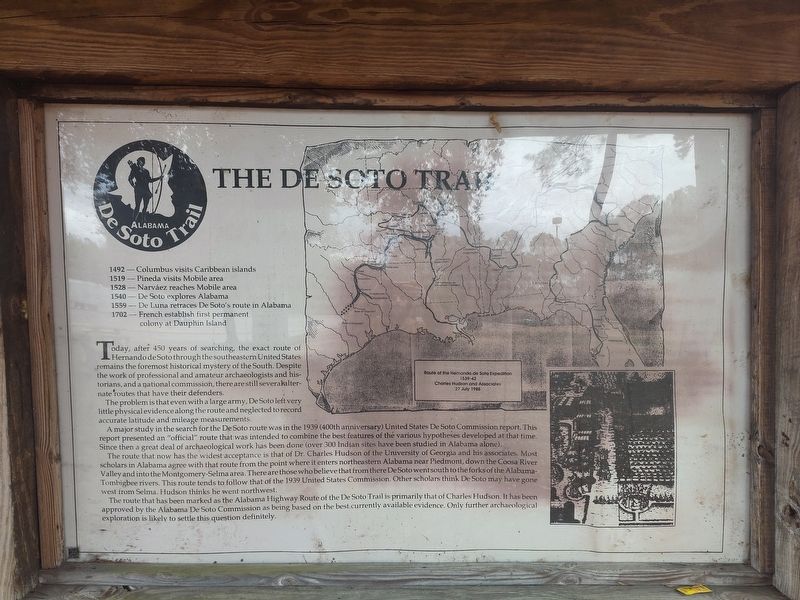
The De Soto Trail
| — | Alabama De Soto Trail | — |
Photographed by Craig Doda, February 15, 2026
1. The De Soto Trail Marker
1492 — Columbus visits Caribbean islands
1519 — Pineda visits Mobile area
1528 — Narvaez reaches Mobile area
1540 — De Soto explores Alabama
1559 — De Luna retraces De Soto's route in Alabama
1702 — French establish first permanent colony at Dauphin Island
Today, after 450 years of searching, the exact route of Hernando de Soto through the southeastern United States remains the foremost historical mystery of the South. Despite the work of professional and amateur archaeologists and historians, and a rational commission, there are still several alternate 'routes that have their defenders.
The problem is that even with a large army, De Soto left very little physical evidence along the route and neglected to record accurate latitude and mileage measurements.
A major study in the search for the DeSoto route was in the 1939 (400th anniversary) United States De Soto Commission report. This report presented an "official" route that was intended to combine the best features of the various developed at that time. Since then a great deal of archaeological work has been done (over 300 Indian sites have been studied in
this page online
The route that now has the widest acceptance is that of Dr. Charles Hudson of the University of Georgia and his associates. Most scholars in Alabama agree with that route from the point where it enters northeastern Alabama near Piedmont, down the Coosa River Valley and into the Montgomery-Selma area. There are those who believe that from there De Soto went south to the forks of the Alabama-Tombigbee rivers. This route tends to follow that of the 1939 United States Commission. Other scholars think De Soto may have gone west trom Selma. Hudson thinks he went northwest.
The route that has been marked as the Alabama Highway Route of the De Soto Trail is primarily that of Charles Hudson. It has been approved by the Alabama De Soto Commission as being based on the best currently available evidence. Only further archaeological exploration is likely to settle this question definitely.
Topics. This historical marker is listed in these topic lists: Anthropology & Archaeology • Exploration • Indigenous Peoples and Communities • Roads & Vehicles. A significant historical year for this entry is 1519.
Location. 32° 26.99′ N, 88° 23.846′ W.

Photographed by Craig Doda, February 15, 2026
2. The De Soto Trail Marker

Regionally, this marker is in the American South, specifically in the Deep South, and in the Black Belt. Globally, it is in North America, a Gulf of Mexico state, the Western Hemisphere, the Western World, and the Anglosphere. Historically, it finds itself in what was once New Spain, the territory of the Mississippian Culture, one of the Confederate States of America, and the Antebellum South.
Other nearby markers. At least 8 other markers are within 9 miles of this marker, measured as the crow flies: Hernando De Soto In Alabama (a few steps from this marker); Salem Baptist Church and Cemetery (approx. 5.4 miles away in Mississippi); York Veterans War Memorial (approx. 6.4 miles away); History of York / The Coleman Center (approx. 6.4 miles away); Lauderdale Springs Confederate-Union Cemetery (approx. 6.9 miles away in Mississippi); Line 32° 28´ North Latitude (approx. 8.1 miles away); Old Pigford Cemetery (approx. 8.3 miles away in Mississippi); Lauderdale Springs C.S.A. Cemetery (approx. 8.4 miles away in Mississippi).
Credits. This page was last revised on March 4, 2026. It was originally submitted on March 3, 2026, by Craig Doda of Napoleon, Ohio. This page has been viewed 41 times since then. Photos: 1, 2. submitted on March 3, 2026, by Craig Doda of Napoleon, Ohio. • Devry Becker Jones was the editor who published this page.
