The Hard Land, Independent People

The hard land bred people that had to be fiercely independent and also accept support from their neighbors. They cut ice, butchered cows and pigs, cut up elk, thrashed grain and harvested hay. Together they built foundations of stone. Barter was the coin of the day.
“My great-grandfather, Isaac Taylor, and his brother, Joseph, quarreled over the right of way to his homestead claim. Shots were fired and great-grandfather pleaded self-defense.”
—Dennis Cox
A Hard Land
High elevation. Soil not suited to traditional agriculture. A short growing season. Tough winters and severe weather year-round. Floods and drought. This area was not a place for the timid or weak.
Homesteaders
This was a hardscrabble life. The Homestead Act (1862) gave settlers 160 acres free if they lived on and worked the land.
Hostiles and Outlaws
Skirmishes between settlers and Indians occurred into the mid-1800s. Outlaws frequented the region. In the 1920s bootleggers hid in local canyons.
Strong Women
Both men and women labored at many tasks and also created a sense of community.
Although the region was described as “not a churchy place,” the Ladies' Aid Society
this page online
“City people talk about how something is so many minutes away. Out here, we talk about miles away.”
—Peggy Martin
“Clyde Lawson, brandishing his gun, tried to stop my grandmother from getting water. It was grandmother’s day to irrigate, and no one was going to stop her. Clyde backed down.”
—as told by Nettie Rose Snow Breece
[photo captions]
• Chief Ouray and his wife Chipeta frequented the area.
• George Hall & John Phillips
• W.A. (William Alonzo) Watson was a scout on the Santa Fe Trail, he drove cattle from Texas and was also known for raising polo ponies. The Watson Brand is still in use today, making it the oldest, continuously used brand in the State.
• Ladies’ Aid Society, 1914
• Wetmore Post Office, ca. 1890s, built in 1885 by Dr. J. W. Walters, continues to serve Wetmore today and is listed on the National Register of Historic Places.
• New Hope Church. Second oldest Baptist church in the State of Colorado, built in 1873.
[Women pictured across the bottom of the panel]
Dorothy
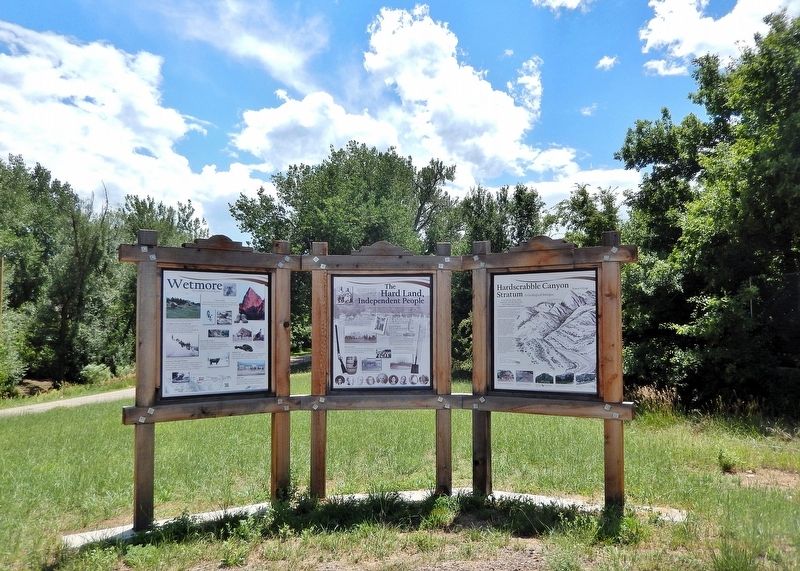
Erected by Colorado Department of Transportation and Custer County.
Topics. This historical marker is listed in these topic lists: Agriculture • Indigenous Peoples and Communities • Settlements & Settlers • Women.
Location. 38° 14.285′ N, 105° 5.147′ W. Marker is in Wetmore, Colorado, in Custer County. It is at the intersection of State Highway 96 and State Highway 67, on the right when traveling west on State Highway 96. Touch for map. Marker is in this post office area: Wetmore CO 81253, United States of America. Touch for directions.

Regionally, this marker is in the American Mountain West. Globally, it is in North America, the Rocky Mountains, the Western Hemisphere, the Western World, and the Anglosphere. Historically, it finds itself in what was once the Comanchería and also the Republic of Texas.
Other nearby markers. At least 8 other markers are within 11 miles of this marker, measured as the crow flies: Hardscrabble Canyon Stratum (here, next to this marker); Wetmore (here, next to this marker); Hardscrabble (approx. 1.8 miles away); a different marker also named Hardscrabble (approx. 1.8 miles away); Cuerno Verde (approx. 1.8 miles away); Cliffhangers and Headbangers (approx. 4.4 miles away); Frontier Pathways Scenic and Historic Byway (approx. 4.4 miles away); Rio Grande Railroad Viaduct (approx. 10.3 miles away). Touch for a list and map of all markers in Wetmore.
Related markers. Click here for a list of markers that are related to this marker.
Also see . . . A Brief History of Wetmore (Wetmore Historical Society).
Excerpt: On May 13, 1871, a group of settlers organized and built the New Hope Baptist Church northeast of present-day Wetmore. There were 110 members at this time. Articles of Incorporation were filed in 1873 by Ira R. Porter, Stephen J. Tanner and William R. Crouch, making it the second oldest Baptist Church in Colorado.(Submitted on March 13, 2026, by Cosmos Mariner of Cape Canaveral, Florida.)The Wetmore area was surveyed in September and October of 1877 by W. W. Brewster, a contract surveyor. His map shows a schoolhouse, blacksmith shop, and stores in the village of Wetmore which was then known as Greenwood Park and or Hardscrabble Park. Public land could not be sold until it was surveyed into townships and sections by the government so the settlers were basically squatters until then.
By 1884, the area was well established with a grocery store, general merchandise store and drug store built by Dr. J. W. Walters. Jacob Betts built a two-story building with a saloon downstairs and a dance hall upstairs. There were two blacksmith shops, carpenter shop, hotel (ran by Mary Payne), a schoolhouse, a photographer (J.C. Stoneman), flouring mill built by W. H. Wetmore and a livery stable. The building that was the drug store now houses the Wetmore Post Office and History Center created by the Wetmore-Hardscrabble Genealogical and Historical Society.
In 1895, W. W. Mashburn had a distillery about two miles south of Wetmore, and in 1897 a public hall known as the W.O.W. (Woodman of the World) Hall was built and was quite popular until torn down in the 1940’s.
Credits. This page was last revised on March 13, 2026. It was originally submitted on March 11, 2026, by Cosmos Mariner of Cape Canaveral, Florida. This page has been viewed 23 times since then. Photos: 1, 2. submitted on March 13, 2026, by Cosmos Mariner of Cape Canaveral, Florida.
