Centerville near Williamsburg in James City County, Virginia — The American South (Mid-Atlantic)
Archaeological Analysis of Hot Water Tract
Photographed by Evan Dwyer, February 14, 2026
1. Archaeological Analysis of Hot Water Tract Marker
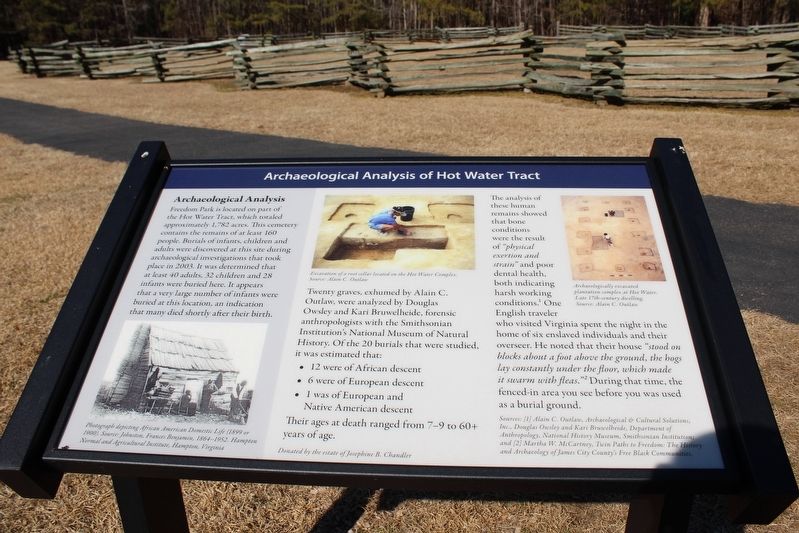
Archaeological Analysis Freedom Park is located on part of the Hot Water Tract, which totaled approximately 1,782 acres. This cemetery contains the remains of at least 160 people. Burials of infants, children and adults were discovered at this site during archaeological investigations that took place in 2003. It was determined that at least 40 adults, 32 children and 28 infants were buried here. It appears that a very large number of infants were buried at this location, an indication that many died shortly after their birth.
Twenty graves, exhumed by Alain C. Outlaw, were analyzed by Douglas Owsley and Kari Bruwelheide, forensic anthropologists with the Smithsonian Institution's National Museum of Natural History. Of the 20 burials that were studied, it was estimated that:
• 12 were of African descentTheir ages at death ranged from 7-9 to 60+ years of age.
• 6 were of European descent
• 1 was of European and Native American descent
The analysis of these human remains showed that bone conditions were the result of "physical exertion and strain" and poor dental health, both indicating harsh working conditions.[1]
this page online
Sources: [1] Alain C. Outlaw, Archaeological & Cultural Solutions, Inc., Douglas Owsley and Kari Bruwelheide, Department of Anthropology, National History Museum, Smithsonian Institution; and [2] Martha W. McCartney, Twin Paths to Freedom: The History and Archaeology of James City County's Free Black Communities.
Donated by the estate of Josephine B. Chandler
[Captions:]
Photograph depicting African American Domestic Life (1899 or 1900). Source: Johnston, Frances Benjamin, 1864-1952. Hampton Normal and Agricultural Institute, Hampton, Virginia.
Excavation of a root cellar located on the Hot Water Complex.
Source: Alain C. Outlaw
Archaeologically excavated plantation complex at Hot Water. Late 17th-century dwelling.
Source: Alain C. Outlaw
Erected by James City County
Photographed by Evan Dwyer, February 14, 2026
2. Hot Water Tract Cemetery
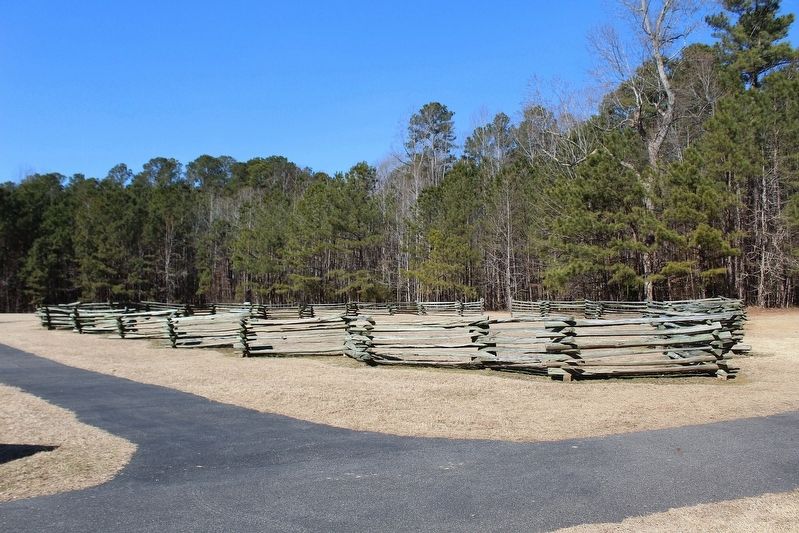
The cemetery itself has no markers (wooden markers rotted away, field stone markers were removed for other uses - carved marble or stone markers were not common at the time the cemetery was active) and is only a series of discernible pits in the ground where soil has settled over the grave shafts. The shadow of the marker is at left.
Topics. This historical marker is listed in these topic lists: African Americans • Anthropology & Archaeology • Cemeteries & Burial Sites • Settlements & Settlers. A significant historical year for this entry is 2003.
Location. 37° 19.222′ N, 76° 47.99′ W. Marker is near Williamsburg, Virginia, in James City County. It is in Centerville. It can be reached from Hotwater Trail one mile west of Centerville Road (Virginia Route 614), on the right when traveling west. This marker stands on the grounds of Freedom Park. Touch for map. Marker is at or near this postal address: 5537 Centerville Road, Williamsburg VA 23188, United States of America. Touch for directions.

Regionally, this marker is on Virginia’s Peninsula, in Coastal Virginia, and in the Hampton Roads Metropolitan Area. It is also in the American South, specifically in the Upper South, in the Tidewater, and on the Eastern Seaboard. Globally, it is in the North Atlantic Region, North America, the Western Hemisphere, the Western World, and the Anglosphere. Historically, it finds itself in what was once the territory of the Mississippian
Photographed by Evan Dwyer, February 14, 2026
3. Hot Water Tract Ground Stains
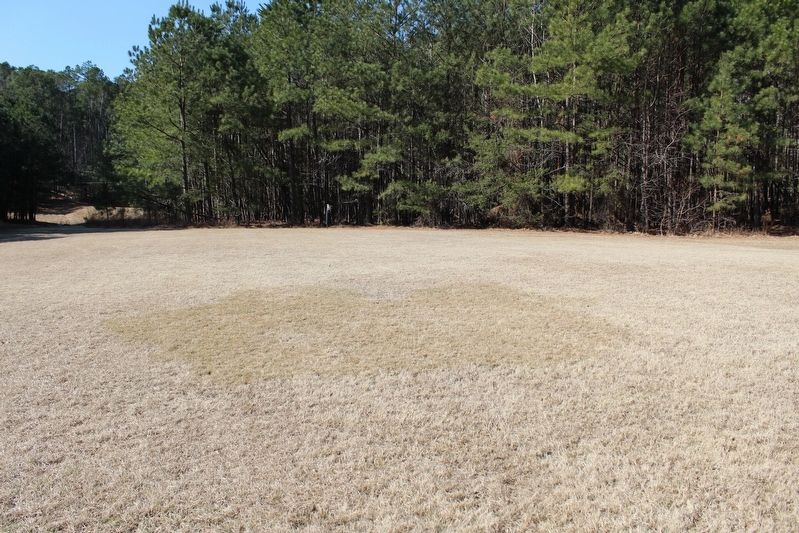
Ground staining typically indicates archaeological sites and underground features like building foundations. Two are visible here, just south of the cemetery. They are most visible in winter and from the air.
Other nearby markers. At least 8 other markers are within walking distance of this marker: Timeline of the Hot Water Tract (within shouting distance of this marker); Welcome to the Hot Water Tract (about 300 feet away); Welcome to Freedom Park (about 600 feet away); Engagement at Spencer's Ordinary (about 600 feet away); Brown Home (approx. 0.2 miles away); Jackson Home (approx. 0.2 miles away); Lightfoot Home (approx. 0.2 miles away); Free Black Settlement (approx. 0.2 miles away). Touch for a list and map of all markers in Williamsburg.
Another marker is no longer nearby. Early Settlement and Cemetery (was about 300 feet away, measured in a direct line but has been replaced with another marker now near it).
Photographed by Evan Dwyer, February 14, 2026
4. Hot Water Tract Cemetery Monument
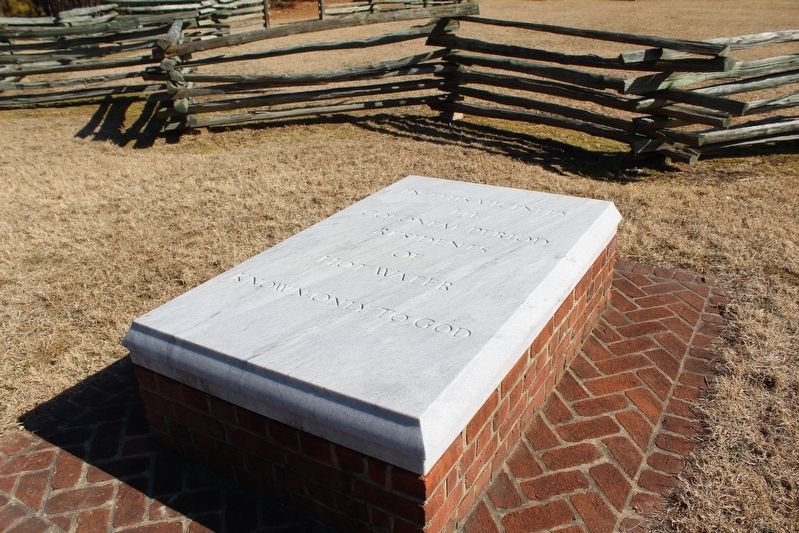
Installed to commemorate the ~160 unknown persons buried in the adjacent, fenced-in cemetery.
Photographed by Evan Dwyer, February 14, 2026
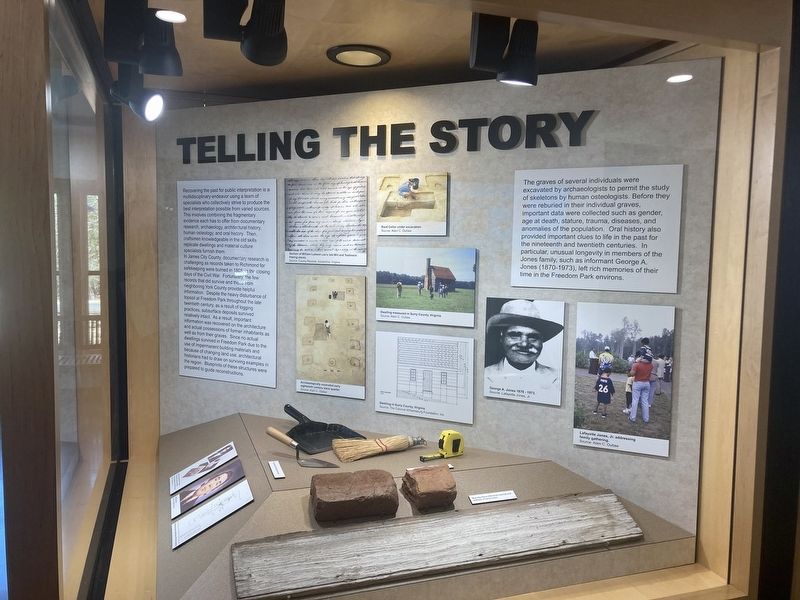
5. Hot Water Tract Exhibit
Within the Freedom Park Interpretive Center. The exhibit is four panels. This is one that focuses on the archaeological study.
Credits. This page was last revised on March 14, 2026. It was originally submitted on March 13, 2026, by Evan Dwyer of Richmond, Virginia. This page has been viewed 23 times since then. Photos: 1, 2, 3, 4, 5. submitted on March 13, 2026, by Evan Dwyer of Richmond, Virginia. • Devry Becker Jones was the editor who published this page.
