Near Antonito in Archuleta County, Colorado — The American Mountains (Southwest)
Nurturing Forest
Photographed by Cosmos Mariner, July 13, 2025
1. Nurturing Forest Marker
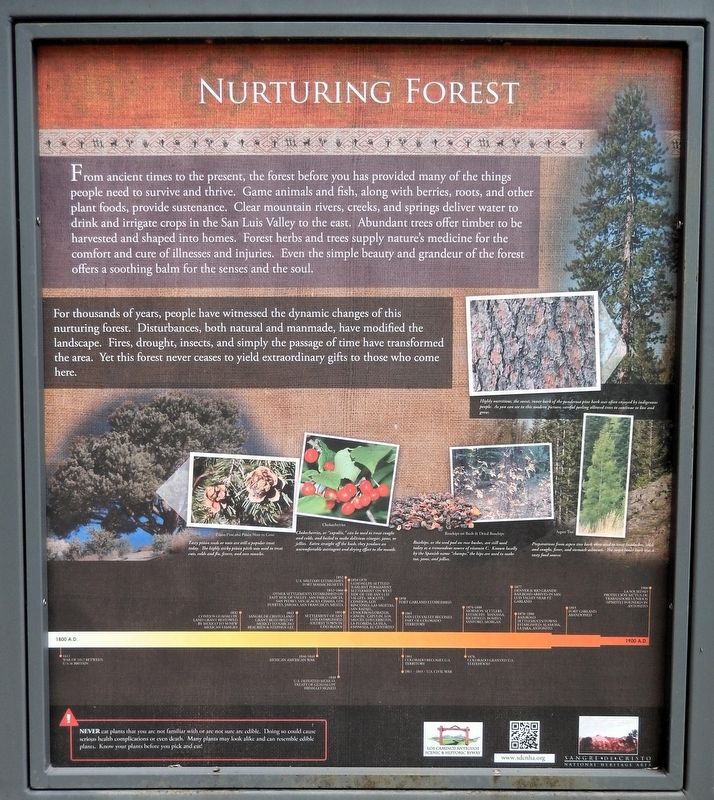
From ancient times to the present, the forest before you has provided many of the things people need to survive and thrive. Game animals and fish, along with berries, roots, and other plant foods, provide sustenance. Clear mountain rivers, creeks, and springs deliver water to drink and irrigate crops in the San Luis Valley to the east. Abundant trees offer timber to be harvested and shaped into homes. Forest herbs and trees supply nature's medicine for the comfort and cure of illnesses and injuries. Even the simple beauty and grandeur of the forest offers a soothing balm for the senses and the soul.
For thousands of years, people have witnessed the dynamic changes of this nurturing forest. Disturbances, both natural and manmade, have modified the landscape. Fires, drought, insects, and simply the passage of time have transformed the area. Yet this forest never ceases to yield extraordinary gifts to those who come here.
[photo captions]
• Highly nutritious, the sweet, inner bark of the ponderosa pine bark was often enjoyed by indigenous people. As you can see in this modern picture, careful peeling allowed trees to continue
this page online
• Piñón Pine and Piñón Nuts in Cone. Tasty piñón seeds or nuts are still a popular treat today. The highly sticky piñón pitch was used to treat cuts, colds and flu, fevers, and sore muscles.
• Chokecherries, or “capulin,” can be used to treat coughs and colds, and boiled to make delicious vinegar, jams, or jellies. Eaten straight off the bush, they produce an uncomfortable astringent and drying effect to the mouth.
• Rosehips, or the seed pod on rose bushes, are still used today as a tremendous source of vitamin C. Known locally by the Spanish name “champe,” the hips are used to make tea, jams and jellies.
• Aspen Tree. Preparations from aspen tree bark were used to treat headaches, colds and coughs, fever, and stomach ailments. The sweet inner bark was a tasty food source.
Timeline [across bottom of interpretive panel]
1812 • War of 1812 between U.S. & Britain
1832 • Conejos Guadalupe Land Grant bestowed by Mexico to 50 New Mexican families
1843 • Sangre de Cristo Land Grant bestowed by Mexico to Narcisco Beaubien & Stephen Lee
1846-1848 • Mexican American War
1848 • U.S. defeated Mexico, Treaty of Guadalupe Hidalgo signed
1851 • Settlement of San Luis established (oldest town in Colorado)
1852 • U.S. military establishes Fort Massachusetts
1852-1860 • Other settlements established on east side of valley: San Pablo Garcia, San Pedro, San Acacio, Chama, Los Fuertes, Jaroso, San Francisco, Mesita
1854-1870 • Guadalupe settled (earliest permanent settlement on west side of the San Luis Valley): Mogote, Conejos, Los Rincones, Las Mesitas, San Rafael, Ceniceros/Lobatos, Cañon, Capulin, Los Sauces, Los Cerritos, La Florida, La Isla, Espinoza, El Centrito
1858 • Fort Garland established
1861 • San Luis Valley becomes part of Colorado Territory
1861 • Colorado becomes U.S. Territory
1861-1865 • U.S. Civil War
1874-1888 • Mormon settlers establish: Manassa, Richfield, Romeo, Sanford, Morgan
1876 • Colorado granted U.S. statehood
1877 • Denver & Rio Grande Railroad arrives in San Luis Valley near Fort Garland
1878-1880 • Railroad settlements/towns established: Alamosa, La Jara, Antonito
1883 • Fort Garland abandoned
1900 • La Sociedad Protección Mutua de Trabajadores Unidos (SPMDTU) founded in Antonito
NEVER east plants that you are not familiar with or are not sure are edible. Doing so could cause serous health complications or even death. Many plants may look alike and can resemble edible plants. Know your plants before you pick and eat!.
Erected by Colorado
Photographed by Cosmos Mariner, July 13, 2025
2. Nurturing Forest Marker
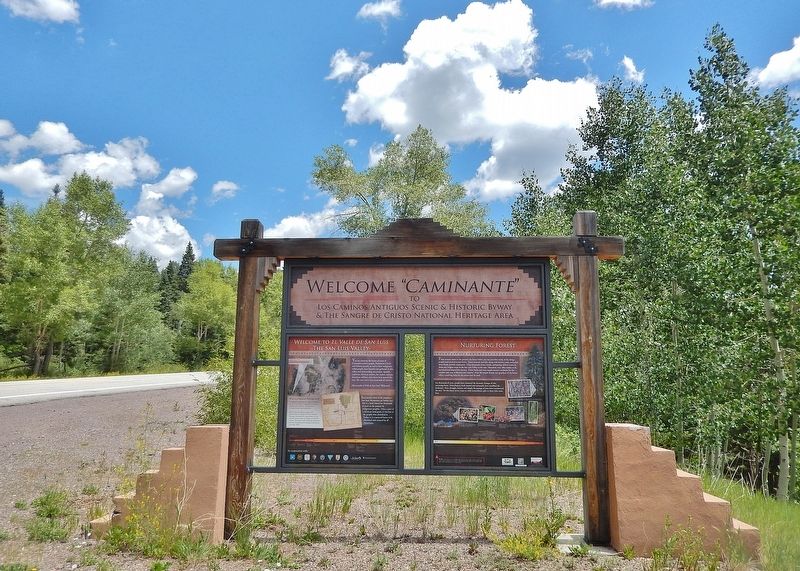
Welcome “Caminante” — to Los Caminos Antiguos Scenic & Historic Byway and The Sangre de Cristo National Heritage Area
This marker is the rightmost of two interpretive panels on the south side of the Los Caminos Antiguos Scenic & Historic Byway kiosk just north of the Colorado/New Mexico state line.
Looking north; Colorado Highway 17 is on the left.
This marker is the rightmost of two interpretive panels on the south side of the Los Caminos Antiguos Scenic & Historic Byway kiosk just north of the Colorado/New Mexico state line.
Looking north; Colorado Highway 17 is on the left.
Topics. This historical marker is listed in these topic lists: Agriculture • Horticulture & Forestry • Indigenous Peoples and Communities • Science & Medicine.
Location. 36° 59.947′ N, 106° 29.422′ W. Marker is near Antonito, Colorado, in Archuleta County. It is on State Highway 17 at milepost 0.7, on the right when traveling north. The marker is 0.7 miles north of the Colorado/New Mexico state line. Touch for map. Marker is in this post office area: Antonito CO 81120, United States of America. Touch for directions.

Regionally, this marker is on the Continental Divide. It is also in the American Mountain West and at the Four Corners. Globally, it is in North America, the Rocky Mountains, the Western Hemisphere, the Western World, and the Anglosphere. Historically, it finds itself in what was once the territory of the Ancestral Puebloans.
Other nearby markers. At least 8 other markers are within 4 miles of this marker, measured as the crow flies: Who Owns This Land? (here, next to this marker); Welcome to El Valle de San Luis (here, next to this marker); This is Our land (here, next to this marker); Cumbres Pass (approx. 0.6 miles away); The Historic Operations at Cumbres Pass (approx. 2.7 miles away); a different marker also named Cumbres Pass (approx. 2.7 miles away); Welcome “Caminante” to… (approx. 4 miles away); Los Caminos Antiguos (approx. 4 miles away). Touch for a list and map of all markers in Antonito.
Credits. This page was last revised on March 19, 2026. It was originally submitted on March 18, 2026, by Cosmos Mariner of Cape Canaveral, Florida. This page has been viewed 17 times since then. Photos: 1, 2. submitted on March 19, 2026, by Cosmos Mariner of Cape Canaveral, Florida.
