Wessagusset in Weymouth in Norfolk County, Massachusetts — The American Northeast (New England)
First English Settlement
Wessagusset Historic Woodlot
Photographed by G.W.Bartlett
1. First English Settlement Marker
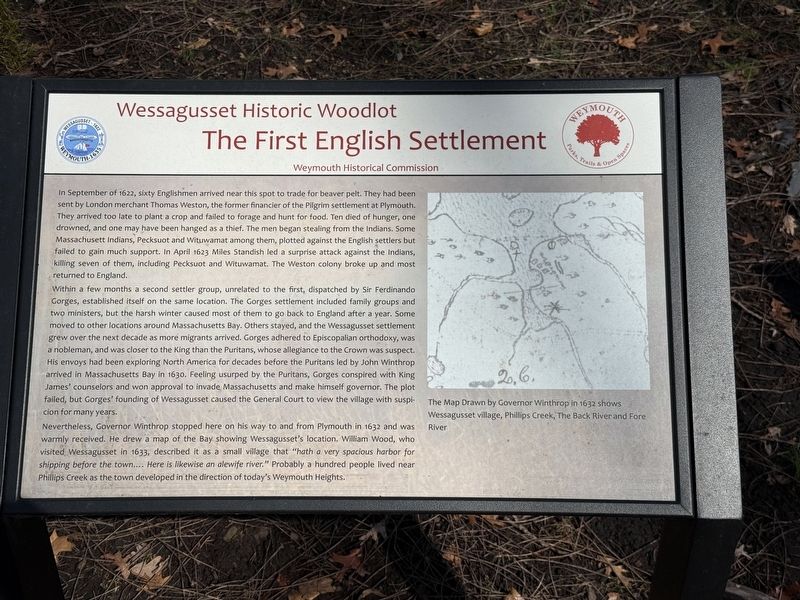
In September of 1622, sixty Englishmen arrived near this spot to trade for beaver pelt. They had been sent by London merchant Thomas Weston, the former financier of the Pilgrim settlement at Plymouth. They arrived too late to plant a crop and failed to forage and hunt for food. Ten died of hunger, one drowned, and one may have been hanged as a thief. The men began stealing from the Indians. Some Massachusett Indians, Pecksuot and Witawamat among them, plotted against the English settlers but failed to gain much support. In April 1623 Miles Standish led a surporise attack against the Indians killing seven of them, including Pecksuot and Witawamat. The Weston colony broke up and most returned to England.
Within a few months a second settler group, unrelated to the first, dispatched by Sir Ferdinando Gorges, established itself on the same location. The Gorges settlement included family groups and two ministers, but the harsh winter caused most of them to go back to England after a year. Some moved to other locations around Massachusetts Bay. Others stayed, and the Wessagusset settlement grew over the next decade as more migrants arrived. Gorges adhered to Episcopalian orthodoxy, was a nobleman, and was closer to the King than the Puritans, whose allegiance to the Crown was suspect. His envoys had
this page online
Nevertheless, Governor Winthrop stopped here on his way to and from Plymouth in 1632 and was warmly received. He drew a map of the Bay showing Wessagusset's location. William Wood, who visited Wessagusset in 1633, described it as a small village that "hath a very spacious harbor for shipping before the town.... Here is likewise an alewife river." Probably a hundred people lived near Phillips Creek as the town developed in the direction of today's Weymouth Heights.
[Caption:]
The Map Drawn by Governor Winthrop in 1632 shows Wessagusset village, Phillips Creek, The Back River and Fore River.
Erected 2001 by Weymouth Historical Commission.
Topics. This historical marker is listed in these topic lists: Colonial Era • Indigenous Peoples and Communities • Parks & Recreational Areas • Settlements & Settlers. A significant historical month for this entry is April 1623.
Location. 42° 14.792′ N, 70° 57.183′ W. Marker

Photographed by G.W.Bartlett, April 5, 2026
2. First English Settlement Marker (wide)

Regionally, this marker is in Greater Boston. It is also in the American Northeast, in New England, and on the Eastern Seaboard. Globally, it is in the North Atlantic Region, North America, the Western Hemisphere, the Western World, and the Anglosphere. Historically, it finds itself in what was once one of the original Thirteen Colonies.
Other nearby markers. At least 8 other markers are within walking distance of this marker: The Incorporation of Weymouth (here, next to this marker); Puddingstone Memorials (a few steps from this marker); The Massachusett Tribe (a few steps from this marker); Settlement of Weymouth (approx. 0.6 miles away); Abigail Adams to John Adams, August 14, 1776 (approx. 0.8 miles away); Abigail Adams to John Adams, July 21, 1776 (approx. 0.9 miles away); Abigail Adams to John Adams, July 14, 1776 (approx. 0.9 miles away); Abigail Adams to John Adams, August 29, 1776 (approx. 0.9 miles away). Touch for a list and map of all markers in Weymouth.
Regarding First English Settlement. A

Photographed by G.W.Bartlett, April 5, 2026
3. Marker Group from Path
Phineas Pratt of the earliest Weston trading post/settlement, who is known for running from Weymouth to Plymouth to request the assistance of Myles Standish, remained in the colonies. He is buried in Phipps Street Burying Ground in Charlestown, and is recognized on a cenotaph memorial in Cohasset Central Cemetery along with several generations of descendants.
Related markers. Click here for a list of markers that are related to this marker.
Also see . . .
1. Wessagussett Wetland and Woodland - Historic Conservation Site.
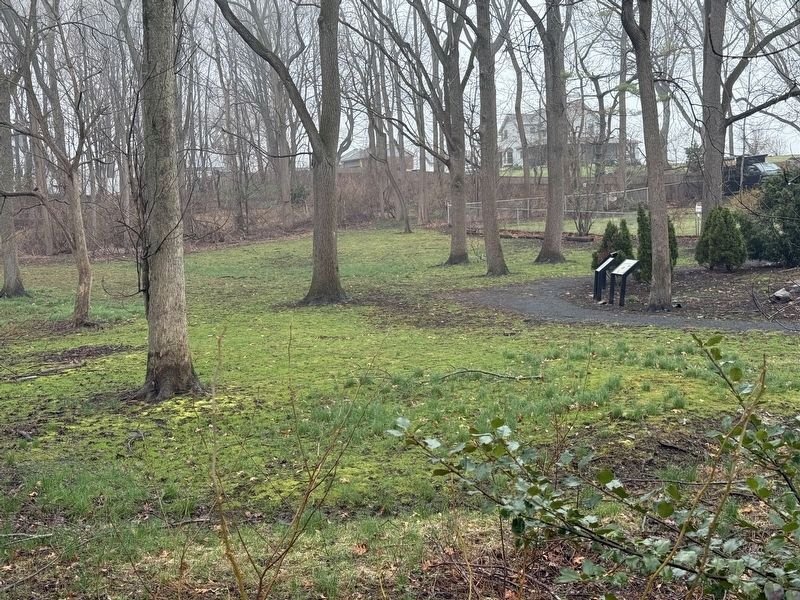
The Wessagusset Wetland and Woodland is a small historic site with a grassy area and short woodland trails, located in a neighborhood setting in North Weymouth. Interpretive signage shares Native American and Colonial history.(Submitted on March 25, 2026, by G.W.Bartlett of Hingham, Massachusetts.)
2. Thomas Weston and the Early Settlers of Wessagusset.
The first European settlement in what is now Weymouth(Submitted on April 5, 2026, by G.W.Bartlett of Hingham, Massachusetts.)was established at Wessagusset in 1622. Thomas Weston is generally considered the founder of the Wessagusset colony. He was a merchant from London and he thought that a North American colonial settlement should be foremost a commercial venture, consisting of single, able-bodied men.Photographed by G.W.Bartlett, April 5, 20264. Historic Woodlot & Markers from Sea Street
Credits. This page was last revised on April 9, 2026. It was originally submitted on March 25, 2026, by G.W.Bartlett of Hingham, Massachusetts. This page has been viewed 46 times since then. Last updated on March 25, 2026, by G.W.Bartlett of Hingham, Massachusetts. Photos: 1. submitted on March 25, 2026, by G.W.Bartlett of Hingham, Massachusetts. 2, 3, 4. submitted on April 5, 2026, by G.W.Bartlett of Hingham, Massachusetts. • Devry Becker Jones was the editor who published this page.
