Bethesda in Montgomery County, Maryland — The American Northeast (Mid-Atlantic)
We Are Still Here
Remarkable Montgomery: Untold Stories
⎯⎯⎯
Seguimos aquí
Montgomery Extraordinario: Historias Sin Contrar
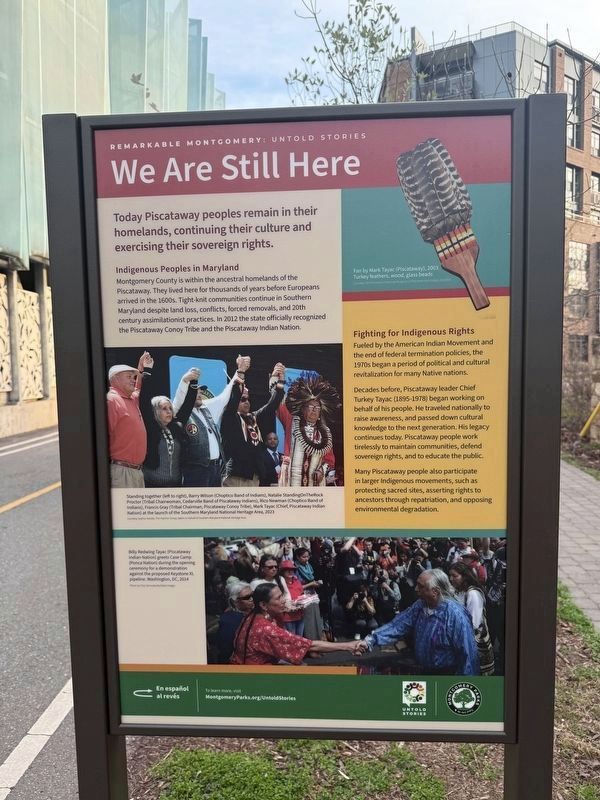

Today Piscataway peoples remain in their homelands, continuing their culture and exercising their sovereign rights.
Indigenous Peoples in Maryland
Montgomery County is within the ancestral homelands of the Piscataway. They lived here for thousands of years before Europeans arrived in the late 1600s. Tight-knit communities continue in Southern Maryland despite land loss, conflicts, forced removals, and 20th century assimilationist practices. In 2012 the state officially recognized the Piscataway Conoy Tribe and the Piscataway Indian Nation.
Fighting for Indigenous Rights
Fueled by the American Indian Movement and the end of federal termination policies, the 1970s began a period of political and cultural revitalization for many Native nations.
Decades before, Piscataway leader Chief Turkey Tayac (1895-1978) began working on behalf of his people. He traveled nationally to raise awareness, and passed down cultural knowledge to the next generation. His legacy continues today. Piscataway people work tirelessly to maintain communities, defend sovereign rights, and to educate the public.
Many Piscataway people
this page online
[Captions:]
Fan by Mark Tayac (Piscataway), 2003
Turkey feathers, wood, glass beads
Standing together (left to right), Barry Wilson (Choptico Band of Indians), Natalie StandingOnTheRock Proctor (Tribal Chairwoman), Cedarville Band of Piscataway Indians), Rico Newman (Choptico Band of Indians), Francis Gray (Tribal Chairman, Piscataway Conoy Tribe), Marc Tayac (Chief, Piscataway Indian Nation) at the launch of the Southern Maryland National Heritage Area, 2023
Billy Redwing Tayac (Piscataway Indian Nation) greets Case Camp (Ponca Nation) during the opening ceremony for a demonstration against the proposed Keystone XL pipeline. Washington, DC, 2014
Pueblo indígenas de Maryland
El condado de Montgomery está dentro de las tierrasancestrales del pueblo piscataway. Este pueblo vivió aquí durante miles de años antes de la
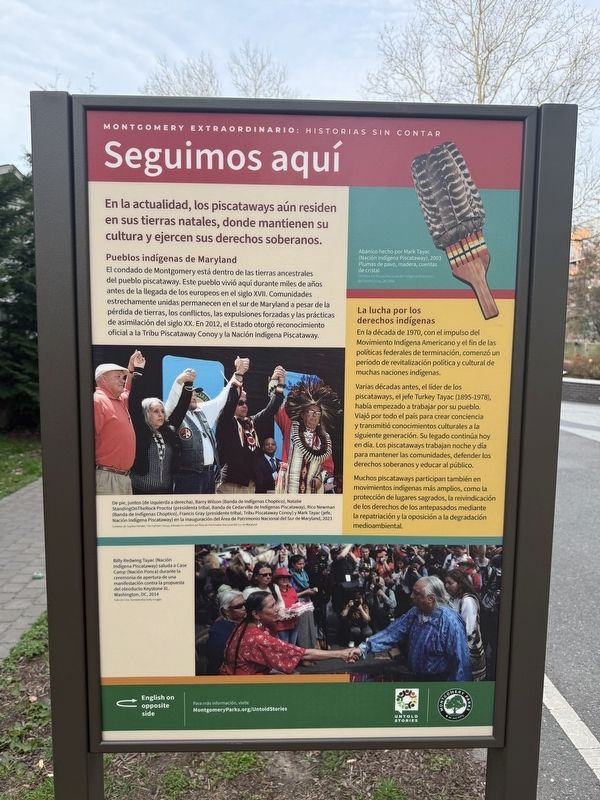
La lucha por los derechos indígenas
En la década de 1970, con el impulso del Movimiento Indígena Americano y el fin de las políticas federalesde terminación, comenzó un período de revitalización política y cultrual de muchas naciones indígenas.
Varias décadas antes, el líder de los piscataways, el jefe Turkey Tayac (1895-1978), había empezado a trabajar por su pueblo. Viajó por todo el país para crear conciencia y transmitió conocimientos culturales a la siguiente generación. Su legado continúa hoy en día. Los piscataways trabajan noche y día para mantener las comunidades, defender los derechos soberanos y educar al público.
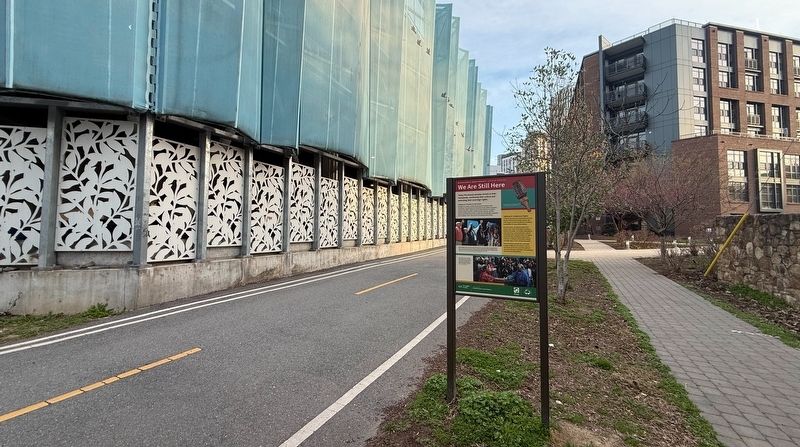
Photographed by Devry Becker Jones (CC0), March 26, 2026
3. We Are Still Here / Seguimos aquí Marker
[Nota al calce:]
Abanico hecho por Mark Tayac (Nación Indígena Piscataway), 2003
Plumas de pavo, madera, cuentas de cristal
De pie, juntos (de izquierda a derecha), Barry Wilson (Banda de Indígenas Choptico), Natalie StandingOnTheRock Proctor (presidenta tribal, Banda de Cedarville de Indígenas Piscataway), Rico Newman (Banda de Indígenas Choptico), Fancis Gray (presidente tribal, Tribu Piscataway Conoy) y Mark Tayac (jefe Nación Indígena Piscataway) en la inauguración del Àrea de Patrimonio Nacional del Sure de Maryland, 2023
Billy Redwing Tayac (Nación Indígena Piscataway) saluda a Case Camp (Nación Ponca) durante la cermemonia de apertura de una manifestación contra la propuesta del oleoducto Keystone XL. Washington, DC, 2014
Erected 2025 by Montgomery Parks.
Topics and series. This historical marker is listed in these topic lists: Anthropology & Archaeology • Civil Rights • Indigenous Peoples and Communities • Settlements & Settlers. In addition, it is included in the Maryland, Montgomery Parks series list. A significant historical year for this entry is 2012.
Location. 38° 58.805′ N,
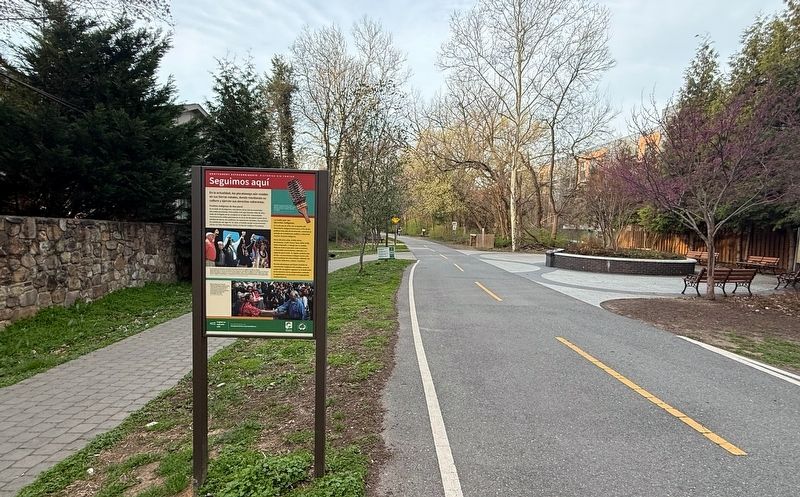
Photographed by Devry Becker Jones (CC0), March 26, 2026
4. We Are Still Here / Seguimos aquí Marker

Regionally, this marker is in the Washington Metropolitan Area. It is also in the American Mid-Atlantic. Globally, it is in North America, the Western Hemisphere, the Western World, and the Anglosphere. Historically, it finds itself in what was once one of the original Thirteen Colonies and also the Antebellum South.
Other nearby markers. At least 8 other markers are within walking distance of this marker: The Georgetown Branch Railroad (a few steps from this marker); We Drivers! (about 300 feet away, measured in a direct line); Meleney Park (about 700 feet away); Caroline Freeland (approx. 0.2 miles away); Madonna of the Trail (approx. 0.3 miles away); In Loving Memory of Robert W. Lebling (approx. 0.3 miles away); Five Points, historic crossroads (approx. 0.3 miles away); This Complex of Buildings and Gardens (approx. half a mile away). Touch for a list and map of all markers in Bethesda.
Other markers no longer nearby. Looking North up Wisconsin Avenue at Old Georgetown Road in 1940 (was approx. 0.4 miles away but has been permanently removed); The First Building for the Bethesda Fire Department (was approx. 0.4 miles away but has been confirmed missing); The Bank of Bethesda Building (was approx. 0.4 miles away but has been confirmed missing); Old Georgetown Road (was approx. 0.4 miles away but has been permanently removed).
Credits. This page was last revised on March 26, 2026. It was originally submitted on March 26, 2026, by Devry Becker Jones of Washington, District of Columbia. This page has been viewed 25 times since then. Photos: 1, 2, 3, 4. submitted on March 26, 2026, by Devry Becker Jones of Washington, District of Columbia.
