
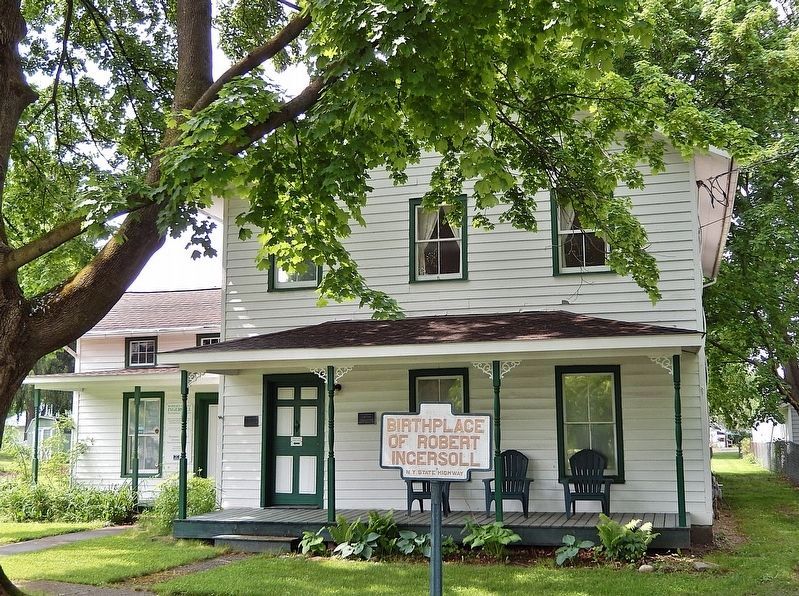
Birthplace of Robert Ingersoll

Erected by New York State Highway.
Topics and series. This historical marker is listed in these topic lists: Abolition & Underground RR • Architecture • Civil Rights • Women. In addition, it is included in the National Register of Historic Places (NRHP) series list. A significant historical date for this entry is August 11, 1833.
Location. 42° 41.045′ N, 76° 57.358′ W. Marker is in Dresden, New York, in Yates County. It is on Main Street just east of Charles Street, on the right when traveling east. The marker is along the sidewalk in front of the R. G. Ingersoll Birthplace & Museum. Touch for map. Marker is at or near this postal address: 61 Main Street, Dresden NY 14441, United States of America. Touch for directions.

Regionally, this marker is in Upstate New York, specifically in Western New York, and in the Finger Lakes. It is also in the American Northeast and in the Mid-Atlantic. Globally, it is in North America, the Western Hemisphere, the Western World, and the Anglosphere. Historically, it finds itself in what was once the Haudenosaunee (Iroquois) Confederacy, New Netherland,
this page online
Other nearby markers. At least 8 other markers are within 4 miles of this marker, measured as the crow flies: Tree of Liberty (about 400 feet away, measured in a direct line); Routes of the armies of General John Sullivan and General James Clinton (approx. 3.8 miles away); Ken-Dai-A (approx. 3.8 miles away); Veterans Memorial Bench (approx. 3.9 miles away); Veterans Memorial (approx. 3.9 miles away); American Veterans Memorial (approx. 3.9 miles away); William Thomas Sampson (approx. 3.9 miles away); a different marker also named Veterans Memorial Bench (approx. 3.9 miles away).
Regarding Birthplace of Robert Ingersoll. National Register of Historic Places № 88000110.
From the National Register Nomination prepared by Nancy L. Todd and Alicia A. Jettner, 12/1987:
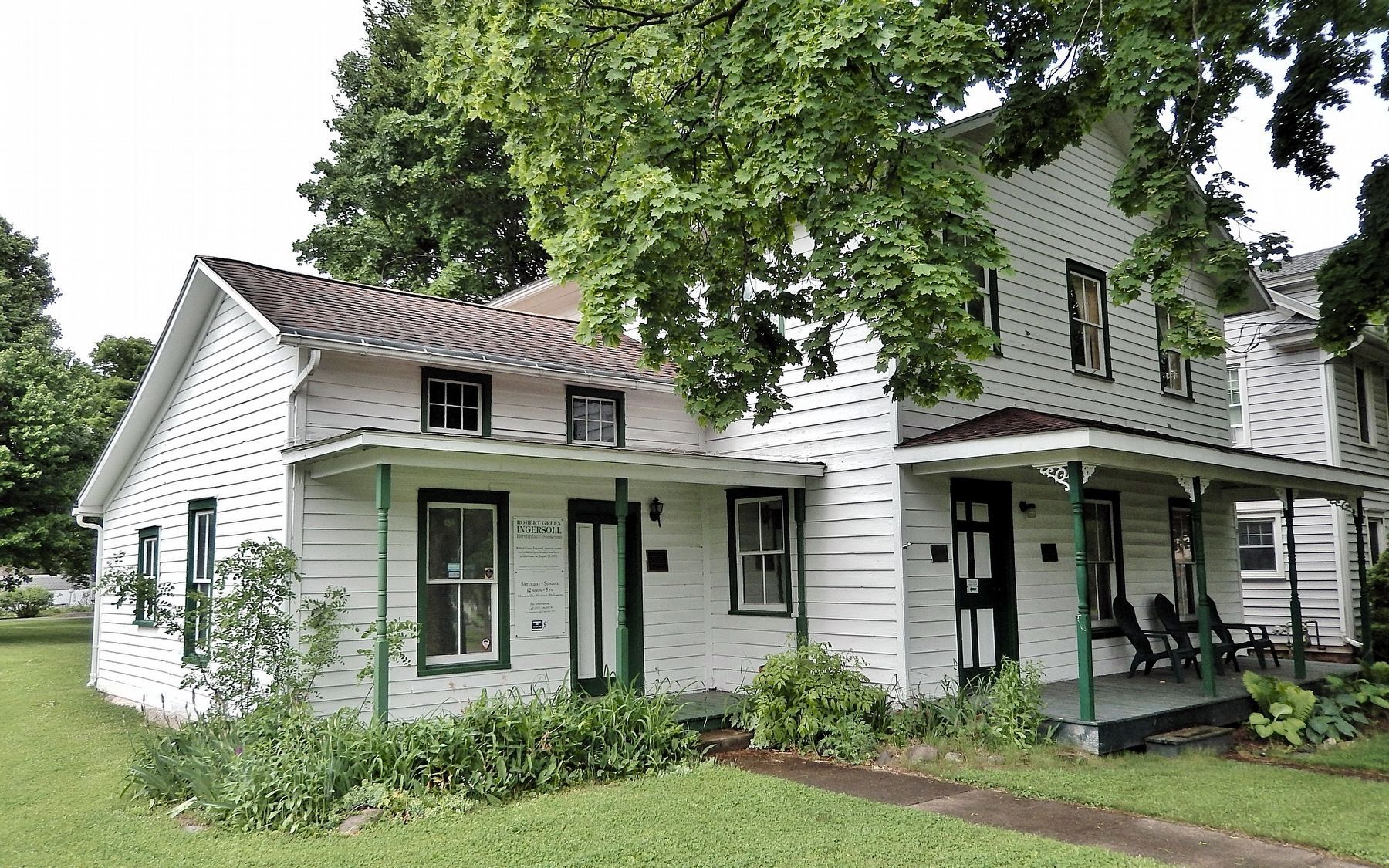
The Robert Ingersoll Birthplace is architecturally and historically significant as an intact example of early nineteenth century vernacular residential architecture in Dresden and as the only known extant historic resource associated with Robert Ingersoll, one of the most popular and well-known American orators of the nineteenthcentury.Photographed by Cosmos Mariner, May 22, 20222. Birthplace of Robert IngersollLooking north from Main Street. The marker is along the sidewalk in front of the R. G. Ingersoll Birthplace & Museum.The residence is composed of two independent sections that predate Ingersoll's birth in 1833. At some time in the nineteenth century (probably around the time of Ingersoll's birth or shortly thereafter) they were moved to the present site and joined. Each section retains distinctive forms, details and materials representative of its period of construction. The building remains substantially intact to the period of Ingersoll's residence and provides a representative example of early nineteenth century residential architecture in this rural, western New York village.
The Ingersoll house is typical of Dresden's residential building stock; the village is characterized by a variety of modest vernacular architecture dating primarily from the mid to late nineteenth century. Few other buildings in the village, however, retain the level of integrity displayed by the Ingersoll house. The Ingersoll house embodies a variety of distinctive features of early nineteenth century vernacular residential architecture, including the two-story, three-bay, gable-roofed form of the main block, restrained, yet finely crafted, woodwork, regular fenestration,
clapboard siding and, on the interior, a simple functional plan and simple detailing. The interior is especially intact, retaining room configurations and finishes. Although plain and utilitarian in its overall character, the Ingersoll house (the main block, in particular) reflects the influence of the formal and fashionable Federal style in its balanced proportions, massing and fenestration and simple, yet finely crafted, detailing. Thus, the house illustrates a shift away from the crude, utilitarian, settlement period vernacular architecture of the region's rural areas towards the more sophisticated building traditions practiced by the emerging middle classes in prosperous village settings.Photographed by Cosmos Mariner, May 22, 20223. National Register of Historic Places Marker(on left side of east entrance)
This property has been placed on the
National Register of Historic Places
by the United States Department of the Interior
Feb. 11, 1988
Circa 1800The Ingersoll house has in the past few years again become the site of commemorative activities honoring the great orator, since it is the last of Ingersoll's homes still standing. His home in Peoria, IL was razed at an unknown date and replaced with a plaque In the asphalt. The house on Lafayette Square in Washington, D.C. is also gone. In 1882 Ingersoll moved to New York City; according to current available sources his first residence in the
city on Madison Avenue is no longer standing. In 1888 Ingersoll moved to Gramercy Park and lived in an elaborate brownstone, where he entertained the leading Intellectual and cultural figures of his time. This has also been razed, to make way for the Gramercy Park Hotel. Today, the only surviving resource associated with Robert G. Ingersoll Is the small house in Dresden, New York, the house of his birth.Photographed by Cosmos Mariner, May 22, 20224. Porch Restoration Marker(on right side of east entrance)
Porch Restoration 2016 by Jeff Ingersoll
Funded by a grant from the James Hervey Johnson Charitable Educational TrustRobert Ingersoll (1833-1899) began his professional life as a teacher and a lawyer, but he soon developed an interest in politics. After a short but unsuccessful period in which he tried for several elective offices, Ingersoll shifted his ambition to political speech making. His rise to national prominence is attributed to his "Plumed Knight" speech for James G. Blaine at the Republican National Convention in 1876, after which Ingersoll became widely sought on the lecture circuit, speaking in nearly every state in the union.
Ingersoll's beliefs were distinctly modern for his time, celebrating progress and science over what he believed to be religious superstition and advocating civil rights for blacks and women. After Ingersoll's death,
his birthplace in Dresden was purchased by members of his family to preserve it as a community center in his memory. It has been held as a commemorative by a variety of organizations since that time and is believed to be the only resource associated with Ingersoll's life that survives.Photographed by Cosmos Mariner, May 22, 20225. Robert Green Ingersoll Birthplace Museum(on left side of west entrance) Robert Green Ingersoll, agnostic orator and political speechmaker, was born in this house on August 11, 1833.Restored 1987 by the Robert G. Ingersoll Memorial Committee, a project of the Council for Secular Humanism
Renovated 2014
Saturday — Sunday
12 NOON - 5 PM
Memorial Day Weekend - Halloween
For information, Call (315) 536-1074
In emergency call (716) 636-7571Ingersoll spent only the first three months of his life in the Dresden home. Ingersoll's father, a Congregationalist minister, was forced to move numerous times due to his outspoken opposition to slavery. Ingersoll shared his father's bitter hatred of slavery, and throughout his career he spoke often and passionately for the rights of black men and women. He used his influence to secure a Library of Congress job for the black poet Paul Laurence Dunbar; he took a black student into his law office; he gave freely of his lodging to Frederick Douglass when no hotel or minister in town would take him in, and he even made a contribution to a black Baptist church for a new roof.
Ingersoll did not hesitate to espouse generally unpopular causes. Not only was he a staunch advocate of civil rights for black Americans ("It is easy to see why the colored people should
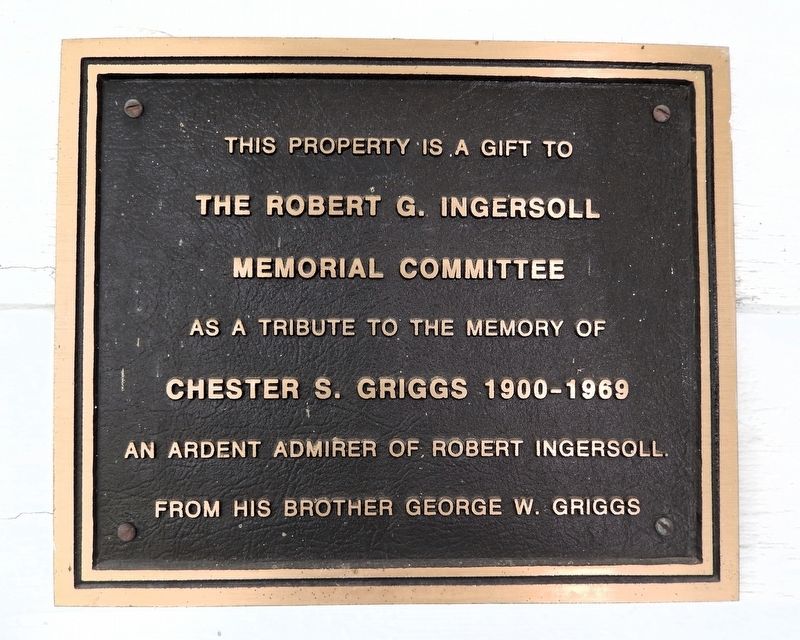
hate us, but why we should hate them is beyond my comprehension"), but he also supported the rights of women ("There will never be a generation of great men until there has been a generation of free women"), children ("I will tell you what I say to my children: Go where you will, commit what crime you may, fall to what depth of degradation you may, you can never commit any crime that will shut my door, my arms, or my heart to you"), and the oppressed everywhere ("To live on the unpaid labor of other men — that is blasphemy. To enslave your fellow man, to put chains upon his body — that is blasphemy. To enslave the minds of men, to put manacles upon the brain, padlocks upon the lips— that is blasphemy").Photographed by Cosmos Mariner, May 22, 20226. Chester S. Griggs Memorial(on right side of west entrance) This property is a gift to The Robert G. Ingersoll Memorial Committee as a tribute to the memory of Chester S. Griggs 1900-1969 an ardent admirer of Robert Ingersoll. From his brother George W. GriggsIngersoll died in 1899. It is not known whether he ever returned to visit the house of his birth. On October 2, 1889, he spoke at the Yates County Fair in Penn Yan, about six miles from Dresden, and said: "I want to congratulate myself that I was born in Yates County, the most beautiful spot in New York State, although I went away from here nearly fifty-six years ago. Since that time, I have seen much of this world. I have been in many
places and seen many people. As I come back again, I congratulate myself on being born in such a splendid, lovely country."Photographed by Cosmos Mariner, May 22, 20227. Robert Ingersol Birthplace (southwest elevation)


Also see . . .
1. Robert Ingersoll Birthplace (Wikipedia).
Excerpt: Robert Ingersoll Birthplace, also known as Robert Green Ingersoll Birthplace Museum, is a historic home located at Dresden in Yates County, New York. It is a Federal-style structure that consists of a two-story, three-bay, gable-roofed central block with a two-part, 1+1⁄2-story saltbox ell on the west side. The central block and the front portion of the ell were built separately and joined sometime before they were moved to their present location prior to 1833. The rear portion of the ell was added on-site at the current location at an unknown date. The house was the birthplace of noted agnostic and politician Robert G. Ingersoll (1833–1899). It was listed on the National Register of Historic Places in 1988 and added to New York State's Register of Historic Places in 1987.(Submitted on April 3, 2026, by Cosmos Mariner of Cape Canaveral, Florida.)The Robert Green Ingersoll Birthplace Museum opened on Memorial Day weekend in 1993. The Museum has been open to the public on weekends each summer and
fall ever since. Conspicuous developments have included, in 2001, installation of a large bust of Ingersoll that had decorated a Dowagiac, Michigan, theater razed in 1968. In 2003, a historically accurate front porch was added by volunteer contractor (and Ingersoll descendant) Jeff Ingersoll. In that year the Museum also adopted its current tagline, referring to Ingersoll as "the most remarkable American most people never heard of," a reference to his near-exclusion from history by religious detractors. In 2014, the museum interior was fully renovated. Display cases were refurbished and all-new interpretive signage was developed, including professionally designed mural-sized wall graphics. A formerly private room on the second floor was added to the public display space.
2. Robert Green Ingersoll (Wikipedia).
Excerpt: Nicknamed "the Great Agnostic", he was an American lawyer, writer, and orator during the Golden Age of Free Thought, who campaigned in defense of agnosticism. With the beginning of the American Civil War, he raised the 11th Regiment Illinois Volunteer Cavalry of the Union Army and assumed command. The regiment fought in the Battle of Shiloh. Ingersoll was later captured in a skirmish with the Confederates near Lexington, Tennessee on December 18, 1862, then paroled.(Submitted on April 3, 2026, by Cosmos Mariner of Cape Canaveral, Florida.)He was a prominent member of the Republican Party and, though he never held elected office, he was nonetheless an active participant in politics. His speech nominating James G. Blaine for the 1876 presidential election was unsuccessful, as Rutherford B. Hayes received the Republican nomination, but the speech itself, known as the "Plumed Knight" speech, was considered a model of political oratory. His opinions on slavery, woman's suffrage, and other issues of the time would sometimes become part of the mainstream, but his atheism/agnosticism effectively prevented him from ever pursuing or holding political offices higher than that of state attorney general.
On October 30, 1880, Ingersoll was introduced as "the Great Agnostic" by Rev. Henry Ward Beecher, before a political speech delivered to a large audience at the Academy of Music in Brooklyn. He opposed the Chinese Exclusion Act and supported a more lenient policy toward Chinese workers coming to the United States. Ingersoll defended women’s rights and opposed racial discrimination and capital punishment.
In 2005, a popular edition of Ingersoll's work was published by Steerforth Press. Edited by the Pulitzer Prize-winning music critic Tim Page, What's God Got to Do With It: Robert Ingersoll on Free Speech, Honest Talk and the Separation of Church and State brought Ingersoll's thinking to a new audience.
Credits. This page was last revised on April 3, 2026. It was originally submitted on April 2, 2026, by Cosmos Mariner of Cape Canaveral, Florida. This page has been viewed 17 times since then. Photos: 1, 2, 3, 4, 5. submitted on April 2, 2026, by Cosmos Mariner of Cape Canaveral, Florida. 6, 7. submitted on April 3, 2026, by Cosmos Mariner of Cape Canaveral, Florida.
