Ithaca in Tompkins County, New York — The American Northeast (Mid-Atlantic)
Cayuga Lake And The Erie Canal:
Ithaca’s Waterway To The World

Photographed by Susan A. Dalaba, March 10, 2026
1. Cayuga Lake And The Erie Canal: Marker
Before The Erie Canal
Indigenous people lived along these waters long before the Erie Canal was imagined, with 13,000 year-old canoe-building tools found near Watertown, NY, demonstrating the importance of watercraft to the early people.
The Gayogoho:no? (Guy-uh-kono) whose name roughly translates as “from the swampy land.” have held a deep connection to Cayuga Lake and waterways for food, trade, and transportation. During the Revolutionary War, the U.S. Military was ordered to attack Gayogoho:no? and allied tribes, including the Tutelo people. Though driven from their lands and waters, both groups retain their ancestral ties to the region today.
Gayogoho:no people are members of the Haudenosaunee Confederacy (formerly also known as the Iroquois) notable for their elm bark canoes. Although heavy, these boats were relatively quick to make, and could carry multiple
this page online
Ithaca On The Erie Canal
The Erie Canal established the first modern all water route between the Great Lakes and the Atlantic coast. Completed in 1825, the canal opened Upstate New York and the Midwest to settlement, commercial agriculture and industrialization.
The 364 mile-long waterway was so successful that communities throughout New York clamored for canals of their own. Ithaca has been a canal port since 1828, when the Cayuga-Seneca Canal connected the two largest Finger Lakes with the Erie Canal, boosting local production of lumber, wheat, and whiskey. Boatworks and lumber yards lined the Ithaca Inlet, along with services for travelers passing through the town. While the canal system remains in service today, most of its traffic is recreational.
Steamboats
From 1895-1915, steamboats regularly brought scores of visitors from resorts on Cayuga Lake to Stewart Park (then Renwick Park). Passengers would disembark to enjoy picnics, concerts, and dancing throughout the summer months. Steamers also docked at the pier to offer commutes and tours up the lake. The last of the steamers, the Frontenac, remained

Photographed by Susan A. Dalaba, September 2, 2025
2. Cayuga Lake And The Erie Canal: Marker
Paddlng For Competition And Recreation
In the late 1800s, small-capacity boating became increasingly popular along Ithaca’s waterfront with canoes and rowboats available for rent, sailing clubs opening, and building, the Cascadilla Boathouse, was constructed by the Cascadilla School to house their racing shells.
Today, Cayuga Lake is still a haven for recreational boating for all ages. Sweep teams row the inlet, kayakers hug the shore, fishermen cast from their skiffs, and a Haudenosaunee recreational group regularly canoes their waters. Sailors take advantage of the winds on the open lake. Look out at the lake and you may see some now. In 2009, the Cayuga Lake Blueway Trail opened as a public water-recreation trail connecting non-motorized watercrafts like kayaks, stand up paddleboards, and canoes to many local businesses and recreation areas along Cayuga Lake and the Erie Canal.
Crew racing has been popular on Cayuga Lake since the 1870s. The Cascadilla Boathouse, built in 1896, is still used today by the Cascadilla Boat Club. For more history on competitive crew

Photographed by Susan A. Dalaba, September 2, 2025
3. Cayuga Lake And The Erie Canal: Marker
Erected by Erie Canalway National Heritage Corridor.
Topics and series. This historical marker is listed in these topic lists: Indigenous Peoples and Communities • Industry & Commerce • Parks & Recreational Areas • Waterways & Vessels. In addition, it is included in the Erie Canal series list. A significant historical year for this entry is 1825.
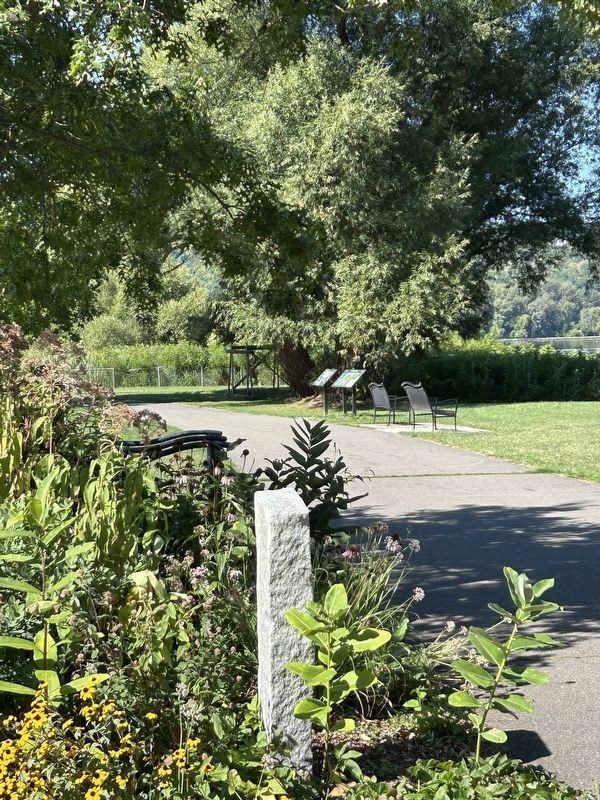
Location. 42° 27.753′ N, 76° 30.193′ W. Marker is in Ithaca, New York, in Tompkins County. It can be reached from James L Gibbs Drive south of East Shore Drive, on the right when traveling south. Marker on the pathway by the lake. Touch for map. Marker is at or near this postal address: 1 James L Gibbs Dr, Ithaca NY 14850, United States of America. Touch for directions.

Regionally, this marker is in Upstate New York and in the Southern Tier. It is also in the American Northeast and in the Mid-Atlantic. Globally, it is in North America, the Western Hemisphere, the Western World, and the Anglosphere. Historically, it finds itself in what was once the Haudenosaunee
Photographed by Susan A. Dalaba, September 2, 2025
4. Cayuga Lake And The Erie Canal: Marker
Other nearby markers. At least 8 other markers are within walking distance of this marker: Welcome to Stewart Park! (here, next to this marker); The Picnic Pavilion (within shouting distance of this marker); Stewart Park (within shouting distance of this marker); Wharton Studio (about 300 feet away, measured in a direct line); The Movie Studio (about 300 feet away); Edwin Crowell Stewart (about 500 feet away); Remington Point (approx. ¼ mile away); Louis Agassiz Fuertes Memorial Bird Sanctuary & Overlook (approx. 0.3 miles away). Touch for a list and map of all markers in Ithaca.

Photographed by Susan A. Dalaba, March 10, 2026
5. Cayuga Lake And The Erie Canal: Marker
Credits. This page was last revised on April 7, 2026. It was originally submitted on April 6, 2026, by Susan A. Dalaba of Cortland, New York. This page has been viewed 24 times since then. Photos: 1, 2, 3, 4, 5. submitted on April 6, 2026, by Susan A. Dalaba of Cortland, New York. • Devry Becker Jones was the editor who published this page.
