Scotland in St. Mary's County, Maryland — The American Northeast (Mid-Atlantic)
The Maryland Flagpole ⎯⎯⎯ Point Lookout Cemetery Trustees
April 11, 2026
1. The Maryland Flagpole / Point Lookout Cemetery Trustees Marker
Inscription.
The Maryland Flagpole, also, Point Lookout Cemetery Trustees. .
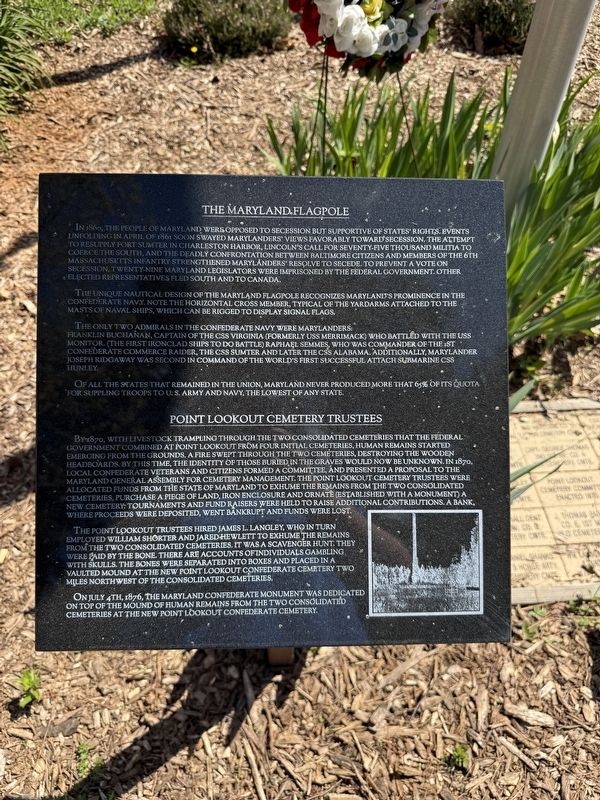
The Maryland Flagpole. In 1860, the people of Maryland were opposed to secession but supportive of states' rights. Events unfolding in April of 1861 soon swayed Marylanders' views favorably toward secession. The attempt to resupply Fort Sumter in Charleston Harbor, Lincoln's call for seventy-five thousand militia to coerce the South, and the deadly confrontation between Baltimore citizens and members of the 6th Massachusetts Infantry strengthened Marlanders' resolve to secede. To prevent a vote on secession, twenty-nine Maryland legislators were imprisoned by the federal government. Other elected representatives fled south and into Canada., The unique nautical design of the Maryland flagpole recognizes Maryland's prominence in the Confederate navy. Note the horizontal cross member, typical of the yardarms attached to the masts of naval ships, which can be rigged to display signal flags., The only two admirals in the Confederate navy were Marylanders: Franklin Buchanan, Captain of the CSS Virginia (formerly USS Merrimack) who battled with the USS Monitor. (The first ironclad ships to do battle) Raphael Semmes, who was commander of the 1st Confederate commerce raider, the CSS Sumter and later the CSS Alabama. Additionally, Marylander Joseph Ridgaway was second in command of the world's first successful attach submarine CSS Huntley., Of all the states that remained in the Union, Maryland never produced more than 65% of its quota for suppling troops to the U.S. Army and Navy, the lowest of any state.,
Point Lookout Cemetery Trustees. By 1870, with livestock trampling through the two consolidated cemeteries that the federal government combined at Point Lookout from four initial cemeteries, human remains started emerging from the grounds. A fire swept through the two cemeteries, destroying the wooden headboards. by this time, the identity of those buried in the graves would now be unknown. In 1870, local Confederate veterans and citizens formed a committee, and presented a proposal to the Maryland General Assembly for cemetery management. The Point Lookout Cemetery Trustees were allocated funds from the State of Maryland to exhume the remains from the two consolidated cemeteries, purchase a piece of land, iron enclosure and ornate (established with a monument) a new cemetery. Tournaments and fund raisers were held to raise additional contributions. A bank, where proceeds were deposited, went bankrupt and funds were lost., The Point Lookout Trustees hired James L. Langley, who in turn employed William Shorter and Jared Hewlett to exhume the remains from the two consolidated cemeteries. It was a scavenger hunt. They were paid by the bone. There are accounts of individuals gambling with skulls. the bones were separated into boxes and placed in a vaulted mound at the new Point Lookout Confederate Cemetery two miles northwest of the consolidated cemeteries., On July 4th, 1876, the Maryland Confederate Monument was dedicated on top of the mound of human remains from the two consolidated cemeteries at the new Point Lookout Confederate Cemetery.
The Maryland Flagpole
In 1860, the people of Maryland were opposed to secession but supportive of states' rights. Events unfolding in April of 1861 soon swayed Marylanders' views favorably toward secession. The attempt to resupply Fort Sumter in Charleston Harbor, Lincoln's call for seventy-five thousand militia to coerce the South, and the deadly confrontation between Baltimore citizens and members of the 6th Massachusetts Infantry strengthened Marlanders' resolve to secede. To prevent a vote on secession, twenty-nine Maryland legislators were imprisoned by the federal government. Other elected representatives fled south and into Canada.
The unique nautical design of the Maryland flagpole recognizes Maryland's prominence in the Confederate navy. Note the horizontal cross member, typical of the yardarms attached to the masts of naval ships, which can be rigged to display signal flags.
The only two admirals in the Confederate navy were Marylanders:
Franklin Buchanan, Captain of the CSS Virginia (formerly USS Merrimack) who battled with the USS Monitor. (The first ironclad ships to do battle) Raphael Semmes, who was commander of the 1st Confederate commerce raider, the CSS Sumter and later the CSS Alabama. Additionally, Marylander Joseph Ridgaway was second in command of the world's first successful attach submarine CSS Huntley.
Of all the states that remained in the Union, Maryland never produced more than 65% of its quota for suppling troops to the U.S. Army and Navy, the lowest of any state.
Point Lookout Cemetery Trustees
By 1870, with livestock trampling through the two consolidated cemeteries that the federal government combined at Point Lookout from four initial cemeteries, human remains started emerging from the grounds. A fire swept through the two cemeteries, destroying the wooden headboards. by this time, the identity of those buried in the graves would now be unknown. In 1870, local Confederate veterans and citizens formed a committee, and presented a proposal to the Maryland General Assembly for cemetery management. The Point Lookout Cemetery Trustees were allocated funds from the State of Maryland to exhume the remains from the two consolidated cemeteries, purchase a piece of land, iron enclosure and ornate (established with a monument) a new cemetery. Tournaments and fund raisers were held to raise additional contributions. A bank, where proceeds were deposited, went bankrupt and funds were lost.
The Point Lookout Trustees hired James L. Langley, who in turn employed William Shorter and Jared Hewlett to exhume the remains from the two consolidated cemeteries. It was a scavenger hunt. They were paid by the bone. There are accounts of individuals gambling with skulls. the bones were separated into boxes and placed in a vaulted mound at the new Point Lookout Confederate Cemetery two miles northwest of the consolidated cemeteries.
On July 4th, 1876, the Maryland Confederate Monument was dedicated on top of the mound of human remains from the two consolidated cemeteries at the new Point Lookout Confederate Cemetery.
Location. 38° 4.416′ N, 76° 20.467′ W. Marker is in Scotland, Maryland, in St. Mary's County. It is on Point Lookout Road (Maryland Route 5) east of St. Michaels Manor Way, on the right when traveling east. Touch for map. Marker is at or near this postal address: 11625 Point Lookout Rd, Scotland MD 20687, United States of America. Touch for directions.

Regionally, this marker is in Southern Maryland. It is also in the American South, specifically in the Upper South, in the Mid-Atlantic, in the Tidewater, in the Chesapeake Bay Region, and on the Eastern Seaboard. Globally, it is in the North Atlantic Region, North America, the Western Hemisphere, the Western World, and the Anglosphere. Historically, it finds itself in what was once one of the original Thirteen Colonies and
April 11, 2026
2. The Maryland Flagpole / Point Lookout Cemetery Trustees Marker
Credits. This page was last revised on April 12, 2026. It was originally submitted on April 12, 2026. This page has been viewed 12 times since then. Photos:1, 2. submitted on April 12, 2026.
