Riverside in Newport News, Virginia — The American South (Mid-Atlantic)
The Longleaf Pine
Pinus palustris
Photographed by Evan Dwyer, February 14, 2026
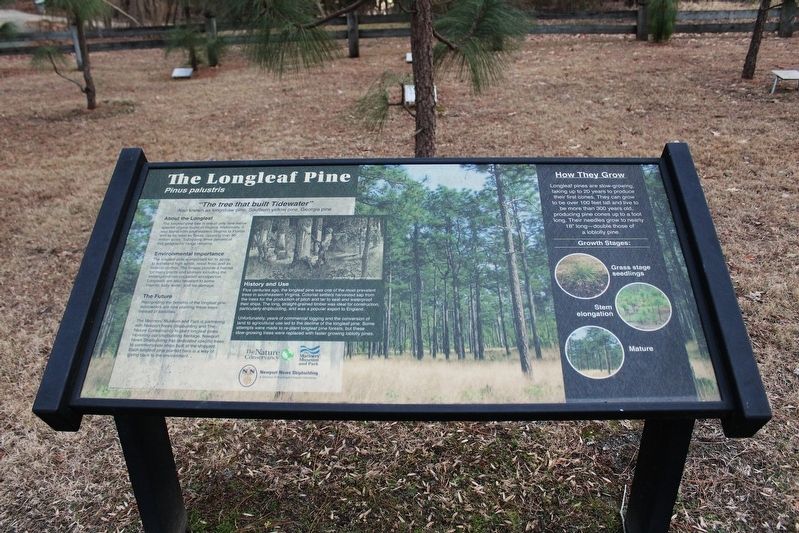
1. The Longleaf Pine Marker
"The tree that built Tidewater"
Also known as longstraw pine, Southern yellow pine, Georgia pine
About the Longleaf
The longleaf pine tree is one of only nine native species of pine found in Virginia. Historically, it was found from southeastern Virginia to Florida and as far west as Texas, covering over 90 million acres. Today only three percent of this geographic range remains.
Environmental Importance
The longleaf pine is important for its ability to withstand high winds, resist fires, and as erosion control. The forests provide a habitat for many plants and animals including the endangered red-cockaded woodpecker. Longleafs are also resistant to some insects, salty water, and ice damage.
The Future
Recognizing the benefits of the longleaf pine, landowners are now planting these trees instead of loblollies.
The Mariners' Museum and Park is partnering with Newport News Shipbuilding and The Nature Conservancy to plant longleaf pines. Honoring our shipbuilding heritage, Newport News Shipbuilding has dedicated specific trees to commemorate ships built at the shipyard. Each longleaf pine planted here is a
this page online
History and Use
Five centuries ago, the longleaf pine was one of the most prevalent trees in southeastern Virginia. Colonial settlers harvested sap from the trees for the production of pitch and tar to seal and waterproof their ships. The long, straight-grained timber was ideal for construction, particularly shipbuilding, and was a popular export to England.
Unfortunately, years of commercial logging and the conversion of land to agricultural use led to the decline of the longleaf pine. Some attempts were made to re-plant longleaf pine forests, but these slow-growing trees were replaced with faster growing loblolly pines.
How They Grow
Longleaf pines are slow-growing, taking up to 20 years to produce their first cones. They can grow to be over 100 feet tall and live to be more than 300 years old, producing pine cones up to a foot long. Their needles grow to nearly 18" long - double those of a loblolly pine.
Growth Stages:
Grass stage seedlings
Stem elongation
Mature
Erected by The Nature Convservancy, The Mariners' Museum and Park, Newport News Shipbuilding.
Topics.
Photographed by Evan Dwyer, February 14, 2026
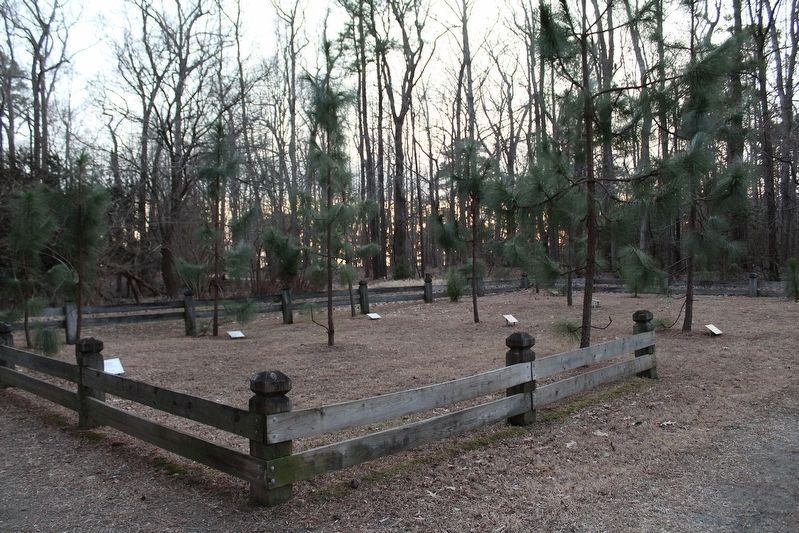
2. The Longleaf Pine Plot
Marker is at right, out of sight.
Location. 37° 2.637′ N, 76° 29.252′ W. Marker is in Newport News, Virginia. It is in Riverside. It can be reached from Museum Drive 0.2 miles north of Museum Parkway, on the left when traveling south. Marker is on the Noland Trail, part of The Mariners' Museum and Park. Touch for map. Marker is at or near this postal address: 100 Museum Drive, Newport News VA 23606, United States of America. Touch for directions.

Regionally, this marker is on Virginia’s Peninsula, in Hampton Roads, in Coastal Virginia, and in the Hampton Roads Metropolitan Area. It is also in the American South, specifically in the Upper South, in the Tidewater, and on the Eastern Seaboard. Globally, it is in the North Atlantic Region, North America, the Western Hemisphere, the Western World, and the Anglosphere. Historically, it finds itself in what was once the territory of the Mississippian Culture, one of the original Thirteen Colonies,

Photographed by Evan Dwyer, February 14, 2026
3. Dorothy Tree Marker
Dorothy, which served in World War I in a coastal patrol role as USS J. Alvah Clark, was the first hull produced by Newport News Shipbuilding and was restored for static display in downtown Newport News across from the historic shipyard administration building, where it remains as a local landmark.
Other nearby markers. At least 8 other markers are within walking distance of this marker: Capture of the 'Patriot' (about 800 feet away, measured in a direct line); Skirmish at Cedar Lane (approx. ¼ mile away); Admiralty Pattern Anchor (approx. 0.7 miles away); USS Monitor: America's First Ironclad (approx. 0.7 miles away); Sloop La Nube (approx. 0.7 miles away); Lt. Col. Charles D. Dreux (approx. ¾ mile away); US Navy Admiralty Pattern Anchor (approx. ¾ mile away); Spanish Bronze Gun (approx. 0.8 miles away). Touch for a list and map of all markers in Newport News.
Other markers no longer nearby. Skirmish at Waters Creek (was approx. 0.2 miles away but has been confirmed missing); Walking Beam and A-Frame (was approx. ¾ mile away but has been confirmed missing); Walking Beam (was approx. ¾ mile away but has been confirmed missing).

Photographed by Evan Dwyer, February 14, 2026
4. USS Enterprise (CVAN-65) Tree Marker
Enterprise, the first nuclear-powered aircraft carrier in the world, served as the beginning of Newport News Shipbuilding's long history as the USA's only builder of nuclear carriers. It has a tree dedicated in its honor near the marker, along with several other nuclear-powered naval vessels.
Credits. This page was last revised on April 23, 2026. It was originally submitted on April 12, 2026, by Evan Dwyer of Richmond, Virginia. This page has been viewed 16 times since then. Photos: 1. submitted on April 12, 2026, by Evan Dwyer of Richmond, Virginia. 2, 3, 4. submitted on April 22, 2026, by Evan Dwyer of Richmond, Virginia. • Bernard Fisher was the editor who published this page.
