Park View in Portsmouth, Virginia — The American South (Mid-Atlantic)
Colonel James Gregory Hodges
1828 - 1863

Photographed by C. Ryan Dodson, April 10, 2026
1. Colonel James Gregory Hodges Marker
James Hodges was born on Christmas Day, 1828 in Portsmouth, schooled at the Portsmouth Literary, Scientific and Military Academy and graduated from the University of Pennsylvania. He became a Physician. James had dark hair, bright dark eyes, a highly intellectual face and was gentle in manners. In 1856 and 1857 he was elected mayor of Portsmouth and colonel of the 3rd Virginia Volunteers. His sense of duty and his strict observance of it, was illustrated by his supreme conduct as colonel of his regiment.
On April 20, 1861, the Federal Navy burned and abandoned the Gosport Navy Yard in Portsmouth. For his quick action taken to protect the navy yard and city from more harm, the Governor of Virginia gave Colonel Hodges a command in the 14th Virginia Infantry. Even though Portsmouth was occupied by Virginia and Confederate forces, Fort Monroe on the Hampton Roads side of the James River remained throughout the war in control of the Federals. During the summer of 1861, his officers and men were trained and drilled by cadets of the Virginia Military Institute at Camp Lee outside Richmond. The 14th Regiment quickly learned
this page online
In August 1861, when General John B. Magruder learned that the Federals intended to use abandoned homes near Fort Monroe to house troops and contraband, he ordered destruction of the town of Hampton. Colonel Hodges was saddened at the devastation, but it was a necessity of war.
May 1862, the Regiment was ordered to Suffolk and made a part of General Armistead's brigade. At Malvern Hill in a memorable charge on July 1, Colonel Hodges lost, killed and wounded, about one-fourth of his command. The battle flag had 47-holes in it. The 14th Regiment was never in the presence of the enemy without his being there. His officers and men were devoted to him. He fully enjoyed their admiration, esteem and confidence He was ardently patriotic and his whole being, convictions and feelings were with the Confederate cause.
The 14th Regiment was placed in the newly formed division of
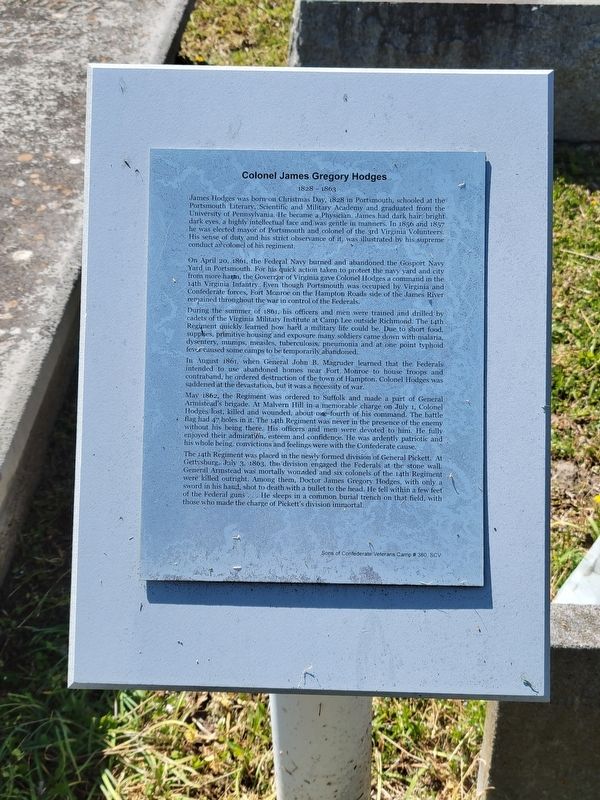
Photographed by C. Ryan Dodson, April 10, 2026
2. Colonel James Gregory Hodges Marker
Erected 2008 by Stonewall Camp # 380, SCV (Sons of Confederate Veterans).
Topics and series. This historical marker is listed in these topic lists: Cemeteries & Burial Sites • Patriots & Patriotism • Science & Medicine • War, US Civil. In addition, it is included in the Sons of Confederate Veterans/United Confederate Veterans series list. A significant historical year for this entry is 1863.
Location. 36° 50.299′ N, 76° 18.483′ W. Marker is in Portsmouth, Virginia. It is in Park View. It can be reached from the intersection of Fort Lane and Holladay Street, on the right when traveling north. The Marker is located in Cedar Grove Cemetery. Touch for map. Marker is at or near this postal address: 301 Fort Lane, Portsmouth VA 23704, United States of America. Touch for directions.

Regionally, this marker is in Virginia’s Hampton Roads, specifically in Coastal Virginia, and in the Hampton Roads Metropolitan Area. It is also in the American South, specifically in the Upper South, in the Tidewater, and on the Eastern Seaboard. Globally, it is in the North Atlantic Region, North America, the Western Hemisphere, the Western World, and the Anglosphere. Historically, it finds itself in what was once the territory of the Mississippian Culture, one of the original Thirteen Colonies, one of the Confederate States of America, and the Antebellum South.
Other nearby markers. At least 8 other markers are within walking distance of this marker: Portsmouth Rifles Monument (a few steps from this marker); Co. G, 9th Va. Infantry Monument (a few steps from this marker); John W. H. Porter (within shouting distance of this marker); Commodore James Wallace Cooke (within shouting distance of this marker); Thomas Williamson, M.D. (within shouting distance of this marker); Captain Arthur Emmerson (within shouting distance of this marker); Captain John Julius Guthrie (within shouting distance of this marker); John Luke Porter (within shouting distance of this marker). Touch for a list and map of all markers in Portsmouth.
Credits. This page was last revised on April 30, 2026. It was originally submitted on April 17, 2026, by C. Ryan Dodson of Danville, Virginia. This page has been viewed 15 times since then. Photos: 1, 2. submitted on April 17, 2026, by C. Ryan Dodson of Danville, Virginia. • Devry Becker Jones was the editor who published this page.
