Leonardtown in St. Mary's County, Maryland — The American Northeast (Mid-Atlantic)
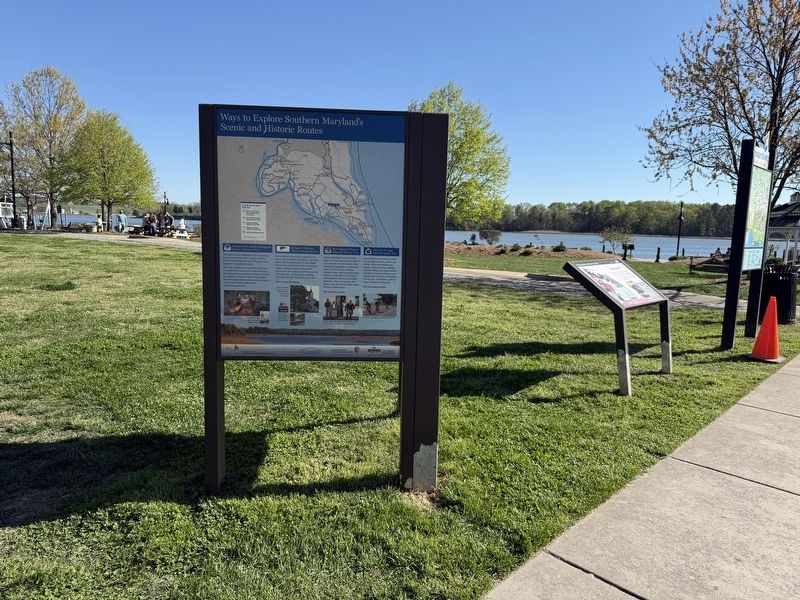
Ways to Explore Southern Maryland's Scenic and Historic Routes

Photographed by Devry Becker Jones (CC0), April 11, 2026
1. Ways to Explore Southern Maryland's Scenic and Historic Routes Marker
Captain John Smith Chesapeake National Historic Trail
This unique trail is designed for you to experience by boat. It is America’s first waterway national historic trail and includes more than 3,000 miles explored by Captain John Smith.
The route is marked at several sites on the water by special buoys that are part of the Chesapeake Bay Interpretive Buoy System (CBIBS). Accessible by cell phone or internet, these buoys transmit date that include historical information related to Captain John Smith’s explorations.
Visit www.nps.gov/cajo
Religious Freedom National Scenic Byway
Automobile is the best way to experience this byway. You can explore various sites—churches, homes, parks, and museums—to learn about the very first attempt in American to introduce religious toleration and the separation of church from state. If you would like to tour any of the churches, we recommend contacting their administrative offices before you visit.
Visit www.bit.ly/rfsbyway
Star-Spangled Banner National Historic Trail
Southern Maryland was an attractive target for British raids during the War of 1812. Along the trail
this page online
Visit www.nps.gov/stsp
Potomac Heritage National Scenic Trail
This evolving trail network is a portal into the region’s history, culture, and ecology. As the metropolitan area expands, hiking, bicycling, paddling, horseback riding, and related outdoor recreation activities provide you with opportunities for intimate connections with the river, its tributaries, and the region’s distinctive landscapes.
Visit www.nps.gov/pohe
Erected by Destination Southern Maryland; Town of Leonardtown, Maryland; National Park Service, U.S. Department of the Interior; Maryland Heritage Areas Authority.
Topics. This historical marker is listed in these topic lists: Colonial Era • Indigenous Peoples and Communities • War of 1812 • Waterways & Vessels. A significant historical year for this entry is 1812.
Location. 38° 17.186′ N, 76° 38.307′ W.
Photographed by Devry Becker Jones (CC0), April 11, 2026
2. Ways to Explore Southern Maryland's Scenic and Historic Routes Marker

Regionally, this marker is in Southern Maryland. It is also in the American South, specifically in the Upper South, in the Mid-Atlantic, in the Tidewater, in the Chesapeake Bay Region, and on the Eastern Seaboard. Globally, it is in the North Atlantic Region, North America, the Western Hemisphere, the Western World, and the Anglosphere. Historically, it finds itself in what was once one of the original Thirteen Colonies and also the Antebellum South.
Other nearby markers. At least 8 other markers are within walking distance of this marker: Discover Southern Maryland's Amazing Stories of Exploration, Hope, and Courage (here, next to this marker); Invasion! (a few steps from this marker); Waterfront Park in the Critical Area (within shouting distance of this marker); Origins of the Compass Rose (within shouting distance of this marker); Restoring Oysters in Breton Bay / Restauración de ostras en la Breton Bay (within shouting distance of this marker); Trade on the Waterfront (within shouting distance of this marker); Breton Bay (within shouting distance of this marker); Fun on the Waterfront (within shouting distance of this marker). Touch for a list and map of all markers in Leonardtown.
Credits. This page was last revised on April 17, 2026. It was originally submitted on April 17, 2026, by Devry Becker Jones of Washington, District of Columbia. This page has been viewed 29 times since then. Photos: 1, 2. submitted on April 17, 2026, by Devry Becker Jones of Washington, District of Columbia.
