Hollywood in St. Mary's County, Maryland — The American Northeast (Mid-Atlantic)
Food and Culinary Traditions at Sotterley

Photographed by Devry Becker Jones (CC0), April 11, 2026
1. Food and Culinary Traditions at Sotterley Marker
Food served at Sotterley was a melting pot of English, African, and Native American foodways, adapted to what was available at the start of the colonial period and evolving into a distinctly American cuisine as the years passed and food production increased and diversified.
The evolving American cuisine enjoyed by the owners, with roots in traditional English fare, was enlivened by the food customs of their African cooks. The cooks utilized foods which had been brought to the colonies on slave cargo ships -- okra, peanuts, black-eyed peas, sesame seeds – and which could be grown here, along with sweet potatoes, which replaced the African yam. Over time, these ingredients found their way onto many American table. James Bowles' estate inventory from 1727 showed that he had the means to enjoy fine dining at Sotterley's table. He owned ivory-handled knives and forks, damask table linens, crystal glasses and decanters, and could afford to import spices and wines. The dining experience of the plantation's enslaved community was nowhere near the owners' in terms of quantity or quality. Sotterley's slaves received food
this page online
When Herbert Satterlee assumed ownership of Sotterley in 1910, after the plantation had experienced years of neglect, one of his first decisions was to hire a farm manager. Under the direction of Charles Knott, Sotterley again became a fertile farm producing food crops plus hogs, turkeys, sheep, beef cattle and milk cows. Though Mr. Satterlee, a New Yorker, visited Sotterley only a few times a year, he looked forward to enjoying the food that was produced here, particularly the smoked hams that gained a favorable reputation locally.
[Captions:]
Very few people in the 17th and 18th century had all these utensils, which are common in our kitchens.
Do you know which one typically was owned only by the wealthy, including Sotterley's James Bowles?
,br> Owning one of these said that you enjoyed more complex dishes and fine dining.
Most people ate with spoons and fingers, using knives to cut meat and get it to the mouth. Bread was used for sopping up gravy. Two prong forks began to be used in America by 1700

Photographed by Devry Becker Jones (CC0), April 11, 2026
2. Food and Culinary Traditions at Sotterley Marker
Erected by Maryland Heritage Areas Authority.
Topics. This historical marker is listed in these topic lists: Agriculture • Anthropology & Archaeology • Colonial Era • Settlements & Settlers. A significant historical year for this entry is 1727.
Location. 38° 22.563′ N, 76° 32.517′ W. Marker is in Hollywood, Maryland, in St. Mary's County. It can be reached from Sotterley Lane north of Sotterley Wharf Road, on the right when traveling north. Touch for map. Marker is at or near this postal address: 44300 Sotterley Ln, Hollywood MD 20636, United States of America. Touch for directions.

Regionally, this marker is in Southern Maryland. It is also in the American South, specifically in the Upper South, in the Mid-Atlantic, in the Tidewater, in the Chesapeake Bay Region, and on the Eastern Seaboard. Globally, it is in the North Atlantic Region, North America, the Western Hemisphere, the Western World, and the Anglosphere. Historically, it finds itself in what was once one of the original Thirteen Colonies and also the Antebellum South.
Other nearby markers. At least 8 other markers are
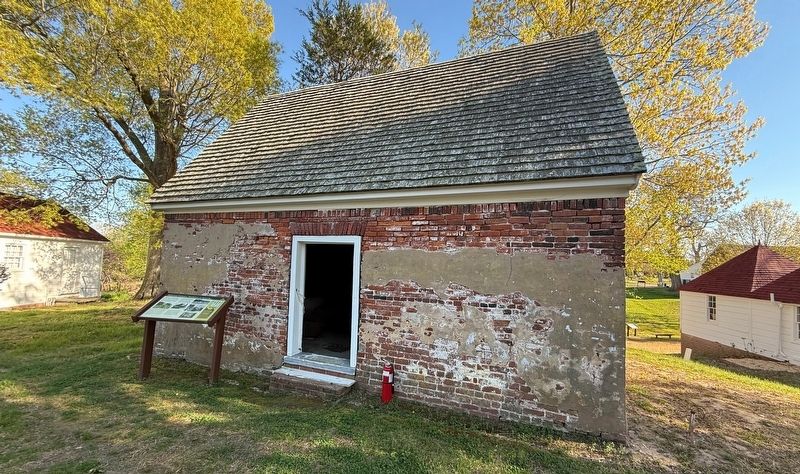
Photographed by Devry Becker Jones (CC0), April 11, 2026
3. Food and Culinary Traditions at Sotterley Marker
Credits. This page was last revised on April 19, 2026. It was originally submitted on April 19, 2026, by Devry Becker Jones of Washington, District of Columbia. This page has been viewed 15 times since then. Photos: 1, 2, 3. submitted on April 19, 2026, by Devry Becker Jones of Washington, District of Columbia.
