Montpelier Station in Orange County, Virginia — The American South (Mid-Atlantic)
Post-Emancipation: A Promise Unfulfilled
Photographed by Evan Dwyer, March 28, 2026
1. Post-Emancipation: A Promise Unfulfilled Marker
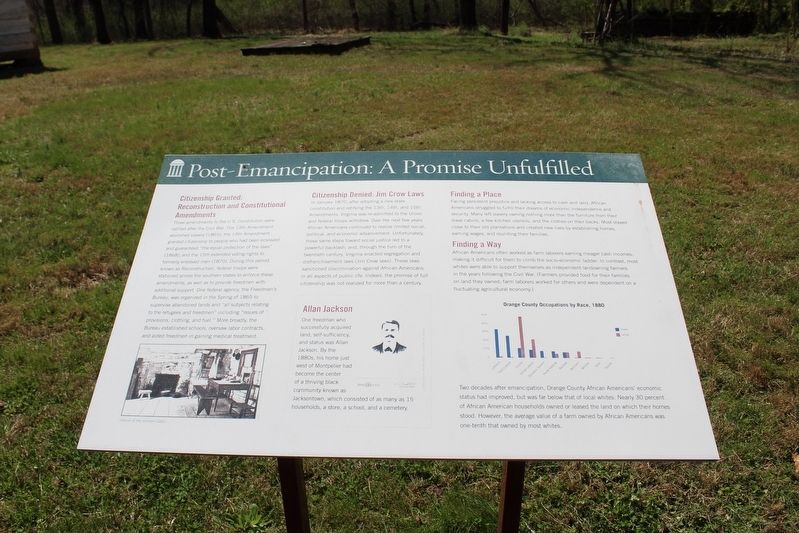
Citizenship Granted: Reconstruction and Constitutional Amendments
Three amendments to the U.S. Constitution were ratified after the Civil War. The 13th Amendment granted citizenship to people who had been enslaved and guaranteed "the equal protection of the laws" (1868); and the 15th extended voting rights to formerly enslaved men (1870). During this period, known as Reconstruction, federal troops were stationed across the southern states to enforce these amendments, as well as to provide freedmen with additional support. One federal agency, the Freedmen's Bureau, was organized in the Spring of 1865 to supervise abandoned lands and "all subjects relating to the refugees and freedmen" including "issues of provisions, clothing, and fuel." More broadly, the Bureau established schools, oversaw labor contracts, and aided freedmen in gaining medical treatment.
Citizenship Denied: Jim Crow Laws
In January 1870, after adopting a new state constitution and ratifying the 13th, 14th, and 15th Amendments. Virginia was re-admitted to the Union and federal troops withdrew Over the next few years African Americans continued to realize
this page online
Allan Jackson
One freedman who successfully acquired land, self-sufficiency, and status was Allan Jackson. By the 1880s, his home just west of Montpelier had become the center of a thriving black community known as Jacksontown, which consisted of as many as 15 households, a store, a school, and a cemetery.
Finding a Place
Facing persistent prejudice and lacking access to cash and land, African Americans struggled to fulfill their dreams of economic independence and security. Many left slavery owning nothing more than the furniture from their slave cabins, a few kitchen utensils, and the clothes on their backs. Most stayed close to their old plantations and created new lives by establishing homes, earning
Photographed by Evan Dwyer, March 28, 2026
2. Post-Emancipation: A Promise Unfulfilled Marker
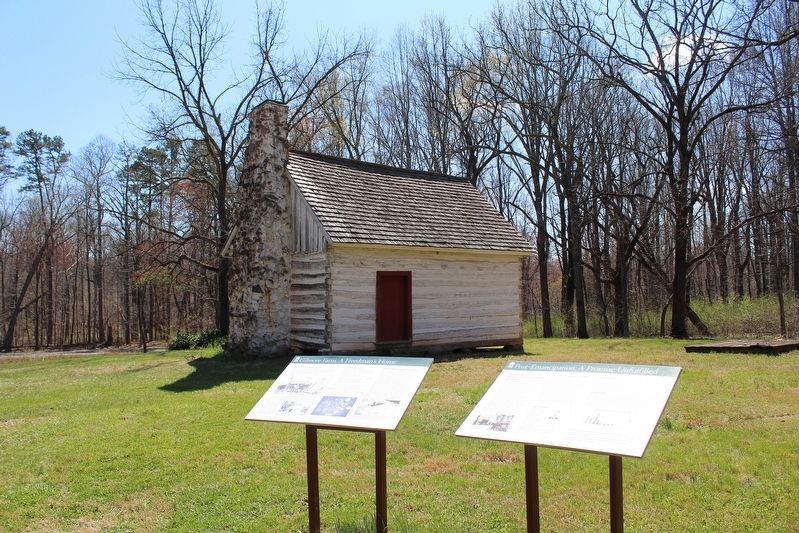
Marker is one of two at the Gilmore Cabin (beyond).
Finding a Way
African Americans often worked as farm laborers earning meager cash incomes, making it difficult for them to climb the socio-economic ladder. In contrast, most whites were able to support themselves as independent landowning farmers in the years following the Civil War. (Farmers provided food for their families on land they owned; farm laborers worked for others and were dependent on a fluctuating agricultural economy.)
Two decades after emancipation, Orange County African Americans' economic status had improved, but was far below that of local whites. Nearly 30 percent of African American households owned or leased the land on which their homes stood. However, the average value of a farm owned by African Americans was one-tenth that owned by most whites.
Erected by James Madison’s Montpelier.
Topics. This historical marker is listed in these topic lists: African Americans • Agriculture • Civil Rights • War, US Civil. A significant historical month for this entry is January 1870.
Location. 38° 13.599′ N, 78° 10.903′ W. Marker is in Montpelier Station, Virginia, in Orange County. It is on Constitution Highway (Virginia Route 20) 0.1 miles west of South Montpelier Road, on the left when traveling east. The marker stands along the Civil War & Gilmore Farm Trail, part of James Madison's Montpelier located southwest of the estate entrance. Touch for map. Marker is at or near this postal address: 11199 Constitution Highway, Orange VA 22960, United States of America. Touch for directions.

Regionally, this marker is in Northern Virginia and in the Piedmont. It is also in the American South and specifically in the Upper South. Globally, it is in North America, the Western Hemisphere, the Western World, and the Anglosphere. Historically, it finds itself in what was once the territory of the Mississippian Culture, one of the original Thirteen Colonies, one of the Confederate States of America, and the Antebellum South.
Other nearby markers. At least 8 other markers are within walking distance of this marker: Gilmore Farm: A Freedman's Home (here, next to this marker); a different marker also named Gilmore Farm (within shouting distance of this marker); Gilmore Family Cemetery (about 400 feet away, measured in a direct line); Dolley Madison (about 400 feet away); Confederate Encampment (about 700 feet away); a different marker also named Confederate Encampment (approx. ¼ mile away); Montpelier Train Station (approx. 0.3 miles away); Montpelier Flag Stop (approx. 0.3 miles away). Touch for a list and map of all markers in Montpelier Station.
Other markers no longer nearby. Gilmore Farm (was a few steps from this marker but has been replaced with another marker now near it); Post-Emancipation (was within shouting distance of this marker but has been replaced with another marker now near it); Civil War Encampment (was approx. ¼ mile away but has been replaced with another marker now near it).
Related marker. Click here for another marker that is related to this marker. It preceded this marker in a similar location, north on the trail.
Credits. This page was last revised on April 24, 2026. It was originally submitted on April 22, 2026, by Evan Dwyer of Richmond, Virginia. This page has been viewed 15 times since then. Photos: 1, 2. submitted on April 22, 2026, by Evan Dwyer of Richmond, Virginia. • Devry Becker Jones was the editor who published this page.
