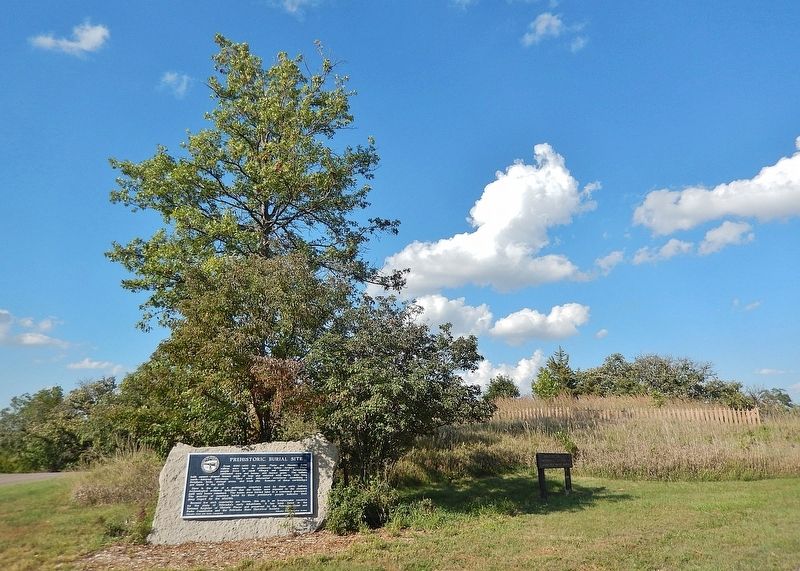
Prehistoric Burial Site

From 1050-1400 the lower Platte and Missouri River valleys were home to prehistoric Indian farmers. These people lived in small villages and isolated farmsteads, cultivated corn and beans, and hunted game. The Indians built square-shaped houses made of logs and covered with earth, with long, earth-covered entryways. They were substantial structures containing a fireplace, beds, storage areas, and trash pits. Remains of these earthlodges are found in the park.
Here is the site of a prehistoric cemetery used by these early Indians. Archeological evidence indicates that the bodies were exposed to the elements until only bones remained. The bones were buried later in a communal graveyard. The practice of cemetery burial by these prehistoric people indicates their deep regard for the afterlife.
Because few such cemeteries are known, this site is an irreplaceable resource for the study of Nebraska’s early inhabitants. It has been listed in the National Register of Historic Places and preserved by the Nebraska Game and Parks Commission and the Nebraska State Historical Society.
Erected by Nebraska Game and Parks Commission
this page online
Topics and series. This historical marker is listed in these topic lists: Anthropology & Archaeology • Architecture • Cemeteries & Burial Sites • Indigenous Peoples and Communities. In addition, it is included in the National Register of Historic Places (NRHP), and the Nebraska State Historical Society series lists. A significant historical year for this entry is 1050 CE.
Location. 41° 1.969′ N, 96° 18.804′ W. Marker is in Ashland, Nebraska, in Cass County. It can be reached from Eugene T. Mahoney State Park Road 1.4 miles north of State Highway 66. The marker and prehistoric cemetery site are near the observation tower at the north end of Eugene T. Mahoney State Park. Touch for map. Marker is at or near this postal address: 28500 West Park Highway, Ashland NE 68003, United States of America. Touch for directions.

Regionally, this marker is in Eastern Nebraska, in Greater Lincoln, and in Greater Omaha. It is also in the American Midwest, in the Lewis & Clark Corridor, in the Corn Belt, and on the prairies. Globally, it is in North America, the Western Hemisphere,
Other nearby markers. At least 8 other markers are within 4 miles of this marker, measured as the crow flies: Platte River (approx. 2.2 miles away); The Ox-Bow Trail (approx. 2.3 miles away); In Honor Of John McBride Belnap (approx. 2.6 miles away); The Mormon Pioneer Trail (approx. 2.8 miles away); Welcome to the Canyon Ponds (approx. 3½ miles away); Gretna Fish Hatchery (approx. 3½ miles away); Native Americans in the Lower Platte Valley (approx. 4.1 miles away); Melia (approx. 4.1 miles away). Touch for a list and map of all markers in Ashland.
Regarding Prehistoric Burial Site. National Register of Historic Places № 75001090.
Also see . . . Prehistoric Burial Site (Nebraska State Historical Society).
Excerpt: When the communal Indigenous burial site was discovered during construction of an access road in Eugene T. Mahoney State Park, the NSHS State Archeological Office (SAO), Nebraska Games and Parks Commission, and the Nebraska Department of Transportation worked together by state and federal(Submitted on November 11, 2025, by Cosmos Mariner of Cape Canaveral, Florida.)laws which govern how such circumstances are handled.Photographed by Cosmos Mariner, September 15, 20253. Prehistoric Burial Site SignPrehistoric burial site preservation a gift from the Ladonna Irene Mahoney Memorial.Prior to the late twentieth century, human remains were often removed from their burial places for research purposes and as a result of development. The recovered remains were then stored in public and private collections across the country. By the 1970s, Native American groups began to express their indignation for such practices and resentment for the storage of their ancestors’ remains in museum warehouses.
By the early 1990s, a series of state and federal laws (NAGPRA and the Unmarked Human Burial Sites and Skeletal Remains Protection Act) were enacted with the intent to protect burial sites and repatriate human remains and associated funerary objects to descendent groups when encountered. At the time, the SAO held hundreds of individuals’ remains in its collections as a result of donations, inadvertent discoveries, and research. These laws directed the office to determine as specifically as possible who the remains were related to and to work with descendant groups on repatriation. The same laws continue to guide SAO’s response to unmarked burials and human remains today.Between
1990 and 2017, the SAO repatriated the remains of nearly 700 individuals and over 30,000 artifacts from about 80 sites across Nebraska. These remains have been returned largely to the Pawnee Nation of Oklahoma with additional remains repatriated to the Northern Ponca, Ioway, Oto-Missouria, Omaha, Wichita, Arikara, and Northern Cheyenne tribes.Photographed by Cosmos Mariner, September 15, 20254. Prehistoric Burial Site


Credits. This page was last revised on April 23, 2026. It was originally submitted on November 11, 2025, by Cosmos Mariner of Cape Canaveral, Florida. This page has been viewed 160 times since then and 100 times this year. Last updated on April 23, 2026, by Valerie Barbie of Bismarck, North Dakota. Photos: 1, 2, 3, 4. submitted on November 11, 2025, by Cosmos Mariner of Cape Canaveral, Florida. • Devry Becker Jones was the editor who published this page.
