Lowell in Middlesex County, Massachusetts — The American Northeast (New England)
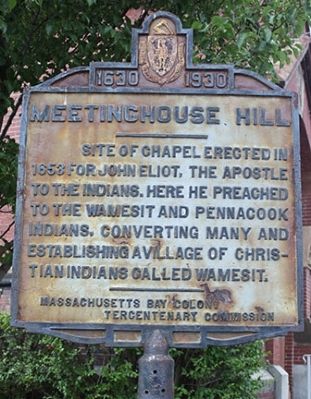
Meetinghouse Hill
1630 - 1930
| — | American Presbyterian and Reformed Historical Site | — |
Photographed by Russell C. Bixby, August 5, 2011
1. Meetinghouse Hill Marker
Site of chapel erected in 1653 for John Eliot, the Apostle to the Indians. Here he preached to the Wamesit and Pennacook Indians, converting many and establishing a village of Christian Indians called Wamesit.
Erected 1930 by Massachusetts Bay Colony-Tercentenary Commission. (Marker Number 119.)
Topics and series. This historical marker is listed in these topic lists: Colonial Era • Indigenous Peoples and Communities • Religion & Religious Structures. In addition, it is included in the American Presbyterian and Reformed Historic Sites, and the Massachusetts Bay Colony—Tercentenary Commission Markers series lists. A significant historical year for this entry is 1653.
Location. 42° 38.329′ N, 71° 18.802′ W. Marker is in Lowell, Massachusetts, in Middlesex County. It is at the intersection of Summer Street and Favor Street, on the right when traveling west on Summer Street. Touch for map. Marker is in this post office area: Lowell MA 01852, United States of America. Touch for directions.

Regionally, this marker is in Greater Boston and in the Merrimack Valley. It is also in the American Northeast,
this page online
Other nearby markers. At least 8 other markers are within walking distance of this marker: Lowell Manufacturing Company (approx. 0.3 miles away); Welcome to Lowell National Historical Park (approx. 0.4 miles away); Central Street (approx. 0.4 miles away); Homage to Women (approx. 0.4 miles away); J.C. Ayer & Company Laboratory (approx. 0.4 miles away); The Worker (approx. 0.4 miles away); W.A. Mack Building (approx. 0.4 miles away); Human Construction (approx. 0.4 miles away). Touch for a list and map of all markers in Lowell.
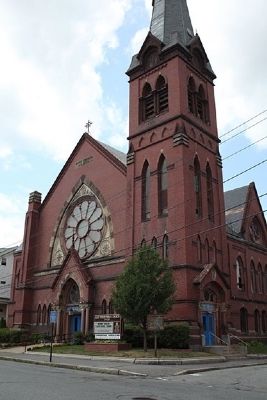
Regarding Meetinghouse Hill. Eliot Presbyterian Church (near the site of Meetinghouse Hill) is one of 445 American Presbyterian and Reformed Historical Sites registered between 1973 and 2003 by the Presbyterian Historical Society (PHS), headquartered in Philadelphia. Approved sites received a metal plaque featuring John Calvin’s seal and the site’s
Photographed by Russell C. Bixby, August 5, 2011
2. Eliot Presbyterian Church
The following text is taken from the Presbyterian Historical Society website:
Eliot Presbyterian Church, formed by the union of First Presbyterian Church and Eliot Union Congregational Church in 1955, is located on or near the site where Rev. John Eliot (1604-1690), Apostle to the Indians, preached to the Wamesit and Pawtucket (or Penacook) Indians in a log chapel. Eliot translated Scriptures into the Indian tongue and made many converts among the Pawtuckets. The present church, of French Gothic design, was built in 1874.
Related markers. Click here for a list of markers that are related to this marker. To better understand the relationship, study each marker in the order shown.
Also see . . .
1. Historical Markers Erected by Massachusetts Bay Colony Tercentenary Commission (1930). Original 1930 publication by the Commonwealth of Massachusetts of Tercentenary Commission Markers, commemorating the three hundredth anniversary of the Massachusetts Bay Colony. (Submitted on August 6, 2011, by Russell Chaffee Bixby of Bernardston, Massachusetts.)
2. History of Chelmsford. History of Chelmsford including 1653-1656 plans showing borders and areas reserved for Indians closeby to the meeting house. (Submitted on April 24, 2026, by G.W.Bartlett of Hingham, Massachusetts.)
3. Native Northeast Portal: Wamesit, John Alyne. John Alyne was a leader of the Wamesit as early as 1675 as part of an order allowing the Wamesit to collect their harvest during King Philip's War. His name later appears on a deed in as part of Wanalancet's Council in 1714. (Submitted on April 24, 2026, by G.W.Bartlett of Hingham, Massachusetts.)
4. The "Sale" of Wamesit.
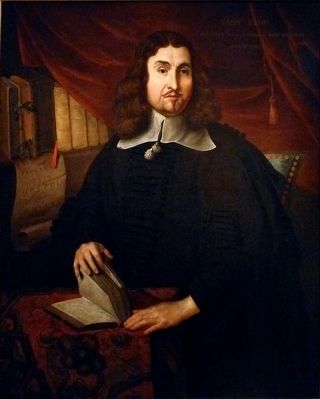
The end of King Philip’s War did not bring an end to the ill-feelings of the English towards(Submitted on April 24, 2026, by G.W.Bartlett of Hingham, Massachusetts.)the Native Americans. On May 24, 1677, the General Court decreed that all Native Americans living in Massachusetts must remain within the bounds of their assigned towns, like Wamesit, where they could be continuously inspected, provide a list of all who resided there, and obtain a permit [from the English] prior to hunting beyond the bounds of the town.Photographed by Allen C. Browne, August 9, 20153. John EliotThis portrait by of John Eliot an unknown artist hangs in the National Portrait Gallery in Washington, DC.
“No Puritan leader in seventeenth-century New England was more interested in the welfare of the region's Native American population than John Eliot. A graduate of Cambridge University, Eliot immigrated to Boston in 1631. While serving as the pastor of a church in Roxbury, Eliot began to search for ways to perform missionary work among the region's tribal communities. He studied the local Algonquian language, and by 1646 he was preaching to the native inhabitants in their own language.
In order to protect his potential Christian converts, he established the first of fourteen towns for so called ‘praying Indians’ in 1651. Perhaps his most extraordinary accomplishment, though, was the translation of the Bible into an Algonquian dialect a task that required Eliot to invent new words and new grammatical structures. Its publication in 1661 marked the first printing of a Bible in America.” — National Portrait Gallery

Photographed by G.W.Bartlett
4. Chelmsford Plan and Indian Land 1656
Map shows initial plans for Chelmsford including areas reserved for Native Americans, identified as Indian Land. For more details see the "History of Chelmsford" link in the "Also See" section.
Credits. This page was last revised on July 7, 2026. It was originally submitted on August 6, 2011, by Russell Chaffee Bixby of Bernardston, Massachusetts. This page has been viewed 1,140 times since then and 49 times this year. Last updated on April 24, 2026, by G.W.Bartlett of Hingham, Massachusetts. Photos: 1, 2. submitted on August 6, 2011, by Russell Chaffee Bixby of Bernardston, Massachusetts. 3. submitted on October 24, 2015, by Allen C. Browne of Silver Spring, Maryland. 4. submitted on April 24, 2026, by G.W.Bartlett of Hingham, Massachusetts. • Devry Becker Jones was the editor who published this page.
