Staunton, Virginia — The American South (Mid-Atlantic)
West Africa, 1700s
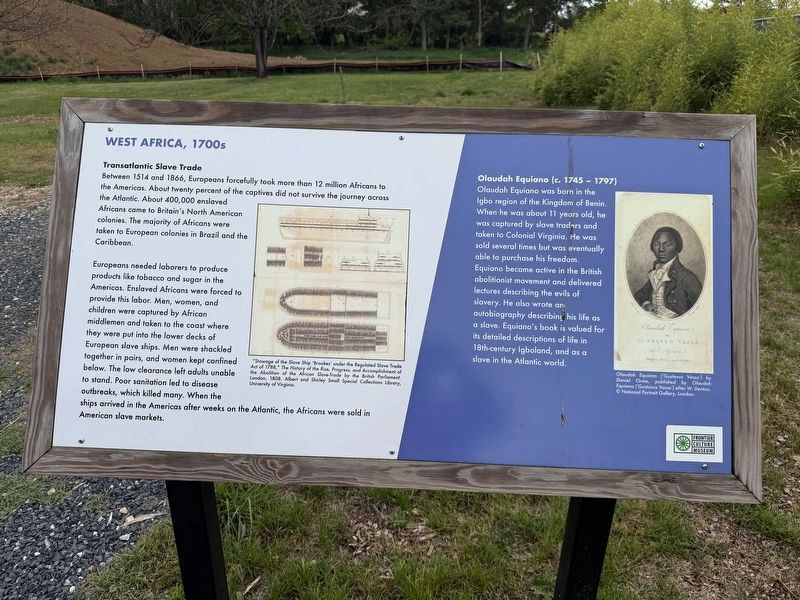
Transatlantic Slave Trade
Between 1514 and 1866, Europeans forcefully took more than 12 million Africans to the Americas. About twenty percent of the captives did not survive the journey across the Atlantic. About 400,000 enslaved Africans came to Britain's North American colonies. The majority of Africans were taken to European colonies in Brazil and the Caribbean.
Europeans needed laborers to produce products like tobacco and sugar in the Americas. Enslaved Africans were forced to provide this labor. Men, women, and children were captured by African middlemen and taken to the coast where they were put into the lower decks of European slave ships. Men were shackled together in pairs, and women kept confined below. The low clearance left adults unable to stand. Poor sanitation led to disease outbreaks, which killed many. When the ships arrived in the Americas after weeks on the Atlantic, the Africans were sold in American slave markets.
Oulaudah Equiano (c. 1745 - 1797)
Oulaudah Equiano was born in the Igbo region of the Kingdom of Benin. When he was about 11 years old, he was captured by slave traders and taken
this page online
Erected by Frontier Culture Museum.
Topics. This historical marker is listed in these topic lists: Abolition & Underground RR • Colonial Era • Industry & Commerce • Waterways & Vessels. A significant historical year for this entry is 1514.
Location. 38° 7.466′ N, 79° 3.108′ W. Marker is in Staunton, Virginia. It can be reached from Frontier Drive north of Barterbrook Road, on the right when traveling north. Touch for map. Marker is at or near this postal address: 1290 Richmond Rd, Staunton VA 24401, United States of America. Touch for directions.

Regionally, this marker is in Virginia’s Shenandoah Valley. It is also in the American South and specifically in the Upper South. Globally, it is in North America,
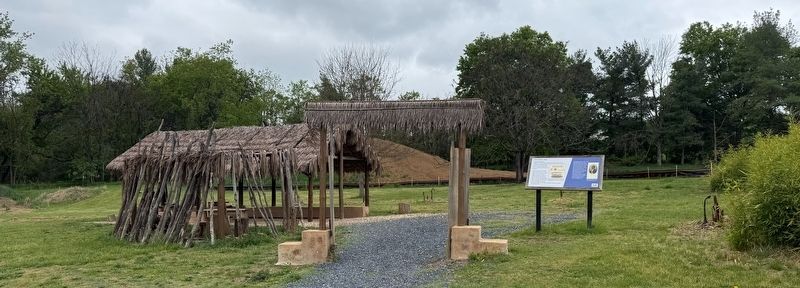
Other nearby markers. At least 8 other markers are within walking distance of this marker: A different marker also named West Africa, 1700s (a few steps from this marker); England, 1650s (about 300 feet away, measured in a direct line); The Great Road (about 400 feet away); Welcome to the Frontier Culture Museum (about 500 feet away); Frontier Culture Museum (about 500 feet away); Great Indian Warrior Trading Path (about 600 feet away); Ireland, 1750s (about 600 feet away); a different marker also named Ireland, 1750s (about 700 feet away). Touch for a list and map of all markers in Staunton.
Additional keywords. human trafficking; Transatlantic slave trade
Credits. This page was last revised on May 1, 2026. It was originally submitted on May 1, 2026, by Devry Becker Jones of Washington, District of Columbia. This page has been viewed 14 times since then. Photos: 1, 2. submitted on May 1, 2026, by Devry Becker Jones of Washington, District of Columbia.
