Staunton, Virginia — The American South (Mid-Atlantic)
Valley of Virginia, 1820s
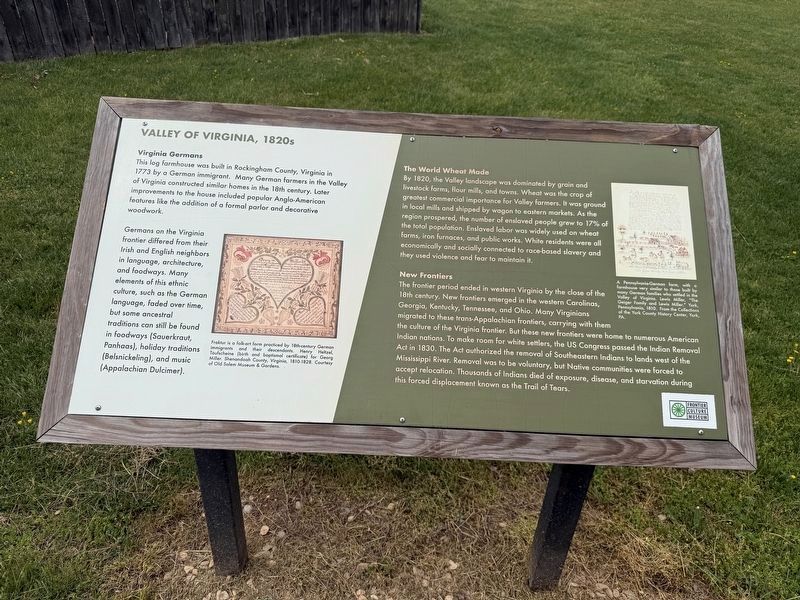
Virginia Germans
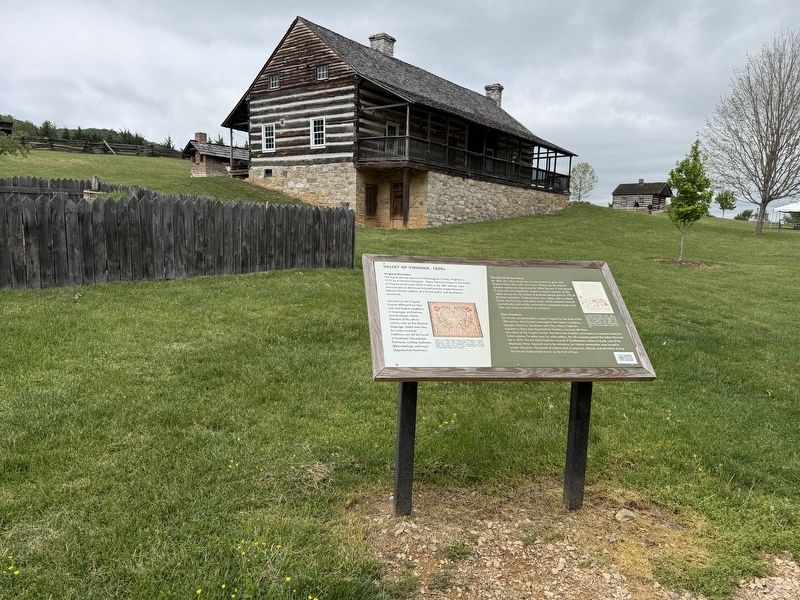
This log farmhouse was built in Rockingham County, Virginia in 1773 by a German immigrant. Many German farmers in the Valley of Virginia constructed similar homes in the 18th century. Later improvements to the house included popular Anglo-American features like the addition of a formal parlor and decorative woodwork.
Germans on the Virginia frontier differed from their Irish and English neighbors in language, architecture, and foodways. Many elements of this ethnic culture, such as the German language, faded over time, but some ancestral traditions can still be found in foodways (Sauerkraut, Panhaas), holiday traditions (Belsnickeling), and music (Appalachian Dulcimer).
The World Wheat Made
By 1820, the Valley landscape was dominated by grain and livestock farms, flour mills, and towns. Wheat was the crop of greatest commercial importance for Valley farmers. It was ground in local mills and shipped by wagon to eastern markets. As the region prospered, the number of enslaved people grew to 17% of the total population. Enslaved labor was widely used on wheat farms, iron furnaces, and public works.
this page online
New Frontiers
The frontier period ended in western Virginia by the close of the 18th century. New frontier emerged in the western Carolinas, Georgia, Kentucky, Tennessee, and Ohio. Many Virginians migrated to these trans-Appalachian frontiers, carrying with them the culture of the Virginia frontier. But these new frontiers were home to numerous American Indian nations. To make room for white settlers, the US Congress passed the Indian Removal Act in 1830. The Act authorized the removal of Southeastern Indians to lands west of the Mississippi River. Removal was to be voluntary, but Native communities were forced to accept relocation. Thousands of Indians died of exposure, disease, and starvation during this forced displaced known as the Trail of Tears.
[Captions:]
Fraktur is a folk-art form practiced by 18th-century German immigrants and their descendants. Henry Heltzel, Taufscheine (birth and baptismal certificate) foer Georg Miller. Shenandoah County, Virginia, 1810-1828. Courtesy of Old Salem Museum & Gardens.
A Pennsylvania-German farm, with a farmhouse very similar to those built by many German families who settled in the Valley of Virginia. Lewis Miller, "The Geiger Family and Lewis Miller." York, Pennsylvania, 1810. From the Collections of the York County History Center, York, PA.
Erected by Frontier
Topics. This historical marker is listed in these topic lists: Agriculture • Immigration • Indigenous Peoples and Communities • Settlements & Settlers. A significant historical year for this entry is 1773.
Location. 38° 7.604′ N, 79° 2.697′ W. Marker is in Staunton, Virginia. It can be reached from Frontier Drive north of Barterbrook Road, on the right when traveling north. Touch for map. Marker is at or near this postal address: 1274 Richmond Rd, Staunton VA 24401, United States of America. Touch for directions.

Regionally, this marker is in the Shenandoah Valley. It is also in the American South and specifically in the Upper South. Globally, it is in North America, the Western Hemisphere, the Western World, and the Anglosphere. Historically, it finds itself in what was once the territory of the Mississippian Culture, one of the original Thirteen Colonies, one of the Confederate States of America, and the Antebellum South.
Other nearby markers. At least 8 other markers are within walking distance of this marker: Shenandoah Valley, 1820s (here, next to this marker); a different marker also named Shenandoah Valley, 1820s (a few steps from this marker); Garden (a few steps from this marker); Bake Oven (within shouting distance of this marker); Main House (within shouting distance of this marker); Springhouse (within shouting distance of this marker); Valley of Virginia, 1850s (within shouting distance of this marker); Schoolhouse, 1840s (within shouting distance of this marker). Touch for a list and map of all markers in Staunton.
Credits. This page was last revised on May 1, 2026. It was originally submitted on May 1, 2026, by Devry Becker Jones of Washington, District of Columbia. This page has been viewed 14 times since then. Photos: 1, 2. submitted on May 1, 2026, by Devry Becker Jones of Washington, District of Columbia.
