Michigan City in LaPorte County, Indiana — The American Midwest (Great Lakes)
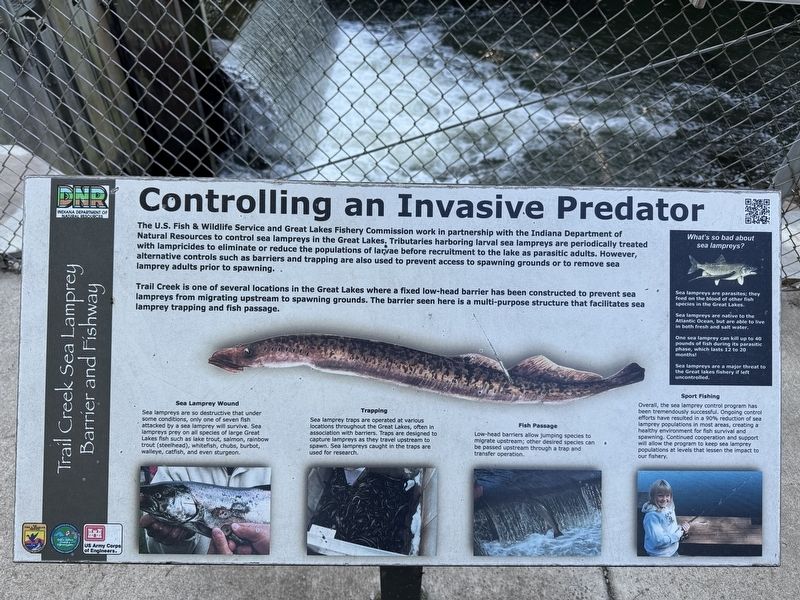
Controlling an Invasive Predator
Trail Creek Sea Lamprey Barrier and Fishway
Photographed by Lou Donkle, September 18, 2025
1. Controlling an Invasive Predator Marker
The U.S. Fish & Wildlife Service and Great Lakes Fishery Commission work in partnership with the Indiana Department of Natural Resources to control sea lampreys in the Great Lakes. Tributaries harboring larval sea lampreys are periodically treated with lampricides to eliminate or reduce the populations of larvae before recruitment to the lake as parasitic adults. However, alternative controls such as barriers and trapping are also used to prevent access to spawning grounds or to remove sea lamprey adults prior to spawning.
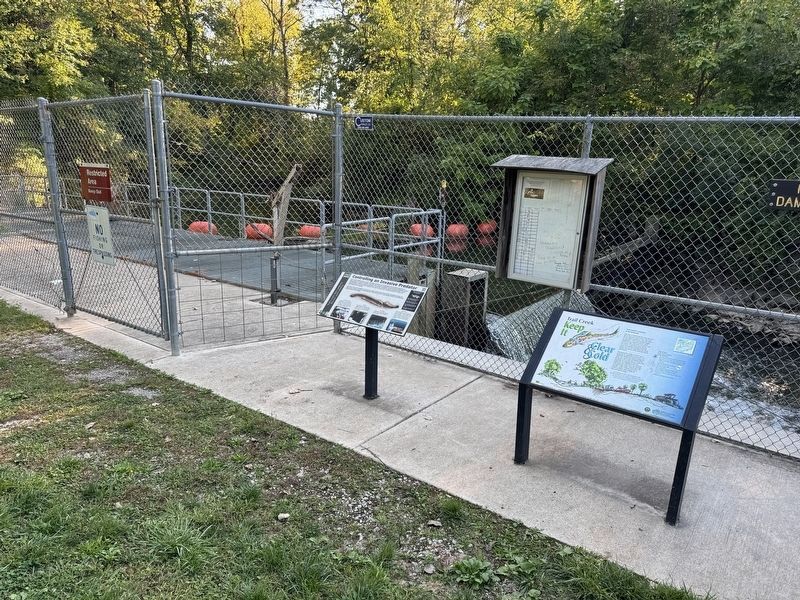
Trail Creek is one of several locations in the Great Lakes where a fixed low-head barrier has been constructed to prevent sea lampreys from migrating upstream to spawning grounds. The barrier seen here is a multi-purpose structure that facilitates sea lamprey trapping and fish passage.
[Captions:]
What's so bad about sea lampreys?
- Sea lampreys are parasites; they feed on the blood of other fish species in the Great Lakes.
- Sea lampreys are native to the Atlantic Ocean, but are able to live in both fresh and salt water.
- One sea lamprey can kill up to 40 pounds of fish during its parasitic phase, which lasts 12 to 20 months.
- Sea lampreys are a major threat to the Great lakes fishery if left uncontrolled.
Sea Lamprey Wound
Sea lampreys are so destructive that under some conditions, only one of seven fish attacked by a sea lamprey will survive. Sea lampreys prey on all species of large Great Lakes fish such as lake trout, salmon, rainbow trout (steelhead), whitefish, chubs, burbot, walleye, catfish, and even sturgeon.
Trapping
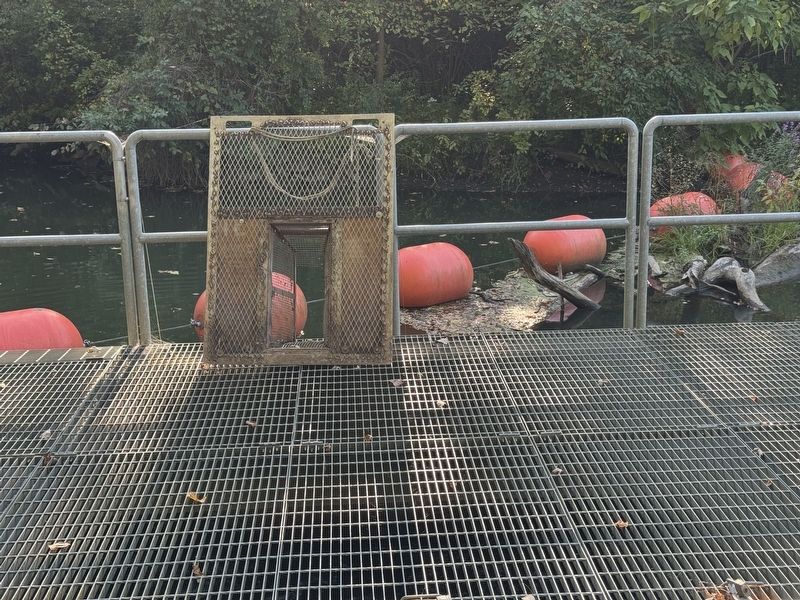
Sea lamprey traps are operated at various locations throughout the Great Lakes, often in association with barriers. Traps are designed to capture lampreys as they travel upstream to spawn. Sea lampreys caught in the traps are used for research.
Fish Passage
Low-head barriers allow jumping species to migrate upstream; other desired species can be passed upstream through a trap and transfer operation.
Sport Fishing
Overall, the sea lamprey control program has been tremendously successful. Ongoing control efforts have resulted in a 90% reduction of sea lamprey populations in most areas, creating a healthy environment for fish survival and spawning. Continued cooperation and support will allow the program to keep sea lamprey populations at levels that lessen the impact to our fishery.
Erected by Indiana
this page online
Topics. This historical marker is listed in these topic lists: Animals • Environment • Parks & Recreational Areas • Waterways & Vessels.
Location. 41° 42.991′ N, 86° 51.575′ W. Marker is in Michigan City, Indiana, in LaPorte County. It can be reached from Springland Avenue west of South Karwick Road, on the left when traveling west. The marker stands east of the bridge over Trail Creek. Park on the shoulder and follow trail south to the marker. Touch for map. Marker is at or near this postal address: 1919 Springland Ave, Michigan City IN 46360, United States of America. Touch for directions.

Regionally, this marker is in Northwest Indiana, specifically on the Indiana Dunes and Lake Michigan Shore, and in Greater South Bend. It is also in the American Midwest and in the Corn Belt. Globally, it is in North America, on the Great Lakes, in the Western Hemisphere, in the Western World, and in the Anglosphere.
Photographed by Lou Donkle, September 18, 2025
2. Marker located at fish dam and trap
Other nearby markers. At least 8 other markers are within 2 miles of this marker, measured as the crow flies: Battle of Trail Creek (approx. ¾ mile away); Camp Anderson (approx. ¾ mile away); Michigan City Civil War Memorial (approx. 1.4 miles away); Saint Stanislaus Cemetery World War II Memorial (approx. 1½ miles away); Michigan City World War II Memorial (approx. 1.6 miles away); P.F.C. Kenneth L. Scott Memorial (approx. 1.7 miles away); Elston Grove Historic District (approx. 1.9 miles away); Naomi Anderson (approx. 2 miles away). Touch for a list and map of all markers in Michigan City.
Photographed by Lou Donkle, September 18, 2025
3. "V" shaped fish trap removed from service in off-season
Credits. This page was last revised on May 5, 2026. It was originally submitted on May 4, 2026, by Lou Donkle of Valparaiso, Indiana. This page has been viewed 32 times since then. Photos: 1, 2, 3. submitted on May 4, 2026, by Lou Donkle of Valparaiso, Indiana. • Devry Becker Jones was the editor who published this page.
