Melbourne, Victoria, Australia — Oceania
Taming the river
| — | Royal Botanic Gardens - Melbourne | — |
Photographed by Dean Barton-Ancliffe, April 14, 2026
1. Taming the river Marker
Taming the river
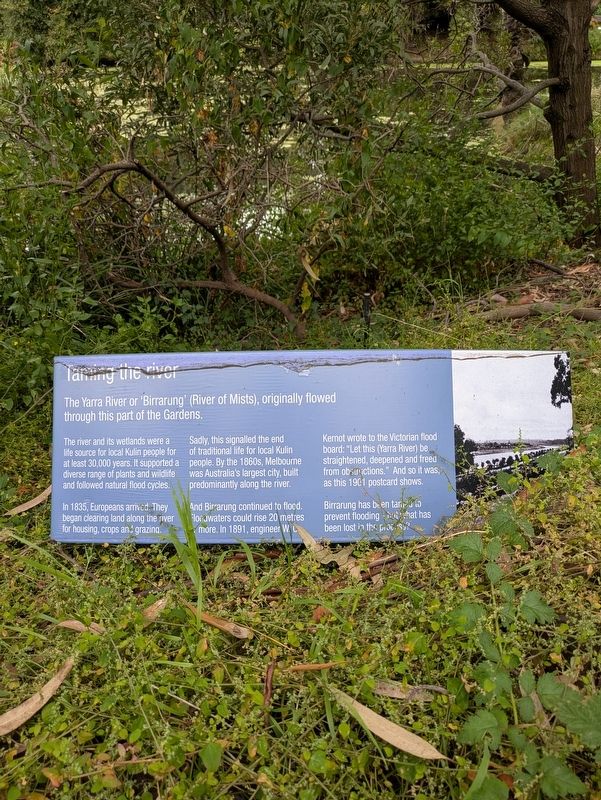
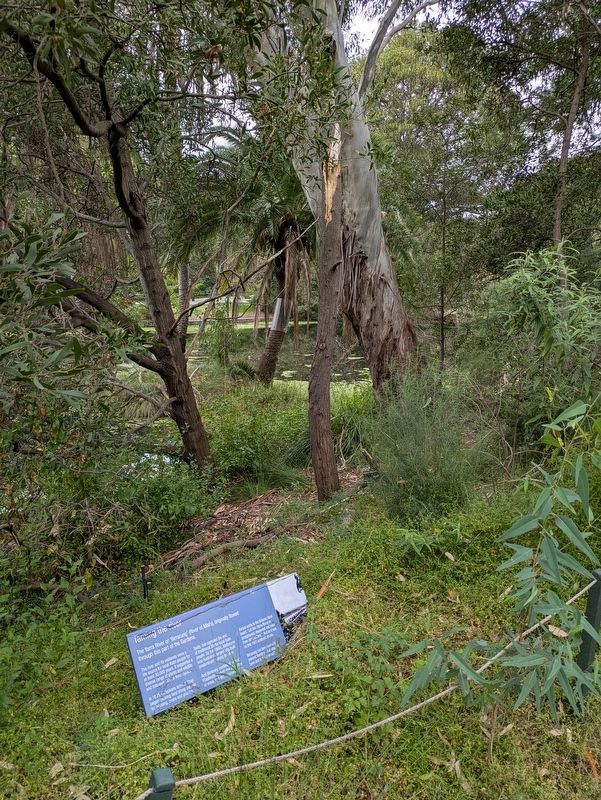
The Yarra River or 'Birrarung' (River of Mists), originally flowed through this part of the Gardens.
The river and its wetlands were a life source for local Kulin people for at least 30,000 years. It supported a diverse range of plants and wildlife and followed natural flood cycles.
In 1835, Europeans arrived. They began clearing land along the river for housing, crops and grazing.
Sadly, this signalled the end of traditional life for local Kulin people. By the 1860s, Melbourne was Australia's largest city, built predominantly along the river.
And Birrarung continued to flood. Floodwaters could rise 20 metres or more. In 1891, engineer W.C. Kernot wrote to the Victorian flood board: "Let this (Yarra River) be straightened, deepened and freed from obstructions." And so it was, as this 1901 postcard shows.
Birrarung has been tamed prevent flooding - but what has been lost in the process?
Topics. This historical marker is listed in these topic lists: Environment • Indigenous Peoples and Communities • Settlements & Settlers • Waterways & Vessels. A significant historical year for this entry is 1835.
Location. 37° 49.68′ S,
this page online

Regionally, it is in Oceania, in Australasia, in the Pacific Ocean, in South Pacific, on the Pacific Rim, in the Western World, and in the Anglosphere. Historically, it finds itself in what was once a British colony.
Other nearby markers. At least 8 other markers are within walking distance of this marker: Victoria's Native Orchids (a few steps from this marker); Victoria's Grassy Woodland (a few steps from this marker); Earth, mother (within shouting distance of this marker); Murong or Yam Daisy (within shouting distance of this marker); Botanic Gardens Curators or Directors (about 90 meters away, measured in a direct line); Director's Residence Royal Botanic Gardens (approx. 0.3 kilometers away); Baron Ferdinand von Mueller K.C.M.G (approx. 0.4 kilometers away); Unwelcome Strangers (approx. 0.4 kilometers away). Touch for a list and map of all
Photographed by Dean Barton-Ancliffe, April 14, 2026
2. Taming the river Marker in the Gardens
Also see . . .
1. Yarra River. Melbourne Water
Mention the Yarra River and you might think of the last few kilometres that cut through the city – but it’s so much more. This iconic river flows 242 kilometres from its source on Mt Baw Baw in the Yarra Ranges National Park, north-east of Melbourne, all the way to Port Phillip Bay.(Submitted on May 5, 2026, by Dean Barton-Ancliffe of Rowville, Victoria.)
There’s plenty of the Yarra to explore beyond the city.
Melbourne’s most valuable natural asset is home to a range of beautiful indigenous plants, animals, birds and fish, and is vital to our social and economic wellbeing:
- as the source of 70 per cent of Melbourne’s drinking water
- in supporting productive agriculture
- providing recreational opportunities like rowing, fishing, bird watching, picnicking and walking.
2. William Charles Kernot (1845–1909). Australian Dictionary of Biograpghy
Kernot was probably best known as what a later generation would call a 'stirrer'; indeed, his character and influence cannot be assessed without examining the stiff sense of professional dignity and ethics which led him into many disputes. His early humiliations in the public service made him a relentless scourge of bureaucratic incompetence and nourished a sense of self-righteousness in his many campaigns for safety, economy and the application of scientific principles in public works. He sternly lectured, in forthright categories, government and municipal engineers when he found faults in their designs, especially when these menaced public safety, and referred to the 'ordinary ignorant empiric who calls himself an engineer'. In the late 1880s he launched a long but successful campaign to have the railways admit the weaknesses in the important Moorabool viaduct near Geelong, and he had a lifelong interest in flood control on the Yarra and Barwon Rivers. Among many other battles he dedicated himself to a lengthy campaign against the anti-academic bias of the prestigious Institution of Civil Engineers in Britain, and to a similar fight against the scientific and anti-theoretical approaches of government departments in appointing and promoting engineers and surveyors.(Submitted on May 5, 2026, by Dean Barton-Ancliffe of Rowville, Victoria.)
Credits. This page was last revised on May 6, 2026. It was originally submitted on May 5, 2026, by Dean Barton-Ancliffe of Rowville, Victoria. This page has been viewed 14 times since then. Photos: 1, 2. submitted on May 5, 2026, by Dean Barton-Ancliffe of Rowville, Victoria. • Andrew Ruppenstein was the editor who published this page.
