Carrabelle in Franklin County, Florida — The American South (South Atlantic)
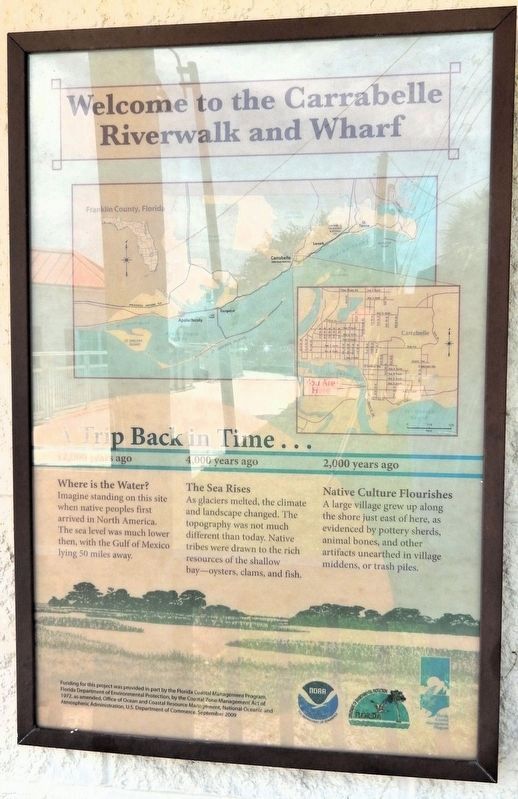
Welcome to the Carrabelle Riverwalk and Wharf
| — | History Timeline | — |
Photographed by Cosmos Mariner, June 16, 2025
1. Welcome to the Carrabelle Riverwalk and Wharf Marker
A Trip Back in Time…
12,000 Years Ago
Where is the Water?
Imagine standing on this site when native peoples first arrived in North America. The sea level was much lower then, with the Gulf of Mexico lying 50 miles away.
4,000 Years Ago
The Sea Rises
As glaciers melted, the climate and landscape changed. The topography was not much different than today. Native tribes were drawn to the rich resources of the shallow bay — oysters, clams, and fish.
2,000 Years Ago
Native Culture Flourishes
A large village grew up along the shore just east of here, as evidenced by pottery sherds, animal bones, and other artifacts unearthed in village middens, or trash piles.
Funding for this project was provided in part by the Florida Coastal Management Program, Florida Department of Environmental Protection, by the Coastal Zone Management Act of 1972, as amended, Office of Ocean and Coastal Resource Management, National Oceanic and Atmospheric Administration, U.S. Department of Commerce. September 2009
Erected 2009 by Florida Coastal Management Program, Florida Department of Environmental Protection, and National Oceanic and Atmospheric Administration.
Topics. This historical marker is listed in these topic lists: Anthropology & Archaeology • Indigenous Peoples and Communities • Waterways & Vessels.
Location. 29° 50.834′ N, 84° 39.843′ W. Marker is in Carrabelle, Florida, in Franklin County. It is at the intersection of Marine Street and Avenue F South, on the right when traveling south on Marine Street. The marker is mounted on the south side of the Carrabelle Riverwalk & Wharf public restroom building. Touch for map. Marker is in this post office area: Carrabelle FL 32322, United States of America. Touch for directions.

Regionally, this marker is on the Florida Panhandle.
this page online
Other nearby markers. At least 8 other markers are within walking distance of this marker: The Land and Sea Provide (here, next to this marker); A Bustling Seaport (here, next to this marker); A Coastal Gem (here, next to this marker); From Boom to Bust... and Back Again! (here, next to this marker); From Sails to Rails (here, next to this marker); Carrabelle Historic City Hall (approx. 0.2 miles away); Georgia Florida & Alabama Railroad (approx. ¼ mile away); The Legend of Tate's Hell (approx. ¼ mile away). Touch for a list and map of all markers in Carrabelle.
Related markers. Click here for a list of markers that are related to this marker. Carrabelle Riverwalk & Wharf — History Timeline
Also see . . . Peopling of the Americas (Wikipedia).
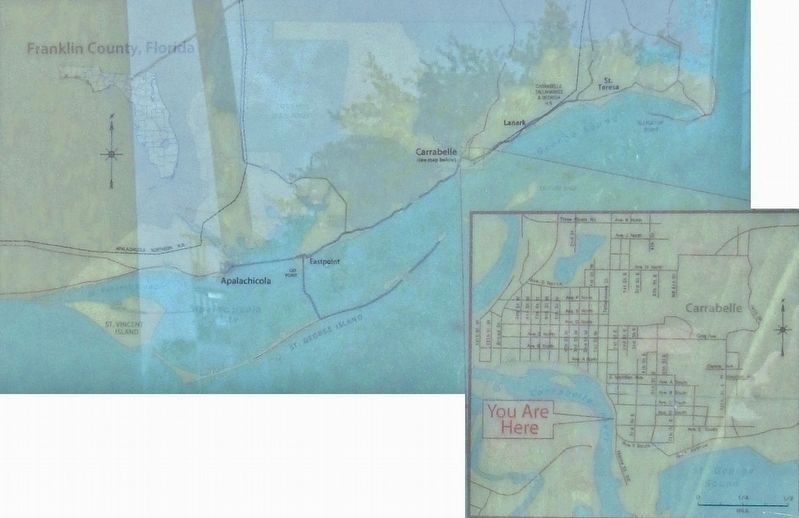
2. Marker detail: Carrabelle Area Map
Excerpt: It is believed that the peopling of the Americas began when Paleolithic hunter-gatherers (Paleo-Indians) entered North America from the North Asian Mammoth steppe via the Beringia land bridge, which had formed between northeastern Siberia and western Alaska due to the lowering of sea level during the Last Glacial Maximum (26,000 to 19,000 years ago). These populations expanded south, either by sea or land, and spread rapidly southward, occupying both North and South America no later than 14,000 years ago, and possibly before 20,000 years ago. Indigenous peoples of the Americas have been linked to Siberian populations by the distribution of blood types, and in genetic composition as reflected by molecular data, such as DNA.(Submitted on May 9, 2026, by Cosmos Mariner of Cape Canaveral, Florida.)
Photographed by Cosmos Mariner, June 16, 2025
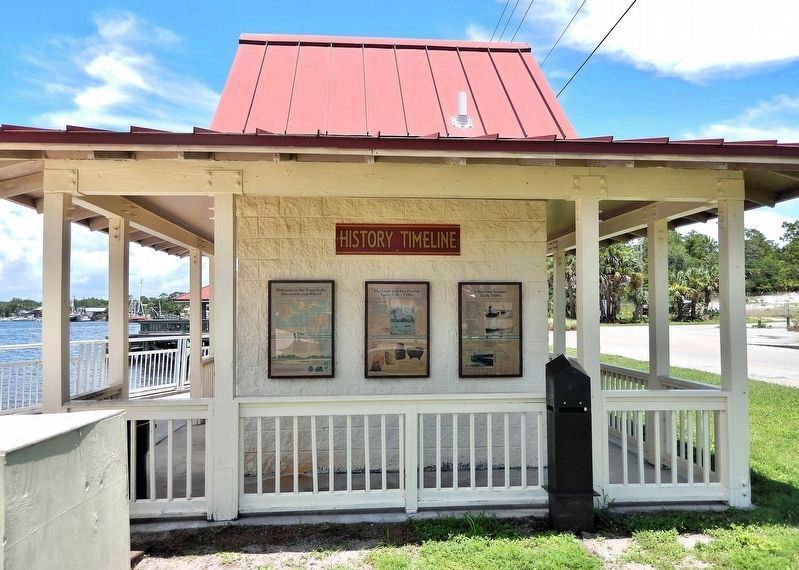
3. Carrabelle Riverwalk & Wharf Public Restrooms
Looking north; the Carrabelle River is on the left. This marker is the leftmost of three interpretive panels on the south side of the building.
Credits. This page was last revised on May 9, 2026. It was originally submitted on May 6, 2026, by Cosmos Mariner of Cape Canaveral, Florida. This page has been viewed 17 times since then. Photos: 1, 2, 3. submitted on May 9, 2026, by Cosmos Mariner of Cape Canaveral, Florida.
