Carrabelle in Franklin County, Florida — The American South (South Atlantic)
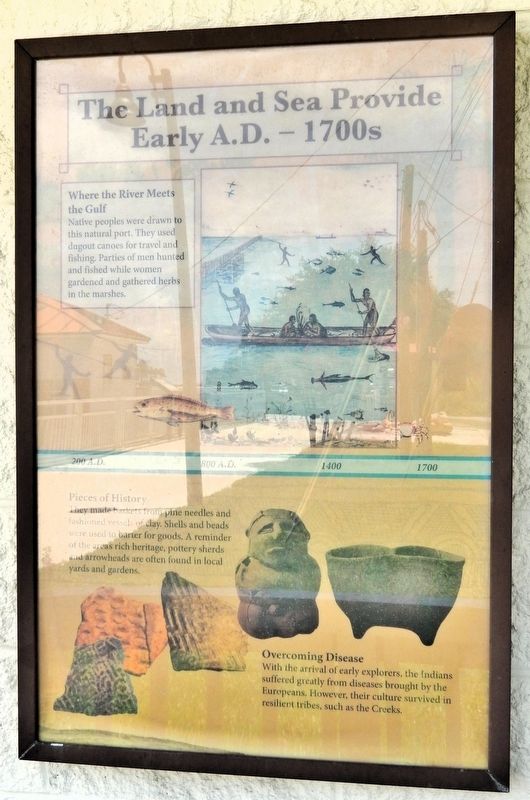
The Land and Sea Provide
Early A.D. — 1700s
| — | History Timeline | — |
Photographed by Cosmos Mariner, June 16, 2025
1. The Land and Sea Provide Marker
Where the River Meets the Gulf
Native peoples were drawn to this natural port. They used dugout canoes for travel and fishing. Parties of men hunted and fished while women gardened and gathered herbs in the marshes.
200 A.D. — 800 A.D. — 1400 — 1700
Pieces of History
They made baskets from pine needles and fashioned vessels of clay. Shells and beads were used to barter for goods. A reminder of the area’s rich heritage, pottery sherds and arrow heads are often found in local yards and gardens.
Overcoming Disease
With the arrival of early explorers, the Indians suffered greatly from diseases brought by the Europeans. However, their culture survived in resilient tribes, such as the Creeks.
Erected 2009 by Florida Coastal Management Program, Florida Department of Environmental Protection, and National Oceanic and Atmospheric Administration.
Topics. This historical marker is listed in these topic lists: Anthropology & Archaeology • Indigenous Peoples and Communities • Industry & Commerce • Waterways & Vessels.
Location. 29° 50.834′ N, 84° 39.841′ W. Marker is in Carrabelle, Florida, in Franklin County. It is at the intersection of Marine Street and Avenue F South, on the right when traveling south on Marine Street. The marker is mounted on the south side of the Carrabelle Riverwalk & Wharf public restroom building. Touch for map. Marker is in this post office area: Carrabelle FL 32322, United States of America. Touch for directions.

Regionally, this marker is on the Florida Panhandle. It is also in the American South, specifically in the Deep South, and on the Gulf Coast. Globally, it is in the North Atlantic Region, North America, a Gulf of Mexico state, the Western Hemisphere, the Western World, and the Anglosphere. Historically,
this page online
Other nearby markers. At least 8 other markers are within walking distance of this marker: A Bustling Seaport (here, next to this marker); Welcome to the Carrabelle Riverwalk and Wharf (here, next to this marker); From Boom to Bust... and Back Again! (here, next to this marker); From Sails to Rails (here, next to this marker); A Coastal Gem (here, next to this marker); Carrabelle Historic City Hall (approx. 0.2 miles away); Georgia Florida & Alabama Railroad (approx. ¼ mile away); The Legend of Tate's Hell (approx. ¼ mile away). Touch for a list and map of all markers in Carrabelle.
Related markers. Click here for a list of markers that are related to this marker. Carrabelle Riverwalk & Wharf — History Timeline
Also see . . . History of Franklin County Florida (Florida's Forgotten Coast).
Excerpt: Apalachicola enjoys a history rich in maritime culture and natural resources. Apalachicola is an Indian word for “land beyond” or “those people residing on(Submitted on May 9, 2026, by Cosmos Mariner of Cape Canaveral, Florida.)the other side” or “friendly people over there.” There were once more than 40,000 Indians in this region. The first Apalachicola Indians were members of the Mississippian Culture. Later tribes included the Seminoles and Creeks.Photographed by Cosmos Mariner, June 16, 20252. Carrabelle Riverwalk & Wharf Public RestroomsLooking north; the Carrabelle River is on the left. This marker is the center one of three interpretive panels on the south side of the building.Rio Carrabella, or “beautiful river” was the early name of Carrabelle. Early settlers in the area, both Indians and early Europeans, hunted game for food and furs, which were then shipped out of St. Marks.

Credits. This page was last revised on May 9, 2026. It was originally submitted on May 6, 2026, by Cosmos Mariner of Cape Canaveral, Florida. This page has been viewed 19 times since then. Photos: 1, 2. submitted on May 9, 2026, by Cosmos Mariner of Cape Canaveral, Florida.
