
Old Town in Alexandria, Virginia — The American South (Mid-Atlantic)
The Earliest Inhabitants
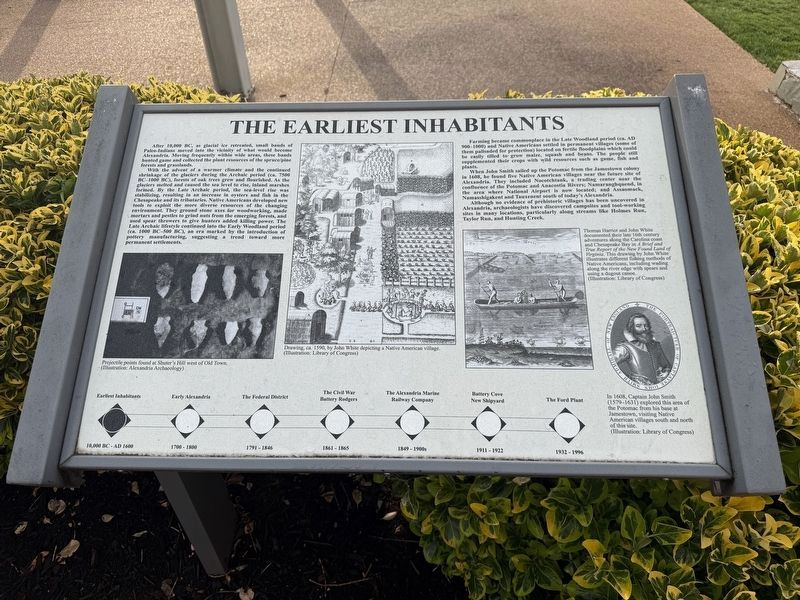
After 10,000 BC, as glacial ice retreated, small bands of Paleo-Indians moved into the vicinity of what would become Alexandria. Moving frequently within wide areas, these bands hunted game and collected the plant resources of the spruce/pine forests and grasslands.
With the advent of a warmer climate and the continued shrinkage of the glaciers during the Archaic period (ca. 7500 BC–1000 BC), forests of oak trees grew and flourished. As the glaciers melted and caused sea level to rise, inland marshes formed. By the Late Archaic period, the sea-level rise was stabilizing, resulting in an increase in oysters and fish in the Chesapeake and its tributaries. Native Americans developed new tools to exploit the more diverse resources of the changing environment. They ground stone axes for woodworking, made mortars and pestles to grind nuts from the emergent forests, and used spear throwers to give hunters added killing power. The Late Archaic lifestyle continued into the Early Woodland period (ca. 1000 BC–500 BC), an era marked by the introduction of pottery manufacturing, suggesting a trend toward more permanent settlements.
Farming
this page online
When John Smith sailed up the Potomac from the Jamestown colony in 1608, he found five Native American villages near the future site of Alexandria. They included Nacotchtank, a trading center near the confluence of the Potomac and Anacostia Rivers; Namoraughquend, in the vicinity of the National Airport is now located; and Assaomeck, the Machodoc and Tauxenent south of today’s Alexandria.
Although no evidence of prehistoric villages has been uncovered in Alexandria, archaeologists have discovered campsites and tool-working sites in many locations, particularly along streams like Holmes Run, Taylor Run, and Hunting Creek.
[Captions:]
Projectile points found at Shuter’s Hill west of Old Town
(Illustration: Alexandria Archaeology)
Drawing, ca. 1590, by John White depicting a Native American village
(Illustration: Library of Congress)
Thomas Harriot and John White documented their late 16th-century adventures along the Carolina coast and Chesapeake Bay in A Briefe and True Report of the New Found Land of Virginia. John White illustrated different fishing methods of Native Americans, including wading along the river edge with spears and using a dugout canoe.
(Illustration: Library of Congress)
In 1608, Captain John Smith (1579–1631) explored this area of the Potomac from his base at Jamestown, visiting Native American villages south and north of this site.
(Illustration: Library of Congress)
Erected by Fords

Topics and series. This historical marker is listed in these topic lists: Anthropology & Archaeology • Colonial Era • Indigenous Peoples and Communities • Settlements & Settlers. In addition, it is included in the Virginia, The City of Alexandria series list.
Location. 38° 47.821′ N, 77° 2.413′ W. Marker is in Alexandria, Virginia. It is in Old Town. It can be reached from Fords Landing Way north of Wharf Street, on the right when traveling north. Touch for map. Marker is at or near this postal address: 620 Fords Landing Way, Alexandria VA 22314, United States of America. Touch for directions.

Regionally, this marker is in the Washington Metropolitan Area and in Northern Virginia. It is also in the American South, specifically in the Upper South, in the Mid-Atlantic, and on the Eastern Seaboard. Globally, it is in the North Atlantic Region, North America, the Western Hemisphere, the Western World, and the Anglosphere. Historically, it finds itself in what was once the territory of the Mississippian Culture, one of the original Thirteen Colonies, one of the Confederate States of America, and the Antebellum South.
Other nearby markers. At least 8 other markers are within walking distance of this marker: Early Alexandria and Keith's Wharf (here, next to this marker); a different marker also named The Federal District and Alexandria (a few steps from this marker); a different marker also named Battery Cove Filled: A New Shipyard (a few steps from this marker); The Alexandria Marine Railway (a few steps from this marker); a different marker also named The Civil War and Battery Rodgers (a few steps from this marker); a different marker also named The Alexandria Ford Plant (a few steps from this marker); Guarding the Potomac (about 600 feet away, measured in a direct line); Zion Baptist Church (approx. 0.2 miles away). Touch for a list and map of all markers in Alexandria.
Other markers no longer nearby. The Earliest Inhabitants (has been replaced with this marker); a different marker also named Early Alexandria and Keith's Wharf (was a few steps from this marker but has been replaced with another marker now near it); Battery Cove Filled: A New Shipyard (was a few steps from this marker but has been replaced with another marker now near it); The Federal District and Alexandria (was a few steps from this marker but has been replaced with another marker now near it); The Civil War and Battery Rodgers (was a few steps from this marker but has been replaced with another marker now near it); The Alexandria Ford Plant (was a few steps from this marker but has been replaced with another marker now near it).
Credits. This page was last revised on May 14, 2026. It was originally submitted on May 14, 2026, by Devry Becker Jones of Washington, District of Columbia. This page has been viewed 16 times since then. Photos: 1, 2. submitted on May 14, 2026, by Devry Becker Jones of Washington, District of Columbia.
