Wiltshire in West Kennet in South West, England, United Kingdom — Northwestern Europe (the British Isles)
Silbury Hill
The Largest Prehistoric Mound in Europe
Photographed by Tracy Andersen Roberts, May 16, 2026
1. Silbury Hill Marker
Silbury Hill
The largest prehistoric mound in Europe
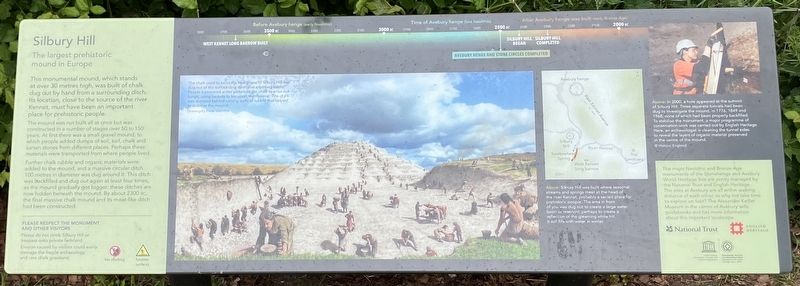
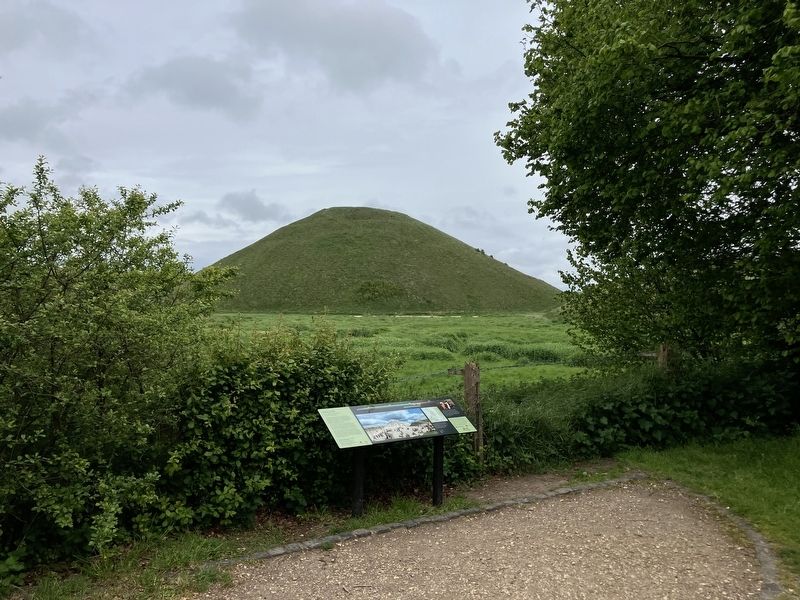
This monumental mound, which stands at over 30 metres high, was built of chalk dug out by hand from a surrounding ditch. Its location, close to the source of the river Kennet, must have been an important place for prehistoric people.
The mound was not built all at once but was constructed in a number of stages over 50 to 150 years. At first there was a small gravel mound, to which people added dumps of soil, turf, chalk and sarsen stones from different places. Perhaps these materials were transported from where people lived.
Further chalk rubble and organic materials were added to the mound, and a massive circular ditch 100 metres in diameter was dug around it. This ditch was backfilled and dug out again at least four times, as the mound gradually got bigger; these ditches are now hidden beneath the mound. By about 2300 BC, the final massive chalk mound and its moat-like ditch had been constructed.
(caption:)
The chalk used to build the final phase of Silbury Hill was dug out of the surrounding ditch and adjoining basin. People hammered antler picks into
this page online
Drawing by Peter Urmston.
Above: Hill was built where seasonal streams and springs meet at the head of the river Kennet, probably a sacred place for prehistoric people. The area in front of you was dug out to create a large water basin or reservoir, perhaps to create a reflection of the gleaming white hill. It still fills with water in winter.
The major Neolithic and Bronze Age monuments of the Stonehenge and Avebury World Heritage Site are jointly managed by the National Trust and English Heritage Above: in 2000, a hole appeared at the summit of Silbury Hill. Three separate tunnels had been dug to investigate the mound, in 1776, 1849 and 1968, none of which had been properly backfilled. To stabilise the monument, a major programme of conservation work was carried out by English Heritage. Here, an archaeologist is cleaning the tunnel sides to reveal the layers of organic material preserved in the centre of the mound.
© Historic England
The sites at Avebury are all
Photographed by Tracy Andersen Roberts, May 16, 2026
2. Silbury Hill with marker in foreground
National Trust
English Heritage
Please Respect the Monument and Other Visitors
Please do not climb Silbury Hill or trespass onto private farmland.
Erosion caused by visitors could easily damage the fragile archeology and rare chalk grassland. No climbing. Uneven surfaces.
Topics. This historical marker is listed in these topic lists: Anthropology & Archaeology • Man-Made Features • Parks & Recreational Areas • Religion & Religious Structures.
Location. 51° 24.973′ N, 1° 51.651′ W. Marker is in West Kennet, England, in South West. It is in Wiltshire. It can be reached from no nearby street. Touch for map. Marker is in this post office area: West Kennet, England SN3 9GU, United Kingdom. Touch for directions.

Regionally, it is on the Atlantic Ocean, in the North Atlantic Region, in Europe, in Atlantic Europe, on one of the British Isles, in the
Photographed by Tracy Andersen Roberts, May 16, 2026
3. Silbury Hill marker in distance
Other nearby markers. At least 6 other markers are within 18 kilometers of this marker, measured as the crow flies: Welcome to the Avebury World Heritage Site (within shouting distance of this marker); GWR Park (approx. 16.7 kilometers away); The Railway Church (approx. 16.8 kilometers away); Isambard Kingdom Brunel (approx. 16.8 kilometers away); College Street School (approx. 17.1 kilometers away); Swindon Station (approx. 17.4 kilometers away).
Also see . . . English Heritage: Silbury Hill. The largest artificial mound in Europe, mysterious Silbury Hill compares in height and volume to the roughly contemporary Egyptian pyramids. Probably completed in around 2400 BC, it apparently contains no burial. Though clearly important in itself, its purpose and significance remain unknown. Silbury Hill is part of the Avebury World Heritage Site, and a Site of Special Scientific Interest. (Submitted on May 26, 2026, by Tracy Andersen Roberts of Atlanta, Georgia.)
Credits. This page was last revised on June 23, 2026. It was originally submitted on May 25, 2026, by Tracy Andersen Roberts of Atlanta, Georgia. This page has been viewed 9 times since then. Photos: 1. submitted on May 25, 2026, by Tracy Andersen Roberts of Atlanta, Georgia. 2, 3. submitted on May 26, 2026, by Tracy Andersen Roberts of Atlanta, Georgia. • Andrew Ruppenstein was the editor who published this page.
