Sudbury in Middlesex County, Massachusetts — The American Northeast (New England)
Haynes Garrison House
Photographed by Stephen St. Denis, January 8, 2020
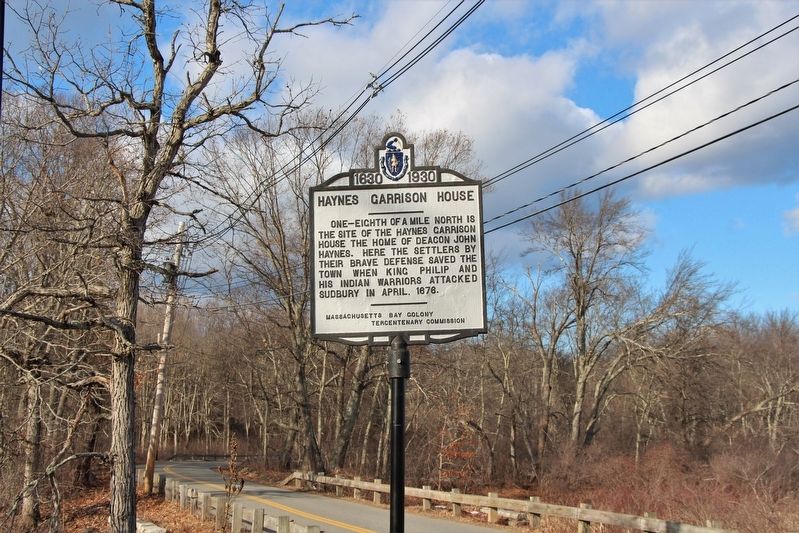
1. Massachusetts Bay Colony Tercentenary Commission Markers Historical Marker - Haynes Garrison House Marker
One-eighth of a mile north is the site of the Haynes Garrison House the home of Deacon John Haynes. Here the settlers by their brave defense saved the town when King Philip and his Indian warriors attacked Sudbury in April, 1676.
Erected 1930 by Massachusetts Bay Colony Tercentenary Commission.
Topics and series. This historical marker is listed in these topic lists: Colonial Era • Notable Events • War, French and Indian. In addition, it is included in the Daughters of the American Revolution (DAR), and the King Philip's War 1675-1676 series lists. A significant historical month for this entry is April 1676.
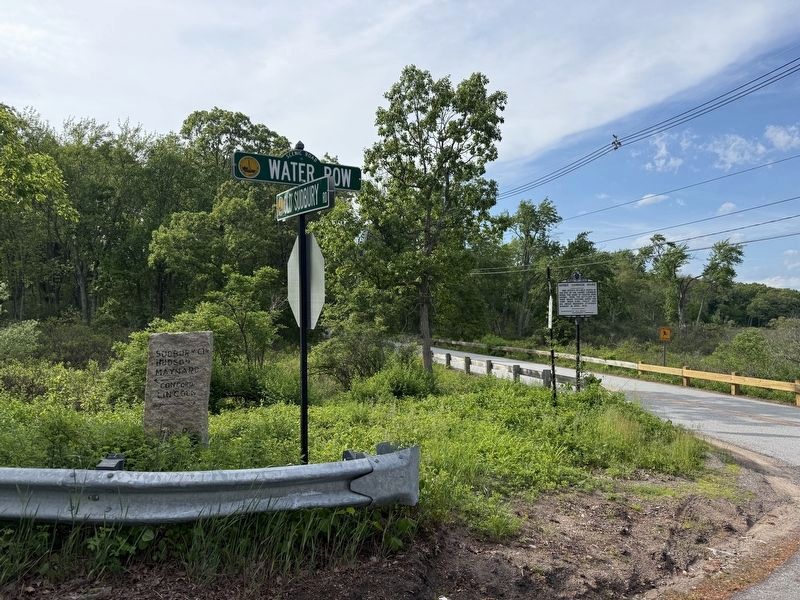
Location. 42° 22.55′ N, 71° 23.317′ W. Marker is in Sudbury, Massachusetts, in Middlesex County. It is at the intersection of Water Row and Old Sudbury Road (State Route 27), on the left when traveling north on Water Row. The Marker is 0.1 (one tenth of a mile) south of the small parking area on Water Row for King Philip Woods in Sudbury, MA. King Philip Woods is part of the Town of Sudbury Conservation lands. Touch for map. Marker is at or near this postal address: 5 Water Row, Sudbury MA 01776, United States
this page online

Regionally, this marker is in Greater Boston. It is also in the American Northeast, in New England, and on the Eastern Seaboard. Globally, it is in the North Atlantic Region, North America, the Western Hemisphere, the Western World, and the Anglosphere. Historically, it finds itself in what was once one of the original Thirteen Colonies.
Other nearby markers. At least 8 other markers are within 2 miles of this marker, measured as the crow flies: Site of the Haynes Garrison House (approx. 0.2 miles away); Old Town Bridge (approx. half a mile away); Sudbury (approx. 0.9 miles away); The Goodnow Garrison House (approx. one mile away); Goodenow Garrison House Site (approx. one mile away); First Town Center (approx. one mile away); The Sudbury Colonists (approx. one mile away); Men of the Sudbury Fight Monument (approx. 1.4 miles away). Touch for a list and map of all markers in Sudbury.
More about this marker. On April 21, 1676, Sudbury, Lancaster, and Marlborough were burned to the ground by marauding Native Americans under the command of the Wampanoag Chief, King Philip. A feeling of
Photographed by Stephen St. Denis, January 12, 2020
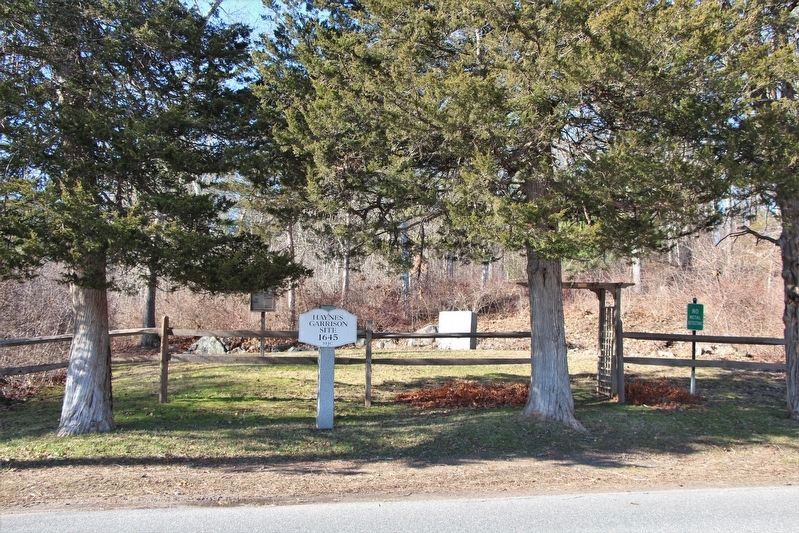
2. Haynes Garrison House Marker
The actual site of the Haynes Garrison House one-eighth mile north on Water Row of the Massachusetts Bay Colony Tercentenary Commission Marker.
Related marker.
Photographed by Stephen St. Denis, January 13, 2020
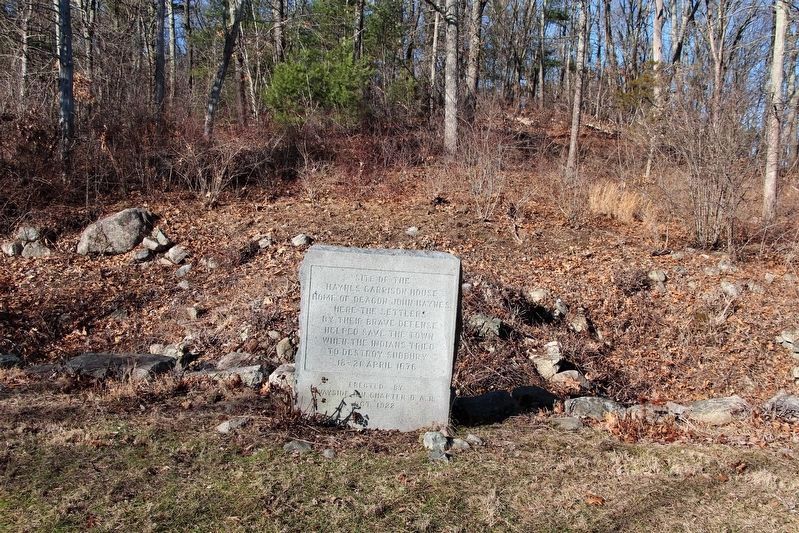
3. Haynes Garrison House Marker
Daughters of the American Revolution Monument at the site of the Haynes Garrison House foundation.
Site of the
Haynes Garrison House
Home of deacon John haynes
Here the settlers
by their brave defense
helped to save the town
when the Indians tried
to destroy Sudbury
18 — 21 April 1676
Erected by
Wayside Inn Chapter D.A.R.
October, 1922
Haynes Garrison House
Home of deacon John haynes
Here the settlers
by their brave defense
helped to save the town
when the Indians tried
to destroy Sudbury
18 — 21 April 1676
Erected by
Wayside Inn Chapter D.A.R.
October, 1922
Also see . . .
1. CPT Samuel Wadsworth - Cenotaph.
This Monument Is Erected By The Commonwealth of Massachusetts And The Town Of Sudbury In Grateful Remembrance of The Service And Suffering of The Founders of The State And Especially In Honor of(Submitted on May 6, 2026, by G.W.Bartlett of Hingham, Massachusetts.)
Capt. S. Wadsworth of Milton
Capt. Brocklebank of Rowley
Lieut. Sharp of Brookline
And Twenty Six Others, Men of Their Command, Who Fell Near This Spot On The 18th of April 1676 While Defending The Frontier Settlements Against The Allied Indian Forces of Philip of Pokanoket.
2. Concord Men Slain by Indians. On the opposite side of the Sudbury River off Old Sudbury Road, accessible via Wayland Country Club entrance (stay to the left) there is a related burial site at the abutment of the "Russell Bridge" / "Old Town Bridge" remnants. The memorial reads:
"Near here are buried James Hosmer, John Barnes, Samuel Potter, Daniel Comy, Joseph Buttrick, David Curry, Josiah Wheeler, William Hayward and others of Concord who were slain by Indians, Apr. 21, 1676 while going to assist the settlers of Sudbury."
Photographed by G.W.Bartlett, May 26, 2026
4. Haynes Garrison House Marker
3. Sudbury Fight - Wikipedia.
The Sudbury Fight (April 18-21, 1676) was a battle of King Philip's War, fought in what is today Sudbury and Wayland, Massachusetts, when approximately five hundred Wampanoag, Nipmuc, and Narragansett Native Americans raided the frontier settlement of Sudbury in Massachusetts Bay Colony. Disparate companies of English militiamen from nearby settlements marched to the town's defense, two of which were drawn into Native ambushes and suffered heavy losses. The battle was the last major Native American victory in King Philip's War before their final defeat in southern New England in August 1676.(Submitted on May 27, 2026, by G.W.Bartlett of Hingham, Massachusetts.)

Photographed by G.W.Bartlett, May 26, 2026
5. View of Sudbury River Marshes from Marker
Credits. This page was last revised on May 28, 2026. It was originally submitted on January 9, 2020, by Stephen St. Denis of Worcester, Massachusetts. This page has been viewed 4,413 times since then and 390 times this year. Last updated on May 26, 2026, by G.W.Bartlett of Hingham, Massachusetts. Photos: 1. submitted on January 9, 2020, by Stephen St. Denis of Worcester, Massachusetts. 2, 3. submitted on January 12, 2020, by Stephen St. Denis of Worcester, Massachusetts. 4, 5. submitted on May 26, 2026, by G.W.Bartlett of Hingham, Massachusetts. • Devry Becker Jones was the editor who published this page.
