Galesville in Anne Arundel County, Maryland — The American Northeast (Mid-Atlantic)
Property-Owning Pioneers
Henry and Catharine "Kitty" Wilson
Photographed by Pete Skillman, May 29, 2026
1. Property-Owning Pioneers Marker
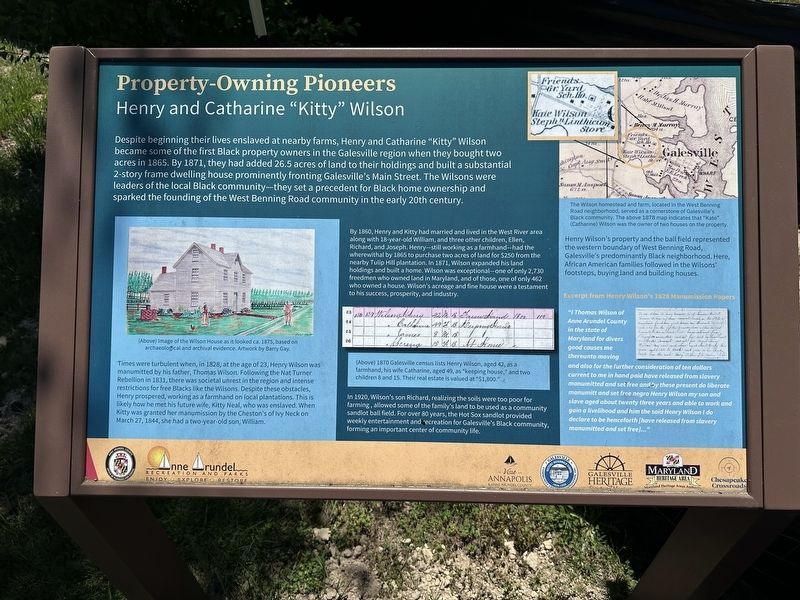
Times were turbulent when, in 1828, at the age of 23, Henry Wilson was manumitted by his father, Thomas Wilson Following the Nat Turner Rebellion in 1833, there was societal unrest in the region and intense restrictions for free Blacks like the Wilsons. Despite these obstacles, Henry prospered, working as a farmhand on local plantations. This is likely how he met his future wife, Kitty Neal, who was enslaved. When Kitty was granted her manumission by the Cheston's of Ivy Neck on March 27, 1844, she had a two-year-old son, William.
By 1860, Henry and Kitty had married and lived
this page online
In 1920, Wilson's son Richard, realizing the soils were too poor for farming, allowed some of the family's land to be used as a community sandlot ball field. For over 80 years, the Hot Sox sandlot provided weekly entertainment and recreation for Galesville's Black community, forming an important center of community life.
Henry Wilson's property and the ball field represented the western boundary of West Benning Road, Galesville's predominantly Black neighborhood. Here, African American families followed in the Wilsons footsteps, buying land and building houses.
Excerpt from Henry Wilson's 1528 Manumission Papers
"I
Photographed by Pete Skillman, May 29, 2026
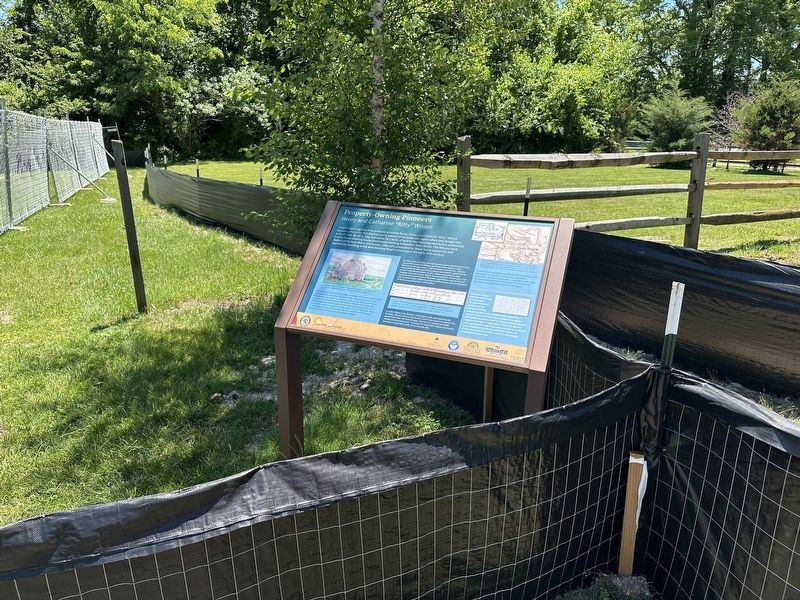
2. Property-Owning Pioneers Marker
[Captions]:
(Above) Image of the Wilson House as it looked ca. 1875, based on archaeological and archival evidence. Artwork by Barry Gay.
(Above) 1870 Galesville census lists Henry Wilson, aged 42, as a farmhand, his wife Catharine, aged 49, as "keeping house," and two children 8 and 15. Their real estate is valued at "$1,800."
The Wilson homestead and farm, located in the West Benning Road neighborhood, served as a cornerstone of Galesville's Black community. The above 1878 map indicates that "Kate" (Catharine) Wilson was the owner of two houses on the property.
Erected by Anne Arundel County Recreation and Parks.
Photographed by Pete Skillman, May 29, 2026
3. Property-Owning Pioneers Marker
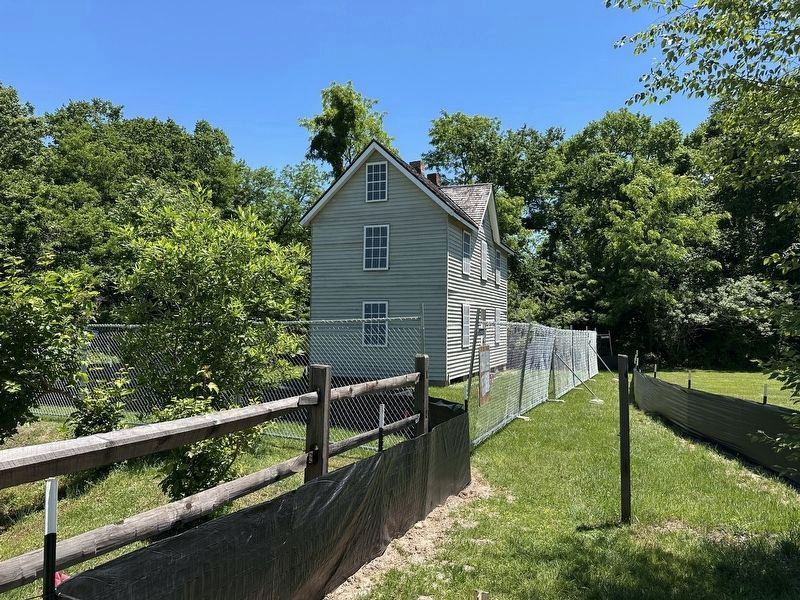
The Wilson House as it stands today.
Topics. This historical marker is listed in these topic lists: African Americans • Agriculture • Civil Rights • Parks & Recreational Areas. A significant historical year for this entry is 1865.
Location. 38° 50.878′ N, 76° 33.14′ W. Marker is in Galesville, Maryland, in Anne Arundel County. It can be reached from Galesville Road. Touch for map. Marker is at or near this postal address: 862 Galesville Rd, Galesville MD 20765, United States of America. Touch for directions.

Regionally, this marker is in Central Maryland. It is also in the American Mid-Atlantic, in the Chesapeake Bay Region, and on the Eastern Seaboard. Globally, it is in the North Atlantic Region, North America, the Western Hemisphere, the Western World, and the Anglosphere. Historically, it finds itself in what was once one of the original Thirteen Colonies and also the Antebellum South.
Other nearby markers. At least 8 other markers are within walking distance of this marker: Let's Play Ball! (within shouting distance of this marker); Farming in Galesville: Montell Farm (about 600 feet away, measured in a direct line); The Heart of Galesville's Black Community (about 700 feet away); West Benning Road Historic District (about 700 feet away); Site of First Quaker Regional Gathering (approx. ¼ mile away); Old Quaker Burying Ground (approx. 0.3 miles away); Cedar Park • Tulip Hill (approx. 0.3 miles away); Maritime Industry on Tenthouse Creek (approx. 0.4 miles away). Touch for a list and map of all markers in Galesville.
Credits. This page was last revised on June 2, 2026. It was originally submitted on May 29, 2026, by Pete Skillman of Wilmington, Delaware. This page has been viewed 22 times since then. Photos: 1, 2, 3. submitted on May 29, 2026, by Pete Skillman of Wilmington, Delaware.
