
Warren in Bristol County, Rhode Island — The American Northeast (New England)
Early Warren and the start of King Philip's War
Photographed by David Weed
1. Early Warren and the start of King Philip's War Marker
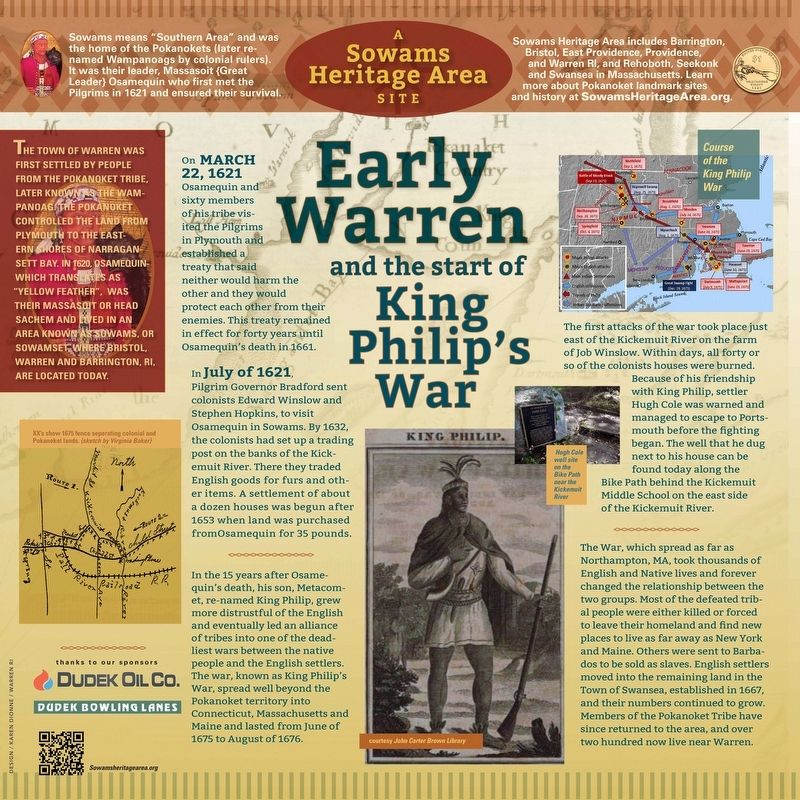
The town of Warren was first settled by people from the Pokanoket Tribe, later known as the Wampanoag. The Pokanoket controlled the land from Plymouth to the eastern shores of Narragansett Bay. In 1620, “Osamequin”, which translates as “Yellow Feather”, was their Massasoit or head Sachem and lived in an area known as “Sowams” or “Sowamset” where Bristol, Warren and Barrington, RI, are located today.
On March 22, 1621, Osamequin and sixty members of his tribe visited the Pilgrims in Plymouth and established a treaty that said neither would harm the other and they would protect each other from their enemies. This treaty remained in effect for forty years until Osamequin’s death in 1661.
In July of 1621, Pilgrim Governor Bradford sent colonists Edward Winslow and Stephen Hopkins, to visit Osamequin in Sowams. By 1632, the colonists had set up a trading post on the banks of the Kickemuit River. There they traded English goods for furs and other items. A settlement of about a dozen houses was begun after 1653 when land was purchased from Osamequin for 35 pounds.
In the 15 years after Osamequin’s death, his son, Metacomet,
this page online
The first attacks of the War took place just east of the Kickemuit River on the farm of Job Winslow. Within days, all forty or so of the colonists houses were burned. Because of his friendship with King Philip, settler Hugh Cole was warned and managed to escape to Portsmouth before the fighting began. The well that he dug next to his house can be found today along the Bike Path behind the Kickemuit Middle School on the east side of the Kickemuit River.
The War, which spread as far as Northampton, MA, took thousands of English and Native lives and forever changed the relationship between the two groups. Most of the defeated tribal people were either killed or forced to leave their homeland and find new places to live as far away as New York and Maine. Others were sent to Barbados to be sold as slaves. English
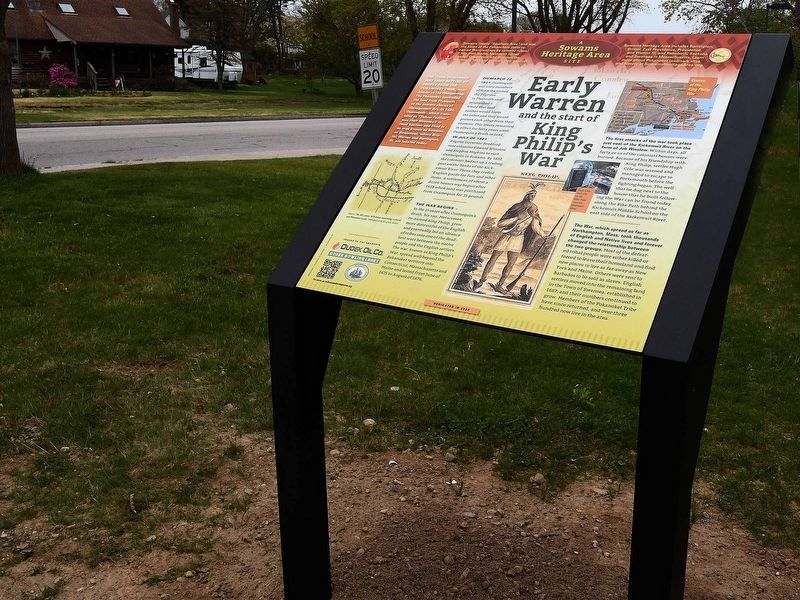
Photographed by David Weed, May 6, 2022
2. Early Warren and the start of King Philip's War Marker
Erected by Sowams Heritage Area Project, Inc.
Topics and series. This historical marker is listed in these topic lists: Colonial Era • Indigenous Peoples and Communities • Settlements & Settlers • Wars, US Indian. In addition, it is included in the King Philip's War 1675-1676 series list. A significant historical date for this entry is June 24, 1675.
Location. 41° 43.823′ N, 71° 15.561′ W. Marker is in Warren, Rhode Island, in Bristol County. It is at the intersection of Child Street (Rhode Island Route 103) and Hugh Cole Road, on the right when traveling east on Child Street. Touch for map. Marker is at or near this postal address: 525 Child Street, Warren RI 02885, United States of America. Touch for directions.

Regionally, this marker is in Greater Providence and on Narragansett Bay. It is also in the American Northeast, in New England, and on the Eastern Seaboard. Globally, it is in the North Atlantic Region, North America, the Western Hemisphere, the Western World, and the Anglosphere. Historically, it finds itself in what was once one of the original Thirteen Colonies.
Other nearby markers. At least 8 other markers are within 2 miles of this marker, measured as the crow flies: In Memory of Hugh Cole (approx. 0.3 miles away); History of the Kickemuit River (approx. 0.3 miles away); Who was Hugh Cole? (approx. 0.3 miles away); Vietnam Memorial (approx. ¾ mile away); Warren, RI (approx. 1.2 miles away); Washington St. (approx. 1.2 miles away); Baptist Church in Warren, R.I. (approx. 1.2 miles away); a different marker also named The Baptist Church in Warren (approx. 1.2 miles away). Touch for a list and map of all markers in Warren.
Related markers. Click here for a list of markers that are related to this marker.
Also see . . .
1. Sowams Heritage Area. (Submitted on May 24, 2023, by Michael Herrick of Southbury, Connecticut.)
2. Timline and Battles of King Philip's War.
King Philip's War (1675-1678) was the pivotal engagement between the second generation of English immigrants who had arrived in New England and the Native American tribes of the region.(Submitted on April 16, 2026, by G.W.Bartlett of Hingham, Massachusetts.)
3. Our Beloved Kin: Remapping a New History of King Philip's War.
This awikhigan is not "a new history" in the sense of creating some thing, entirely new and different, or offering a definitive replacement for a History that is old or outdated. Rather, in the Abenaki sense, the book and website are part of a cycling or spiraling of ôjmowôgan (history), which refers to a process of telling a collective story, an ongoing activity in which we are engaged.(Submitted on April 18, 2026, by G.W.Bartlett of Hingham, Massachusetts.)
4. Sowams Early History: King Philip's War, July 1675 by Stan Svec.
June of 1675 was the last month where peace, of a kind, could exist among the peoples of New England. The end of the month saw the dam burst and sullen rage turning to searing anger as the town of Swansea became the first community to suffer as her neighboring tribe, the Pokanoket of Metacom, took up the tomahawk to avenge injuries longstanding and ultimately the deaths by hanging of three of their Sachems.(Submitted on April 18, 2026, by G.W.Bartlett of Hingham, Massachusetts.)
5. The Start of the War - KPW350.org.
Angered by the loss of land, liberty and lives, the Pokanoket warriors first attacked just east of the Kickemuit River on the farm of Job Winslow on Sunday, June 20, 1675. (Job Winslow was the son of Kenelm Winslow.) While the settlers were in church, the warriors looted several homes, setting two on fire and sending residents to the Myles Garrison and a garrison house off today’s Gardner’s Neck Road in Swansea. Within days, all forty or so of the colonists houses were burned, bringing troops from Taunton and setting off a war that quickly spread.(Submitted on May 28, 2026, by G.W.Bartlett of Hingham, Massachusetts.)
Credits. This page was last revised on June 1, 2026. It was originally submitted on May 20, 2023, by David Weed of Warren, Rhode Island. This page has been viewed 1,242 times since then and 181 times this year. Last updated on June 1, 2026, by G.W.Bartlett of Hingham, Massachusetts. Photos: 1, 2. submitted on May 20, 2023, by David Weed of Warren, Rhode Island. • Devry Becker Jones was the editor who published this page.
