
Near Wheatfield in Jasper County, Indiana — The American Midwest (Great Lakes)
Welcome to the Nature Conservancy's Prairie Border Nature Preserve
Photographed by Daniel Barriball, May 29, 2026
1. Welcome to the Nature Conservancy's Prairie Border Nature Preserve Marker
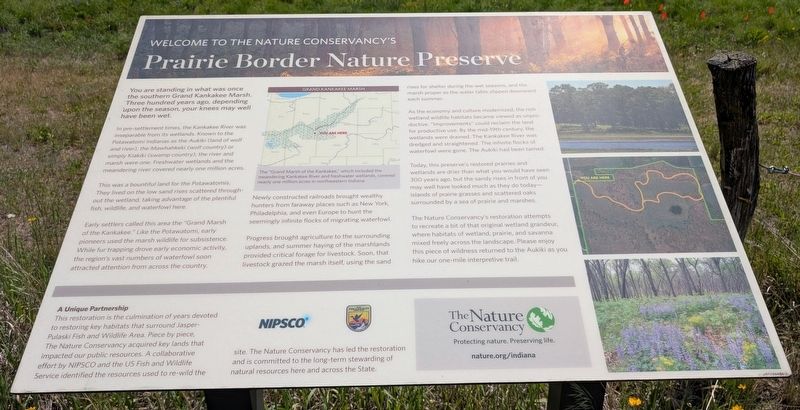
You are standing in what was once the southern Grand Kankakee Marsh. Three hundred years ago, depending upon the season, your knees may well have been wet.
In pre-settlement times, the Kankakee River was inseparable from its wetlands. Known to the Potawatomi Indianas as the Aukiki (land of wolf and river), the Mawhahkeki (wolf country) or simply Kiakiki (swamp country), the river and marsh were one. Freshwater wetlands and the meandering river covered nearly one million acres.
This was a bountiful land for the Potawatomis. They lived on the low sand rises scattered throughout the wetland, taking advantage of the plentiful fish, wildlife, and waterfowl here.
Early settlers called this area the "Grand Marsh of the Kankakee." Like the Potawatomi, early pioneers used the marsh wildlife for subsistence. While fur trapping drove early economic activity, the region's vast numbers of waterfowl soon attracted attention from across the country.
Newly constructed railroads brought wealthy hunters from faraway places such as New York, Philadelphia, and even Europe to hunt the seemingly infinite flocks of migrating waterfowl.
Progress
this page online
As the economy and culture modernized, the rich wetland wildlife habitats became viewed as unproductive. "Improvements" could reclaim the land for productive use. By the mid-19th century, the wetlands were drained. The Kankakee River was dredged and straightened. The infinite flocks of waterfowl were gone. The Aukiki had been tamed.
Today, this preserve's restored prairies and wetlands are drier than what you would have seen 300 years ago, but the sandy rises in front of you may well have looked much as they do today—islands of prairie grasses and scattered oaks surrounded by a sea of prairie and marshes.
The Nature Conservancy's restoration attempts to recreate a bit of that original wetland grandeur, where habitats of wetland, prairie, and savanna mixed freely across the landscape. Please enjoy this piece of wildness returned to the Aukiki
Photographed by Daniel Barriball, May 29, 2026
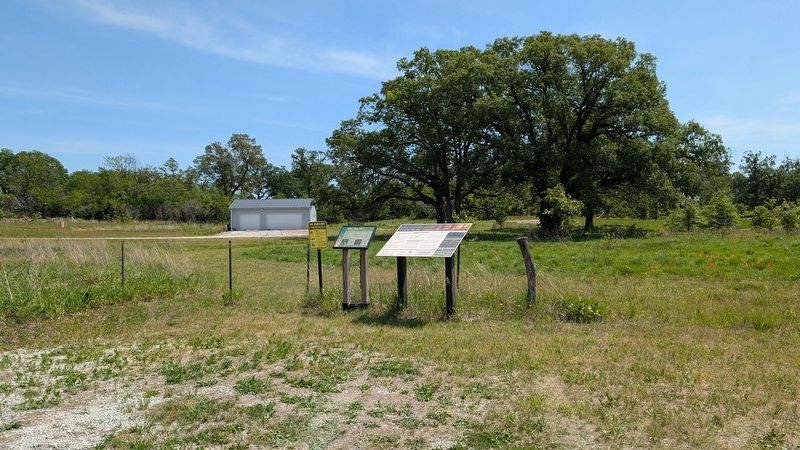
2. Welcome to the Nature Conservancy's Prairie Border Nature Preserve Marker in context
[Caption:] The "Grand Marsh of the Kankakee," which included the meandering Kankakee River and freshwater wetlands, covered nearly one million acres in northwestern Indiana.
A Unique Partnership
This restoration is the culmination of years devoted to restoring key habitats that surround Jasper-Pulaski Fish and Wildlife Area. Piece by piece, The Nature Conservancy acquired key lands that impacted our public resources. A collaborative effort by NIPSCO and the US Fish and Wildlife Service identified the resources used to re-wild the site. The Nature Conservancy has led the restoration and is committed to the long-term stewarding of natural resources here and across the State.
The Nature Conservancy
Protecting nature. Preserving life.
Erected 2018 by The Nature Conservancy.
Topics. This historical marker is listed in these topic lists: Environment • Indigenous Peoples and Communities • Parks & Recreational Areas • Settlements & Settlers.
Location. 41° 10.924′ N, 86° 58.098′ W. Marker is near Wheatfield, Indiana, in Jasper County. It is on County Road N400E 0.3 miles south of State Road 10, on the right when traveling north. This marker stands next to the parking lot at the trailhead of the Prairie Border Nature Preserve. Touch for map. Marker is at or near this postal address: 11687 County Rd 400 E, Wheatfield IN 46392, United States of America. Touch for directions.

Regionally, this marker is in Northwest Indiana. It is also in the American Midwest and in the Corn Belt. Globally, it is in North America, the Western Hemisphere, the Western World, and the Anglosphere. Historically, it finds itself in what was once the territory of the Mississippian Culture and also the Northwest Territory.
Other nearby markers. At least 6 other markers are within 12 miles of this marker, measured as the crow flies: Legendary Dunn's Bridge (approx. 2.6 miles away); San Pierre High School Stood on this Site from 1921-1964 (approx. 4 miles away); Wheatfield High School (approx. 4½ miles away); Frank H. Ono Memorial (approx. 10.3 miles away); Historic White Post (approx. 11.4 miles away); Site of Tassinong (approx. 12 miles away).
Also see . . . Prairie Border Nature Preserve. Official website Contains information beyond what is in the marker about how the Nature Conservancy has restored this habitat.
Once every 2-5 years, the Conservancy prescribes burns in the Prairie Border's natural communities because we believe that fire is a fundamental tool in restoring and managing the prairie. Other conservation efforts go toward protecting and restoring the savanna and wetland areas, as well as protecting viable populations of plants and animals found at the site.(Submitted on June 8, 2026, by Daniel Barriball of Chesterton, Indiana.)
Credits. This page was last revised on June 8, 2026. It was originally submitted on June 8, 2026, by Daniel Barriball of Chesterton, Indiana. This page has been viewed 17 times since then. Photos: 1, 2. submitted on June 8, 2026, by Daniel Barriball of Chesterton, Indiana. • Devry Becker Jones was the editor who published this page.
