Glen Burnie in Anne Arundel County, Maryland — The American Northeast (Mid-Atlantic)
The History of Seat Belts

Photographed by Pete Skillman, June 11, 2026
1. The History of Seat Belts Marker
In 1962, Volvo safety engineer Nils Bohlin received a U.S. patent for the three-point, lap-and-shoulder, vehicle safety belt. It is one of the most important and widespread safety innovations of all time.
Older, two-point lap belts didn't restrain the torso and, in crashes, the buckle position often caused internal injuries besides the crash impact injuries. Developed in just one year, Bohlin's simple belt design buckled on the side and held the torso back in a crash. When Volvo introduced the new seat belts in 1959, they started saving lives immediately.
The National Highway Traffic Safety Administration estimates that three-point seat belts prevent 100,000 injuries a year in the United States alone.
Nils Bohlin received letters from all over the world from thankful car-crash survivors. He loved hearing about lives saved by his invention. He is enshrined in the Automotive Hall of Fame and the National Inventors Hall of Fame. He died at 82 - and he buckled up every time he drove.
In 2011, 87% of Maryland pickup truck owners buckled up compared to 95% of automobile owners.
Why
this page online
Survey data reveal data about lifestyles and behaviors of Maryland drivers and passengers. For example, in 2011, 87% of observed Maryland pickup truck drivers buckled up compared to 95% of automobile occupants. Drivers in rural areas and obese people also wear seat belts less often than the general public.
Safety program such as Click It Or Ticket promote seat belt use. Maryland also has "Buckle Up Tough Guy," an awareness program that targets owners of pickup trucks to educate them on the importance of seat belt use.
One big difference between cars and pickup trucks in crashes is the presence of a "crumple zone." Modern cars with crumple zones provide far superior protection for their occupants in crash tests. Most

Photographed by Pete Skillman, June 11, 2026
2. The History of Seat Belts Marker
Crumple zones are areas of a vehicle that are designed to deform and crumple in a crash. This absorbs energy in an impact, preventing it from being transmitted to the occupants. Crumple zones reduce the crash impact, and redistribute the force before it reaches the vehicle's occupants.
Certain parts of a car, like the passenger compartment and engine, are rigid and resistant to deforming. When those parts hit something, they decelerate fast, with lots of force. So automakers build metal shells, struts and other bendable parts with less rigid materials around them to take the initial impact.The car begins decelerating as soon as the crumple zone starts crumpling, extending deceleration over a few critical tenths of a second.
Most pickup trucks, older model cars and SUVs use a separate chassis frame and have no crumple zones. Rigid frames are great for workloads and towing, but without a crumple zone, there are far less safety benefits for occupants in the event of a crash. So wearing a

Photographed by Pete Skillman, June 11, 2026
3. The History of Seat Belts Marker
The Peltzman Effect and the Need for Comprehensive Occupant Protection Strategies
Is it possible that people drive like idiots because they're wearing a seat belt? After passage of mandatory seat belt laws in the U.S., University of Chicago Professor Sam Peltzman noted that drivers increase their risky behavior, such as speeding and driving impaired, because of changes in their perception of risk: The safer that manufacturers make the cars, the more risks that drivers will be willing to take.
When people adjust their behavior to a regulation in ways that counteract the intended effect of the regulation, it's called the Peltzman Effect. Other examples are leaving childproof safety caps unsecured for easy opening, or football helmets causing increased concussions.
Drivers who believe they are safer by wearing their seat belt also put other users of Maryland's roadways at risk. First, though seat belts may prevent more injuries and fatalities, the number of crashes goes up when risky behavior increases. Second, pedestrians and cyclists are potentially in more danger with
Photographed by Pete Skillman, June 11, 2026
4. The History of Seat Belts Marker
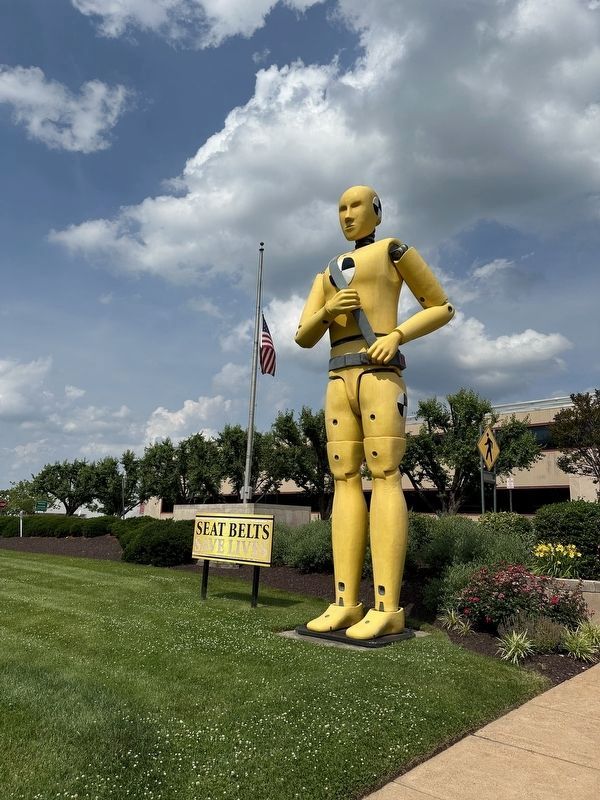
The 34 foot-tall statue adjacent to this marker is purported to be the largest crash test dummy in the world. It was installed as part of a public safety campaign in 2012.
The Peltzman Effect exemplifies the need for additional tools in eliminating roadway fatalities. Car manufacturers and government officials are actively researching, developing, and deploying other passive safety technologies to supplement existing occupant protection features such as crumple zones, curtain airbags, energy-absorbing materials, deformable steering wheels, and head restraints.
The State of Maryland has a Primary Enforcement Seat Belt Law that allows law enforcement officers to stop and ticket the driver when they see a violation of the seat belt law for front seat occupants.
States with Primary Enforcement Seat Belt Laws allow law enforcement officers to stop and ticket the driver when they see a violation of the seat belt law for front seat occupants. No other violation need occur first for an officer to pull you over.
All states except New Hampshire have a seat belt use law, but only 32 states and DC allow Primary Enforcement of their belt laws. In secondary enforcement states, police may issue a citation for seat belt non-use only after stopping the vehicle for a separate traffic infraction.
Only 32 states and DC all Primary Enforcement of their belt laws.
Did You Know?
- Most crashes occur within a few miles of home, at 40 mph or less. Buckle up every trip, every time!
- Maryland ranks 9th in seat belt use among U.S. states - 94% of drivers and passengers. DC is 93%.
- Kids 8 and under must be buckled, unless 4’ 9”or taller, or more than 65 lbs. Child restraints must be federally approved.
- Risky driving behaviors are more prevalent at night.
- One excuse for not wearing seatbelts is that they wrinkle clothes. But what will going through a windshield do to your outfit?
- Drive 15,500 miles in a year: You have a 1 in 100 chance of a fatal crash over a 50-year period.
- Men are involved in fatal crashes twice as much as women on roads. In 2010, more than 81% of unbelted deaths were men.
1885 - First patent for seat belts to Edward Claghorn of New York.
1921 - First child restraints - sacks with drawstrings on a Model T's back seat.
1930 - Doctors see carnage, urge manufacturers to provide belts.
1956 - Ford, Chrysler, Saab and Volvo offer accessory seat belts.
1964 - Most U.S. cars sold with front belts - most unused.
1965 - 50,000 people killed in crashes.
1980s - Crash test dummies Vince and Larry appear in ads. "You can Learn a Lot from a Dummy."
1985 - First mandatory seat belt law in New York. Limited enforcement and public awareness keeps other state legislation and belt use rates low.
1990s - Shocking accidents and injuries too common to ignore.
1993 - Click It or Ticket program combines checkpoints and awareness ads. Seat belt use rises dramatically.
1995 - Every state except New Hampshire has a mandatory seat belt law.
2010 - 32,885 killed in crashes, 2.2 million injured. Crashes are leading cause of death for Americans between 5 and 34.
2012 - Last holdout crashes. In the ER, vows to buckle up every trip, every time.
Erected 2012 by Maryland Highway Safety Office.
Topics. This historical marker is listed in these topic lists: Law Enforcement • Roads & Vehicles • Science & Medicine. A significant historical year for this entry is 1962.
Location. 39° 11.844′ N, 76° 36.776′ W. Marker is in Glen Burnie, Maryland, in Anne Arundel County. It is on Governor Ritchie Highway, on the right when traveling north. The marker is located in front of the headquarters of the Maryland Motor Vehicle Administration (MVA). Touch for map. Marker is at or near this postal address: 6601 Governor Ritchie Hwy, Glen Burnie MD 21062, United States of America. Touch for directions.

Regionally, this marker is in the American Mid-Atlantic and on the Eastern Seaboard. Globally, it is in the North Atlantic Region, North America, the Western Hemisphere, the Western World, and the Anglosphere. Historically, it finds itself in what was once one of the original Thirteen Colonies and also the Antebellum South.
Other nearby markers. At least 8 other markers are within 2 miles of this marker, measured as the crow flies: Veterans Memorial (a few steps from this marker); Curtis Creek Furnace (approx. 0.9 miles away); Formerly Brooklyn Park High School (approx. 1.3 miles away); Ferndale, Maryland (approx. 1.8 miles away); The Freedom Tree (approx. 1.8 miles away); Donald Emerson Shay, Jr. (approx. 1.8 miles away); Patrick Henry (approx. 1.9 miles away); a different marker also named Veterans Memorial (approx. 1.9 miles away). Touch for a list and map of all markers in Glen Burnie.
Also see . . . Glen Burnie, Maryland: Giant Crash Test Dummy.
An impressive 34 feet tall safety-yellow crash test dummy stands in front of the headquarters of the Maryland Motor Vehicle Administration. It cost $63,000 and was set into place by a crane just before Thanksgiving 2012. It's designed to serve as a permanent photo-op (signs encourage passersby to post their photos to Facebook and Twitter) in the hope that it will spread a message of traffic safety.(Submitted on June 11, 2026, by Pete Skillman of Wilmington, Delaware.)
Credits. This page was last revised on June 11, 2026. It was originally submitted on June 11, 2026, by Pete Skillman of Wilmington, Delaware. This page has been viewed 15 times since then. Photos: 1, 2, 3, 4. submitted on June 11, 2026, by Pete Skillman of Wilmington, Delaware.
