Great Bend in Barton County, Kansas — The American Midwest (Upper Plains)
Prey and Play
Hunting and Wildlife Watching Along the Byway
Photographed by Cosmos Mariner, September 8, 2024
1. Prey and Play Marker
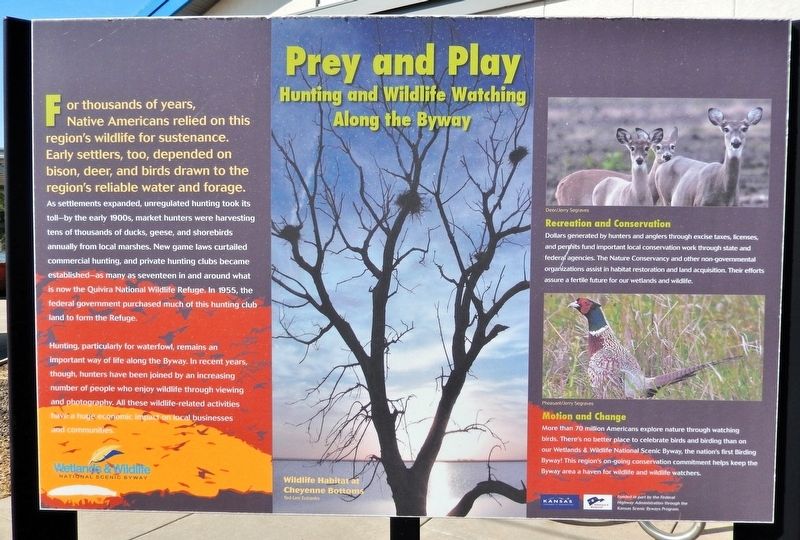
For thousands of years, Native Americans relied on this region's wildlife for sustenance. Early settlers, too, depended on bison, deer, and birds drawn to the region's reliable water and forage.
As settlements expanded, unregulated hunting took its toll — by the early 1900s, market hunters were harvesting tens of thousands of ducks, geese, and shorebirds annually from local marshes. New game laws curtailed commercial hunting, and private hunting clubs became established — as many as seventeen in and around what is now the Quivira National Wildlife Refuge. In 1955, the federal government purchased much of this hunting club land to form the Refuge.
Hunting, particularly for waterfowl, remains an important way of life along the Byway. In recent years, though, hunters have been joined by an increasing number of people who enjoy wildlife through viewing and photography. All these wildlife-related activities have a huge economic impact on local businesses and communities.
Recreation and Conservation
Dollars generated by hunters and anglers through excise taxes, licenses, and permits fund important local conservation work through
this page online
Motion and Change
More than 70 million Americans explore nature through watching birds. There's no better place to celebrate birds and birding than on our Wetlands & Wildlife National Scenic Byway, the nation's first Birding Byway! This region's on-going conservation commitment helps keep the Byway area a haven for wildlife and wildlife watchers.
[image captions]
• Wildlife Habitat at Cheyenne Bottoms/Ted Lee Eubanks
• Deer/Jerry Segraves
• Pheasant/Jerry Segraves
Erected by Wetlands & Wildlife National Scenic Byway, Kansas Dept of Transportation, and Federal Highway Administration.
Topics. This historical marker is listed in these topic lists: Animals • Environment • Indigenous Peoples and Communities • Waterways & Vessels. A significant historical year for this entry is 1955.
Location. 38° 21.671′ N, 98° 45.621′ W. Marker is in Great Bend, Kansas, in Barton County. It is on 10th Street (U.S. 56) just east of

Photographed by Cosmos Mariner, September 8, 2024
2. Prey and Play Marker
The marker is in front of the Great Bend Water Office.

Regionally, this marker is in Central Kansas. It is also in the American Midwest, in the Corn Belt, on the prairies, on the Southern Plains, and on the Santa Fe Trail Corridor. Globally, it is in North America, the Western Hemisphere, the Western World, and the Anglosphere. Historically, it finds itself in what was once the Louisiana Purchase.
Other nearby markers. At least 8 other markers are within walking distance of this marker: Post Rock & Black Gold (here, next to this marker); Santa Fe Trail (approx. ¼ mile away); Lt. Zebulon Pike, 1806 (approx. ¼ mile away); a different marker also named Santa Fe Trail (approx. ¼ mile away); Wild West Superhighway (approx. 0.3 miles away); Veterans of Foreign Wars Memorial (approx. 0.4 miles away); Jack Kilby (approx. 0.4 miles away); Streetscape (approx. 0.4 miles away). Touch for a list and map of all markers in Great Bend.
Credits. This page was last revised on June 13, 2026. It was originally submitted on June 12, 2026, by Cosmos Mariner of Cape Canaveral, Florida. This page has been viewed 13 times since then. Photos: 1, 2. submitted on June 13, 2026, by Cosmos Mariner of Cape Canaveral, Florida.
