Dagsboro Hundred in Sussex County, Delaware — The American Northeast (Mid-Atlantic)
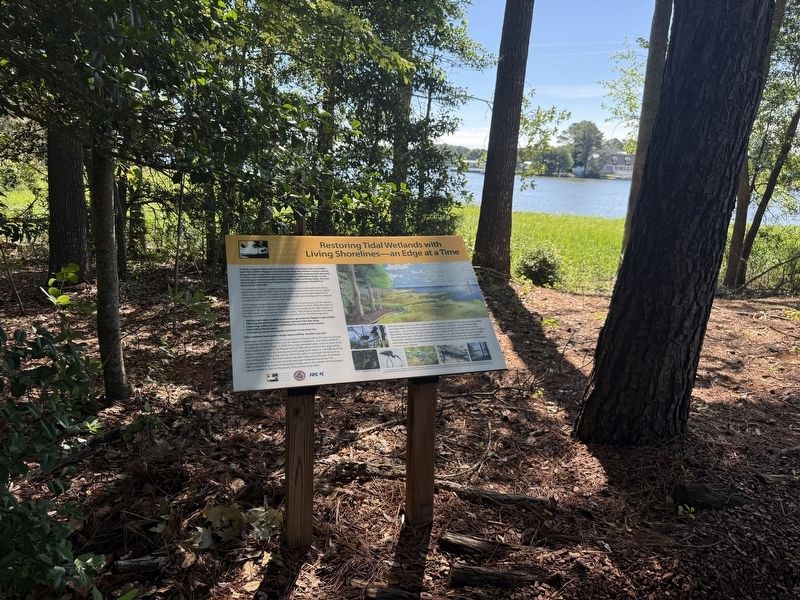
Restoring Tidal Wetlands with Living Shorelines—an Edge at a Time
| — | Delaware Botanic Gardens at Pepper Creek | — |

Photographed by Devry Becker Jones (CC0), June 13, 2026
1. Restoring Tidal Wetlands with Living Shorelines—an Edge at a Time Marker
In 2020, in partnership with the Center for the Inland Bays (CIB) and DNREC, over 300' of DBG's Pepper Creek southeast edge was restored using a natural living shoreline approach to preserve and protect the eroding tidal saltmarsh. In 2023, a second natural approach to shoreline stabilization began on the remaining unrestored portion of the Pepper Creek southwest edge, this one sponsored by the Delaware Department of Transportation (DelDOT) in partnership with DBG.
The $560,000 DelDOT mitigation project restored the eroding saltmarsh along approximately 500' of DBG's tidal shoreline and built out the marsh to its original 1920's extent. This effort created one third of an acre of new tidal wetland and further protected another half acre of existing tidal wetland edge and its adjacent woodlands from erosion due to wave action.
In this hybrid living shoreline approach, a rock sill structure was built for stability and back-filled with sand and vegetation to extend the marsh. While the marsh is covered at high tide, breaks in the rock sill act as an outlet as the tide recedes. As the tide moves in and out over the
this page online
• Adding new native habitat and nursery grounds for Pepper Creek wildlife
• Filtering out pollutants and excess nutrients from the water
• Capturing sediments and stabilizing the shoreline from erosion
• Controlling flood waters
• Increasing coastal woodlands resilience to sea-level rise
Tidal wetlands have quite a large responsibility, wouldn't you say?
Openings built into the rock sill living shoreline structure allow the natural comings and goings of existing wildlife, such as reptiles, amphibians, river otters, shellfish, shorebirds and bald eagles. A 2022 CIB survey recorded a daily count of up to thirty Diamondback terrapins that frequented the DBG site during the spring breeding season, looking for sandy nesting sites and foraging for food (i.e. snails living on the Spartina grasses). This turtle lives its entire life cycle in a brackish habitat such as ours at Pepper Creek. But their habitat has been reduced by the loss of creekside sandy beaches due to unnatural bulkhead-type
Photographed by Devry Becker Jones (CC0), June 13, 2026
2. Restoring Tidal Wetlands with Living Shorelines—an Edge at a Time Marker
[Captions:]
One can imagine that our DBG resident bald eagle family watched from their very tall loblolly pine nest above the shoreline as this project progressed, maybe as wind and flood tides pounded away at their fishing habitat below. And they may have noted that one of their favorite fishing perches remains standing in the middle of the new marsh due to the insight of the restoration team. Although the project's progress was often dependent upon the eagles' mating and breeding seasons, their enhanced habitat is evidence that this partnership's watershed approach to mitigating wetland loss protects far more than just the land restored.
Eagle photo by Nancy E. Hodgspath
The above photos show a rendering of the DBG-DelDOT Hybrid Living Shoreline, the shoreline stabilization Concept Map, some of our coastal wildlife that benefit from the new shoreline (DBG's bald eagle pair, a great blue heron, Diamondback terrapins, and a blue crab), and the new rock sill marsh at incoming tide prior to 2024 Spartina grass planting.
Erected by Delaware Botanic Gardens at Pepper Creek; Delaware Department of Transportation; RK&K.
Topics. This historical marker is listed in these topic lists: Environment • Horticulture & Forestry • Parks & Recreational Areas • Waterways & Vessels. A significant historical year for this entry is 2020.
Location. 38° 33.671′ N, 75° 13.255′ W. Marker is in Dagsboro, Delaware, in Sussex County. It is in Dagsboro Hundred. It can be reached from Piney Neck Road half a mile east of Honeysuckle Drive, on the right when traveling east. Touch for map. Marker is in this post office area: Dagsboro DE 19939, United States of America. Touch for directions.

Regionally, this marker is on Delaware’s Beaches. It is also in the American Mid-Atlantic, on the Delmarva Peninsula, and on the Eastern Seaboard. Globally, it is in the North Atlantic Region, North America, the Western Hemisphere, the Western World, and the Anglosphere. Historically, it finds itself in what was once New Netherland, one of the original Thirteen Colonies, and the Antebellum South.
Other nearby markers. At least 8 other markers are within 2 miles of this marker, measured as the crow flies: A Partnership to Mitigate Inland Bays Wetland Loss (within shouting distance of this marker); The Inland Dunes (approx. 0.2 miles away); Learning Garden (approx. 0.2 miles away); The Rhyne Garden (approx. 0.2 miles away); Baltimore Hundred (approx. one mile away); Prince George's Chapel (approx. 1.3 miles away); a different marker also named Prince George's Chapel (approx. 1.3 miles away); Rev. Edward Dingle of England (approx. 1.3 miles away). Touch for a list and map of all markers in Dagsboro.
Credits. This page was last revised on June 25, 2026. It was originally submitted on June 13, 2026, by Devry Becker Jones of Washington, District of Columbia. This page has been viewed 18 times since then. Photos: 1, 2. submitted on June 13, 2026, by Devry Becker Jones of Washington, District of Columbia.
