Stockade District in Kingston in Ulster County, New York — The American Northeast (Mid-Atlantic)
The Esopus
| — | Senate House State Historic Site | — |
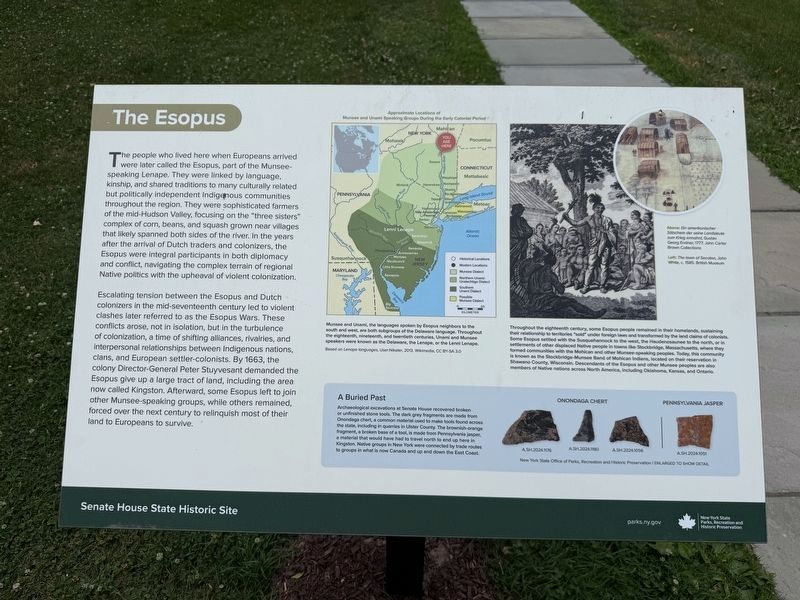
The people who lived here when Europeans arrived were later called the Esopus, part of the Munsee-speaking Lenape. They were linked by language, kinship, and shared traditions to many culturally related but politically independent Indigenous communities throughout the region. They were sophisticated farmers of the mid-Hudson Valley, focusing on the "three sisters" complex of corn, beans, and squash grown near villages that likely spanned both sides of the river. In the years after the arrival of Dutch traders and colonizers, the Esopus were integral participants in both diplomacy and conflict, navigating the complex terrain of regional Native politics with the upheaval of violent colonization.
Escalating tension between the Esopus and Dutch colonizers in the mid-seventeenth century led to violent clashes later referred to as the Esopus Wars. These conflicts arose, not in isolation, but in the turbulence of colonization, a time of shifting alliances, rivalries, and interpersonal relationships between Indigenous nations, clans, and European settler-colonists. By 1663, the colony Director-General Peter Stuyvesant demanded
this page online
[Sidebar:]
A Buried Past
Archaeological excavations at Senate House recovered broken or unfinished stone tools. The dark grey fragments are made from Onondaga chert, a common material used to make tools found across the state, including in quarries in Ulster County. The brownish-orange fragment, a broken base of a tool, is made from Pennsylvania jasper, a material that would have had to travel north to end up here in Kingston. Native groups in New York were connected by trade routes to groups in what is now Canada and up and down the East Coast.
[Captions:]
Munsee and Unami, the languages spoken by Esopus neighbors to the south and west, and both subgroups of the Delaware language. Throughout the eighteenth, nineteenth, and twentieth centuries, Unami and Munsee speakers were known as the Delaware, the Lenape, or the Lenni Lenape.
Throughout the eighteenth century, some Esopus people remained in their homelands, sustaining their relationship to territories "sold" under foreign laws and transformed by the land claims of colonists. Some Esopus settled within the Susquehannock to the west, the Haudenosaunee to the north, or in settlements, of other displaced Native people in towns like Stockbridge, Massachusetts, where they formed communities with the Mohican and other Munsee-speaking peoples. Today, this community is known as the Stockbridge-Munsee Band of Mohican Indians, located on their reservation in Shawano County, Wisconsin. Descendants of the Esopus and other Munsee peoples are also members of Native nations across North America, including Oklahoma, Kansas, and Ontario.
Erected by New
Topics. This historical marker is listed in these topic lists: Anthropology & Archaeology • Indigenous Peoples and Communities • Settlements & Settlers • Wars, US Indian. A significant historical year for this entry is 1663.
Location. 41° 56.079′ N, 74° 1.112′ W. Marker is in Kingston, New York, in Ulster County. It is in the Stockade District. It is on Clinton Avenue south of North Front Street, on the right when traveling south. Touch for map. Marker is at or near this postal address: 319 Clinton Ave, Kingston NY 12401, United States of America. Touch for directions.

Regionally, this marker is in Upstate New York and in the Hudson Valley. It is also in the American Northeast, in the Mid-Atlantic, and on the Eastern Seaboard. Globally, it is in the North Atlantic Region, North America, the Western Hemisphere, the Western World, and the Anglosphere. Historically, it finds itself in what was once New Netherland and also one of the original Thirteen Colonies.
Other nearby markers. At least 8 other markers are within walking distance of this marker: A Radical Idea (a few steps from this marker); Senate House (a few steps from this marker); Three Centuries of Senate House (within shouting distance of this marker); Welcome (within shouting distance of this marker); The Loughran House (within shouting distance of this marker); Senate House Museum (within shouting distance of this marker); a different marker also named Senate House (within shouting distance of this marker); Old Stockade 1658 (about 300 feet away, measured in a direct line). Touch for a list and map of all markers in Kingston.
Other markers no longer nearby. A Radical Idea: Government by the People (was a few steps from this marker but has been replaced with another marker now near it); A Community Attic (was within shouting distance of this marker but has been replaced with another marker now near it); a different marker also named The Loughran House (was within shouting distance of this marker but has been replaced with another marker now near it); The Evolution of the Senate House (was within shouting distance of this marker but has been replaced with another marker now near it).
Credits. This page was last revised on June 22, 2026. It was originally submitted on June 22, 2026, by Devry Becker Jones of Washington, District of Columbia. This page has been viewed 19 times since then. Photos: 1, 2. submitted on June 22, 2026, by Devry Becker Jones of Washington, District of Columbia.
