
Downtown in Frederick in Frederick County, Maryland — The American Northeast (Mid-Atlantic)
The Lynchings of James Carroll, John Biggus, and James Bowens
⎯⎯⎯
Lynching in America

Photographed by Devry Becker Jones (CC0), July 12, 2026
1. The Lynchings of James Carroll, John Biggus, and James Bowens side of the marker
The Lynchings of James Carroll, John Biggus, and James Bowens. Three Black men were victims of racial terror lynching in Frederick County between 1879 and 1895. Each was abducted following reports of attacks against local white women. On April 17, 1879, a mob of more than 70 white people lynched 24-year-old James Carroll. Mr. Carroll was on a train from Washington, D.C., to Frederick in police custody when he was seized by the mob. After he was forced off the train, the mob used a rope it placed around Mr. Carroll's neck to drag im through a muddy embankment to the edge of nearby woods in Point of Rocks, where it hanged him. On November 23, 1887, John Biggus, a 19-year-old Black teen, was lynched by a mob of 100 or more white men. After seizing Mr. Biggus from the Frederick jail, the mob took him to a nearby field and killed him as he professed his innocence. Mr. Biggus was shot three times and hanged. On November 17, 1895, a mob of approximately 300 white men lynched young Black man, James Bowens, after he was seized from the Frederick jail. As Mr. Bowens was hanged, the mob fired a gunshot into his head. A member of
this page online
Lynching in America. Thousands of Black people were the victims of lynching and racial violence in the U.S. between 1865 and 1950. During the Reconstruction era, lynching became a notorious and highly effective form of racial terror intended to intimidate Black communities and enforce racial hierarchy and segregation. After the Civil War, there was violent resistance to equal rights for Black Americans, and an ideology of white supremecy that led to the violent abuse of Black men, women, and children. Though law enforcement was legally required to protect those in their custody, many Black people were pulled out of jails or seized from police hands by white mobs. Racial terror lynchings were not the action of a few extremists—instead lynchings were seen as a community spectacle and included burnings and mutiliation, sometimes carried out in front of

Erected 2026 by Equal Justice Initiative; Frederick Remembrance Memorial Coalition.
Topics. This historical marker is listed in these topic lists: African Americans • Civil Rights • Law Enforcement. A significant historical date for this entry is April 17, 1879.
Location. 39° 24.756′ N, 77° 24.678′ W. Marker is in Frederick, Maryland, in Frederick County. It is in Downtown. It is on South Market Street (Maryland Route 355) north of West All Saints Street, on the left when traveling north. Touch for map. Marker is at or near this

Photographed by Devry Becker Jones (CC0), July 12, 2026
3. The Lynchings of James Carroll, John Biggus, and James Bowens / Lynching in America Marker

Regionally, this marker is in the Washington Metropolitan Area and in Central Maryland. It is also in the American Mid-Atlantic. Globally, it is in North America, the Western Hemisphere, the Western World, and the Anglosphere. Historically, it finds itself in what was once one of the original Thirteen Colonies and also the Antebellum South.
Other nearby markers. At least 8 other markers are within walking distance of this marker: Jacob Engelbrecht's Diary (a few steps from this marker); Number One Engine (within shouting distance of this marker); B & O Railroad Station (within shouting distance of this marker); Frederick's Carroll Creek (within shouting distance of this marker); John Kuhn (about 300 feet away, measured in a direct line); Saints Street (about 400 feet away); Ulysses Grant Bourne (about 400 feet away); Braddock, Washington, and Franklin (about 500 feet away). Touch for a list and map of all markers in Frederick.
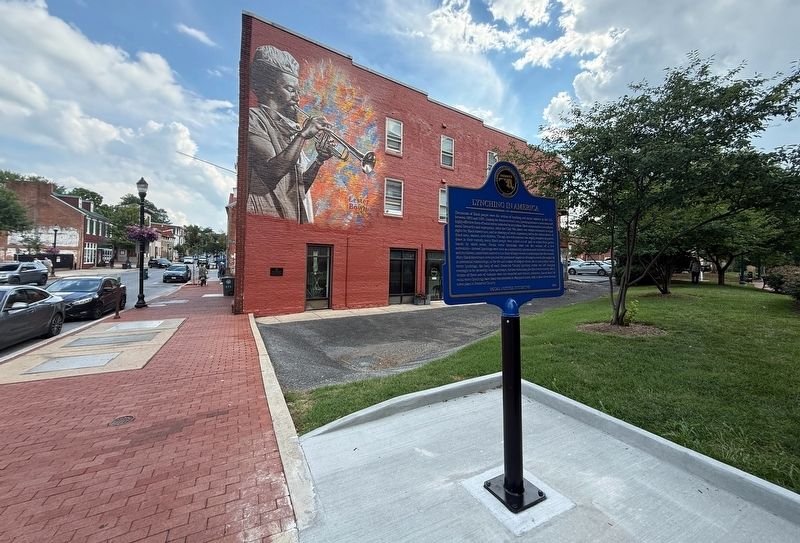
Photographed by Devry Becker Jones (CC0), July 12, 2026
4. The Lynchings of James Carroll, John Biggus, and James Bowens / Lynching in America Marker
Credits. This page was last revised on July 12, 2026. It was originally submitted on July 12, 2026, by Devry Becker Jones of Washington, District of Columbia. This page has been viewed 17 times since then. Photos: 1, 2, 3, 4. submitted on July 12, 2026, by Devry Becker Jones of Washington, District of Columbia.
