
Six Flags Darien Lake in Corfu in Genesee County, New York — The American Northeast (Mid-Atlantic)
The History of Ice Cream

Photographed by Sean P. Flynn, July 20, 2026
1. The History of Ice Cream Marker
When Marco Polo returned from his famous journey to the Orient at the end of the thirteenth century, he brought back a recipe for making water ices, which was said to have been in use in Asia for thousands of years. These water ices became popular in Venice and throughout Italy, and it is possible that milk and cream also were mixed with other ingredients and were served as frozen desserts. From water ices to cream ices was a logical step, but history is silent as to who first took the progressive step. According to one writer, Bernard Buontalenti (1536-1608), an Italian architect, was the first to manufacture frozen drinks and desserts, but they were not well received. The vogue for water ices was established in France when Catherine de Medici, of the celebrated Florentine family, married Henry II in 1533 and brought a staff of her own cooks to Paris. Her son, Henry III, also was addicted to these delicacies and is said to have consumed them daily.
In the next century in France, ice cream apparently had come into its own, for it is narrated of a court dinner given by Louis XIV that, "Toward the end of the feast, his chef (Vatel) caused to be placed before each guest, in silver gilt cups, what was apparently a freshly laid egg, colored
this page online
A state banquet given by Charles I of England some 300 years ago was made memorable by the appearance of a new and unique dish. The king's French chef had concocted a frozen dessert, or cream pie, which the assembled gourmets received and consumed with delight. Charles was so pleased with his culinary masterpiece that he summoned the cook, bade him to hold the recipe forever a secret and pensioned him with 500 pounds a year, so that the delicacy would be reserved for the exclusive use of the royal table.
Ice Cream Appears In America
lee cream, like so many other things was brought across the Atlantic by our colonial forefathers. Searching into some personal letters of this day, we find one written in 1700 by a guest of Governor Bladen of Maryland who said, "... we had a dessert no less Curious; among the Rarities of which it was Compos'd, was some fine Ice Cream which, with the Strawberries and Milk. eat Most Deliciously."
At
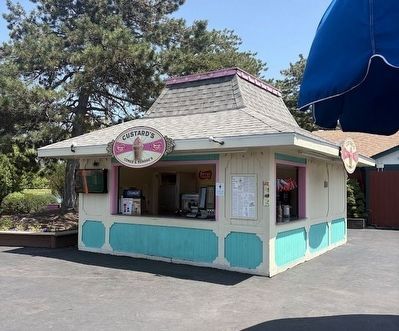
Photographed by Sean P. Flynn, July 20, 2026
2. The History of Ice Cream Marker at Custard's
President Washington was known as a man of discriminating tastes. He took his liking for ice cream to his home, Mt. Vernon, where he kept "two pewter Ice Cream pots." It also is said that Washington bought "a Cream Machine for Making Ice" when he

Photographed by Sean P. Flynn, July 20, 2026
3. The History of Ice Cream Marker
The Boomerang roller coaster is in the far background.
Other famous men who were responsible for founding our country and conquering our frontiers depended on ice cream to lighten the burdens of state and war. General Wayne, hero of the Battle of Fallen Timbers, describes a dinner he and his officers enjoyed at Greenville, Ohio, after returning from a campaign in the West.
"Officers waiting only long enough to wash away travel stains, sat at a table to dine sumptuously on roast venison, beef, boiled mutton, duck, raccoon, o'possum, mince and apple pies, plum cake, floating island, and to cap the jubilation, dishes of Ice Cream, a dainty which the Army had not seen since it left the East."
Dolley Madison, wife of our fourth president, generally is credited with having introduced ice cream at a White House reception. "Last night," says a contemporary account of one of Mrs. Madison's family dinners. "I was bid by our

Photographed by Sean P. Flynn, July 20, 2026
4. Close-up of Washington eating ice cream on the marker
In 1830, Fredrich Goetz, a confectioner of Ilmenau, Germany, wrote a technical treatise on "The Art of Ice Cream Making," which is possibly the first book of this nature. In America the earliest work on the subject apparently was a book entitled Ice Cream and Cakes, published by Scribners in 1883. The author was given merely as "An American." Another author who mentioned ice cream was Thackeray, who related in "Vanity Fair," published in 1847, that Becky Sharp regarded ice cream as a luxury while on her honeymoon.
While ice cream had won its place at an early date in the history of our country, it still was a rare dish, partly because it was so difficult to manufacture. Some of this difficulty was overcome when salt was combined with ice to lower the freezing temperature. When Dolley Madison's servants made the ice cream served at the inaugural balls, they had to beat it by hand and shake it up and down in a pan of salt and ice. This was called the "pot freezer method of making ice cream.
The first improvement in the manufacturer of ice cream was given to us by a woman, Nancy Johnson, who in 1846 invented the hand-cranked freezer. This device still is familiar to many of our grandparents who as boys and girls turned the freezer handle by the hour. By so doing they agitated a container of ice cream mix in a bed of salt and ice until the mix was frozen. As a reward for their labors they received liberal portions of ice cream before it reached the table. Freezers of this type still are to be found in some communities, where they are used in much the same manner as they were a century ago. Because Nancy Johnson lacked the foresight to have her invention patented, her name does not appear on the patent records. A similar type of freezer was, however, patented on May 30, 1848, by a Mr. Young.
As with many good things, this hand-cranked freezer was imitated and "improved", and many other patents were issued for this general type of freezer.
Wholesale Ice Cream
The father of the wholesale ice cream business in the United States was Jacob Fussell, a milk dealer of Baltimore, who began to manufacture ice cream in that city in 1851. The business was so successful that he opened additional wholesale plants in Washington, D.C. in 1856, in Boston in 1862, and in New York in 1864. James Madison Horton started The Horton Ice Cream Company in New York City about this time.
Woman Invents First Freezer
This new enterprise was in sharp contrast to the first small retail establishments where ice cream was made and sold on the premises.
With the westward migration of pioneers and the development of large western cities, a demand for ice cream sprang up. Perry Brazelton, who learned the ice cream industry from Jacob Fussell, opened a plant in St. Louis in 1858. Later this same enterprising gentleman established two more plants, one in Chicago and one in Cincinnati.
As late as 1890 ice cream was manufactured commercially by the hand-cranked freezer method. In a reminiscent mood, F.D. Hutchinson, one of Iowa's pioneer ice cream manufacturers says, "I remember that on the Fourth of July in 1890 we shipped out 300 gallons of Ice Cream — all frozen by hand." What a tedious chore that must have been!
Topics and series. This historical marker is listed in these topic lists: Colonial Era • Industry & Commerce • Wars, US Indian • Women. In addition, it is included in the Believe It or Not, the Former U.S. Presidents: #01 George Washington, and the Former U.S. Presidents: #04 James Madison series lists. A significant historical date for this entry is May 19, 1777.
Location. 42° 55.732′ N, 78° 23.032′ W. Marker is in Corfu, New York, in Genesee County. It is in Six Flags Darien Lake. It can be reached from Alleghany Road (New York State Route 77) near Sumner Road ( Route 21), on the right when traveling north. The marker is attached to Custard's ice cream stand at Six Flags Darien Lake amusement park. Touch for map. Marker is at or near this postal address: 9993 Alleghany Road, Corfu NY 14036, United States of America. Touch for directions.

Regionally, this marker is in Upstate New York, specifically in Western New York, in the Finger Lakes, and in the Rochester Metropolitan Area. It is also in the American Northeast and in the Mid-Atlantic. Globally, it is in North America, the Western Hemisphere, the Western World, and the Anglosphere. Historically, it finds itself in what was once the Haudenosaunee (Iroquois) Confederacy, New Netherland, and one of the original Thirteen Colonies.
Other nearby markers. At least 8 other markers are within 5 miles of this marker, measured as the crow flies: The Darien Lake Sharp (about 500 feet away, measured in a direct line); Mina Griswold (approx. 2.2 miles away); First United Presbyterian Church (approx. 2½ miles away); Veterans Memorial (approx. 2½ miles away); Old Buffalo Road Cemetery (approx. 4½ miles away); Brick House (approx. 4.6 miles away); Town of Pembroke (approx. 4.6 miles away); a different marker also named Veterans Memorial (approx. 4.6 miles away). Touch for a list and map of all markers in Corfu.
More about this marker. Based on a vertical caption in the far upper right corner, it appears that the marker is a reprint of an article that appeared in the February 1990 edition of the Food Service News publication.
Credits. This page was last revised on July 23, 2026. It was originally submitted on July 22, 2026, by Sean P. Flynn of Oak Park, Illinois. This page has been viewed 15 times since then. Photos: 1, 2, 3, 4. submitted on July 22, 2026, by Sean P. Flynn of Oak Park, Illinois.
