Little Compton in Newport County, Rhode Island — The American Northeast (New England)
The Sakonnet Diaspora
⎯⎯⎯
Native Neighbors
⎯⎯⎯
The Last 350 Years
⎯⎯⎯
The Next 350 Years
| — | Awashonks Garden | — |
Photographed by G.W.Bartlett, July 26, 2026
1. The Sakonnet Diaspora Marker
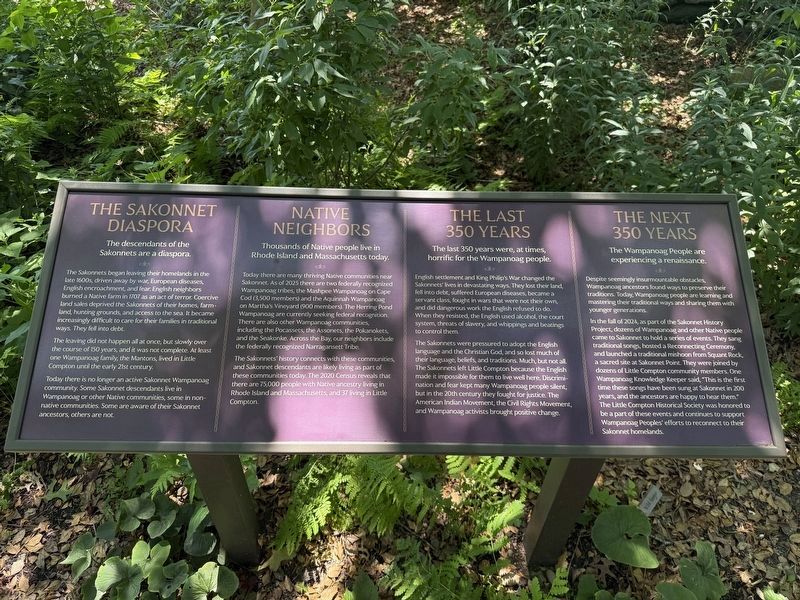
The descendants of the Sakonnets are a diaspora.
The Sakonnets began leaving their homelands in the Late 1600s, driven away by war, European diseases English encroachment, and fear. English neighbors burned a Native farm in 1707 as an act of terror. Coercive land sales deprived the Sakonnets of their homes, farmland, hunting grounds, and access to the sea. It became increasingly difficult to care for their families in traditional ways. They fell into debt.
The leaving did not happen all at once, but slowly over the course of 150 years, and it was not complete. At least one Wampanoag family, the Mantons, lived in Little Compton until the early 21st century.
Today there is no longer an active Sakonnet Wampanoag community. Some Sakonnet descendants live in Wampanoag or other Native communities, some in non-native communities. Some are aware of their Sakonnet ancestors, others are not.
Thousands of Native people live in Rhode Island and Massachusetts today.
Today there are many thriving Native communities near Sakonnet. As of 2025 there are two federally recognized Wampanoag
this page online
The Sakonnets’ history connects with these communities and Sakonnet descendants are likely living as part of these communities today. The 2020 Census reveals that there are 75,000 people with Native ancestry living in Rhode Island and Massachusetts, and 37 living in Little Compton.
The last 350 years were, at times, horrific for the Wampanoag people.
English settlement and King Philip's War changed the Sakonnets’ lives in devastating ways. They lost their land, fell into debt, suffered European diseases, became a servant class, fought in wars that were not their own and did dangerous work the English refused to do. When they resisted, the English used alcohol, the court system, threats of slavery, and whippings and beatings
Photographed by G.W.Bartlett, July 26, 2026
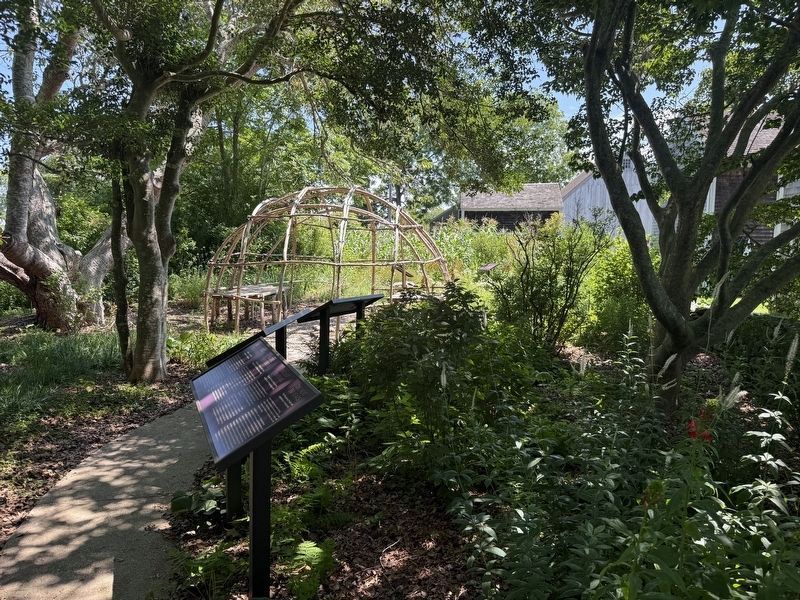
2. The Sakonnet Diaspora Marker
The Sakonnets were pressured to adopt the English language and the Christian God, and so lost much of their language, beliefs, and traditions. Much, but not all. The Sakonetts left Little Compton because the English made it impossible for them to live well here. Discrimination and fear kept many Wampanoag people silent, but in the 20th century they fought for justice. The American Indian Movement, the Civil Rights Movement, and Wampanoag activists brought positive change.
The Wampanoag People are experiencing a renaissance.
Despite seemingly insurmountable obstacles Wampanoag ancestors found ways to preserve their traditions. Today Wampanoag people are learning and mastering their traditional ways and sharing them with younger generations.
In the fall of 2024, as part of the Sakonnet History Project, dozens of Wampanoag and other Native people came to Sakonnet to hold a series of events. They sang traditional songs, hosted a Reconnecting Ceremony, and launched a traditional mishoon from Squant Rock, a sacred site at Sakonnet Point. They were joined by dozens of Little Compton community
Photographed by G.W.Bartlett, July 26, 2026
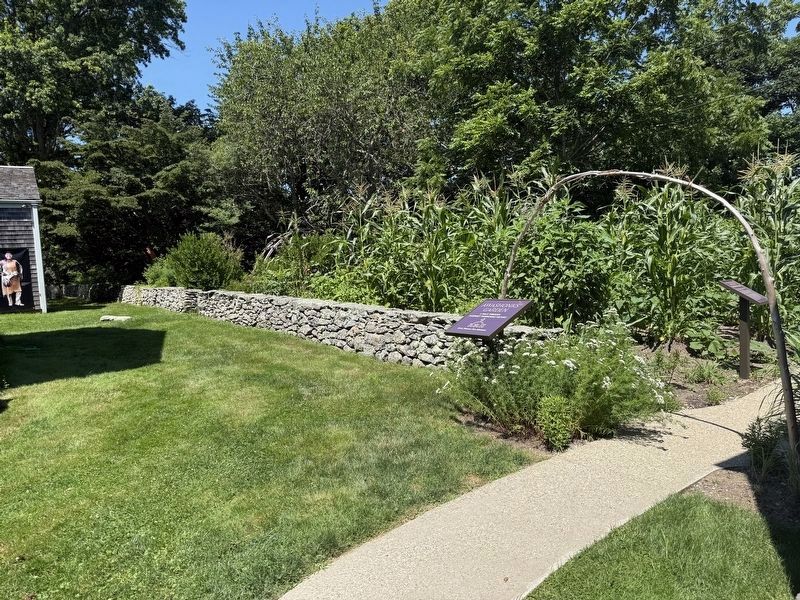
3. Awashonks Garden Entrance
Located behind the Wilbor House on the Little Compton Historical Society grounds.
Erected 2025 by Little Compton Historical Society.
Topics and series. This historical marker is listed in these topic lists: Anthropology & Archaeology • Civil Rights • Indigenous Peoples and Communities • Religion & Religious Structures. In addition, it is included in the Rhode Island, Little Compton Historical Society series list.
Location. 41° 29.593′ N, 71° 11.086′ W. Marker is in Little Compton, Rhode Island, in Newport County. It can be reached from West Main Road (Rhode Island Route 77) south of Fairfields Drive, on the right when traveling north. Touch for map. Marker is at or near this postal address: 548 West Main Road, Little Compton RI 02837, United States of America. Touch for directions.

Regionally, this marker is on Narragansett Bay. It is also in the American Northeast, in New England, and on the Eastern Seaboard. Globally, it is in the North Atlantic Region, North America, the Western Hemisphere, the Western World, and the Anglosphere. Historically, it finds itself in what was once one of the original Thirteen Colonies.
Other nearby markers. At least 8 other markers are within walking distance of this marker: Buying & Selling Acoaxet / The English at Sakonnet / Christian Indians / Life in the 18th Century (here, next to this marker); Mishoon (here, next to this marker); Distrust for the Newcomers (a few steps from this marker); Stone Walls (a few steps from this marker); Squant (a few steps from this marker); Fal Solomon: Indentured Here / Honoring Fal (a few steps from this marker); Ancient Connections (a few steps from this marker); Three Sisters: A Symbiotic Garden (within shouting distance of this marker). Touch for a list and map of all markers in Little Compton.
Related marker. Click here for another marker that is related to this marker. The beginning of King Philip’s War
Also see . . .
1. Reconnecting with Sakonnet Wampanoag History & Communities.
A new garden has been created to honor Awashonks’ legacy and to offer a corrective course to recent history. The Sakonnet History Project, commemorates the 350th anniversary of King Philip’s War and the first attempted English settlement in Sakonnet. The project marks a new phase in the town’s recognition of historical events.(Submitted on July 30, 2026, by G.W.Bartlett of Hingham, Massachusetts.)
2. Little Compton Historical Society.
The Little Compton Historical Society was incorporated in 1937 to preserve the history and cultural heritage of Little Compton for the enrichment and enjoyment of the general public.(Submitted on July 30, 2026, by G.W.Bartlett of Hingham, Massachusetts.)
Credits. This page was last revised on September 27, 2026. It was originally submitted on July 30, 2026, by G.W.Bartlett of Hingham, Massachusetts. This page has been viewed 13 times since then. Photos: 1, 2, 3. submitted on July 30, 2026, by G.W.Bartlett of Hingham, Massachusetts. • Michael Herrick was the editor who published this page.
