Saint Kevin's in Dublin in County Dublin, Leinster, Ireland — Mid-East (and Dublin)
Ról na mBan — san Éirí Amach
⎯⎯⎯
The Role of Women — in the Rising
| — | Éirí Amach 1916 i bhFaiche Stiabhna / The 1916 Rising in St Stephen’s Green | — |
Photographed by Ian Lefkowitz, May 18, 2026
1. Ról na mBan — san Éirí Amach / The Role of Women — in the Rising Marker
 [Gaeilge:]
Is i gCath Fhaiche Stiabhna is mó a d’imir Óglaigh mhná ról in Éirí Amach na Cásca 1916, mar bhaill d’Arm Cathartha na hÉireann nó de Chumann na mBan den chuid is mó. Thug Arm Cathartha na hÉireann cead do mhná teacht isteach agus caitheadh leo mar dhaoine a bhí comhionann leis na fir, á gcur faoi oiliúint le harm tine a úsáid agus ag tabhairt ardaithe céime dóibh go gráid na nOifigeach.
Thug an Ceannfort Michael Mallin coimisiún machaire don Chuntaois Markievicz (Leas-Cheannfort), an bhean ag an raibh an chéim ab airde san Éirí Amach. Ba í an Dr Kathleen Lynn (Captaen) Príomhoifigeach Leighis Arm Cathartha na hÉireann, a bhí i mbun gnímh ag Halla na Cathrach. Bhí an Sáirsint Madeleine ffrench-Mullen i gceannas ar an ospidéal catha i bhFaiche Stiabhna.
Rinne Nora O Daly, cúntóir garchabhrach, cur síos uirthi mar bhean ag a raibh
“éadan ar a raibh cosúlacht chomh deartha le muinín agus iontaoibh, macántacht is crógacht a spreagadh, agus bhí sin ar fad, agus féinmhuinín chiúin, le feiceáil go soiléir ina dreach”
Thóg Margaret Skinnider, múinteoir scoile ó Ghlaschú, seachtaine saoire in aois a trí bliana fiche
this page online
Women also played a vital role as messengers between St Stephen’s Green and the General Post Office on O’Connell Street and other locations in the Rising.
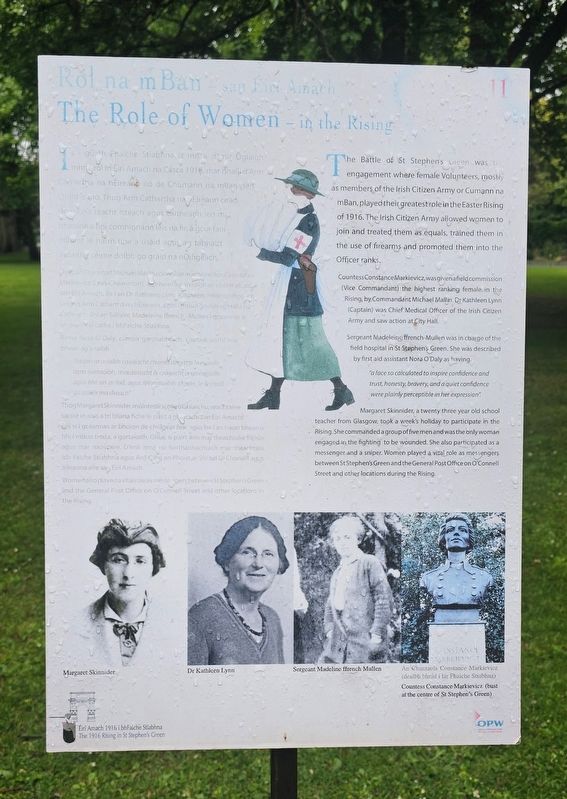
The Battle of St Stephen’s Green was the engagement where female Volunteers, mostly as members of the Irish Citizen Army or Cumann na mBan, played their greatest role in the Easter Rising of 1916. The Irish Citizen Army allowed women to join and treated them as equals, trained them in the use of firearms and promoted them into the Officer ranks.
Countess Constance Markievicz, was given a field commission (Vice Commandant) the highest ranking female in the Rising, by Commandant Michael Mallin. Dr Kathleen Lynn (Captain) was Chief Medical Officer of the Irish Citizen Army and saw action at City Hall.
Sergeant Madeleine ffrench-Mullen
Photographed by Ian Lefkowitz, May 18, 2026
2. Ról na mBan — san Éirí Amach / The Role of Women — in the Rising Marker
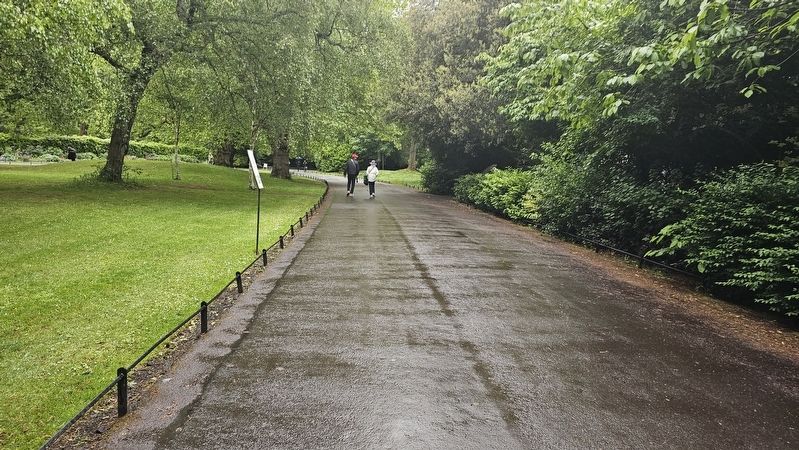
The marker is located towards the southeast of the park, on the path that rings the exterior.
“a face so calculated to inspire confidence and trust, honesty, bravery, and a quiet confidence were plainly perceptible in her expression”.
Margaret Skinnider, a twenty three year old school teacher from Glasgow, took a week’s holiday to participate in the Rising. She commanded a group of five men and was the only woman engaged in the fighting to be wounded. She also participated as a messenger and a sniper. Women played a vital role as messengers between St Stephen’s Green and the General Post Office on O’Connell Street and other locations during the Rising.
(Captions)
Margaret Skinnider
Dr Kathleen Lynn
Sergeant Madeline ffrench Mullen
An Chuntaois Constance Markievicz (dealbh bhráid i lár Fhaiche Stiabhna)
Countess Constance Markievicz (bust at the centre of St Stephen’s Green)
Erected 2016 by The Office of Public Works. (Marker Number 11.)
Topics and series. This historical marker is listed in these topic lists: Parks & Recreational Areas • Patriots & Patriotism • Wars, Non-US • Women. In
Photographed by Ian Lefkowitz, May 18, 2026
3. Constance Markievicz
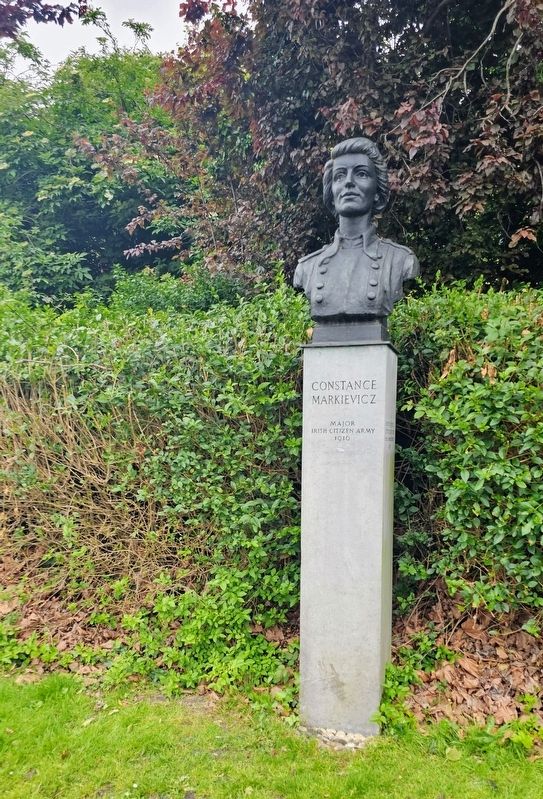
Nearby to the marker, there stands a bust of Countess Constance Markievicz, who was second-in-command at St. Stephen's Green.
Location. 53° 20.222′ N, 6° 15.557′ W. Marker is in Dublin, Leinster, in County Dublin. It is in Saint Kevin's. It can be reached from Saint Stephen's Green west of Leeson Street, on the left when traveling east. The marker is located within St. Stephen's Green. Touch for map. Marker is at or near this postal address: 83 St Stephen's Green, Dublin, Leinster, Ireland. Touch for directions.

Regionally, this marker is in the Ancient East. Globally, it is on the Atlantic Ocean, in the North Atlantic Region, in Europe, on the Island of Ireland, on the Celtic Fringe, in the European Union, in Atlantic Europe, on one of the British Isles, in the Western World, and in the Anglosphere.
Other nearby markers. At least 8 other markers are within walking distance of this marker: Eaglais na hOllscoile / University Church (within shouting distance of this marker); Stáisiúin Garchabhrach / First Aid Stations (within shouting distance of this marker); James Joyce (within shouting distance of this marker); St. Patrick's House of the Catholic University (within shouting distance of this marker); John Henry Newman (about 90 meters away, measured in a direct line); Countess Constance Markievicz (about 90 meters away); Trinsí/Baracáidí / Trenches and Barricades (about 90 meters away); The "Three Fates" (about 90 meters away). Touch for a list and map of all markers in Dublin.
Another marker is no longer nearby. Haslam Memorial Seat (was about 90 meters away but has been permanently removed).
Also see . . .
1. 1916 Exhibition (St. Stephen's Green Park). (Submitted on July 31, 2026, by Ian Lefkowitz of New York, New York.)
2. The untold story of one lesbian couple in the Easter Rising (GCN).
During the Dublin lock-out of 1913, both women worked in the soup kitchen in Liberty Hall. Radical in their ideas and believing in the mission of James Connolly, the lesbian couple joined the Easter Rising – ffrench-Mullen as a lieutenant for the Irish-Citizen Army and Kathleen Lynn as its chief medical officer.(Submitted on July 31, 2026, by Ian Lefkowitz of New York, New York.)
3. Margaret Skinnider (Wikipedia).
In her autobiography, Doing my bit for Ireland Skinnider herself vividly describes her role as a sniper at St. Stephen's Green in the Easter Rising:(Submitted on July 31, 2026, by Ian Lefkowitz of New York, New York.)
It was dark there, full of smoke and the din of firing, but it was good to be in action. I could look across the tops of the trees and see the British soldiers on the roof of the Shelbourne. I could also hear their shot hailing against the roof and wall of our fortress, for in truth this building was just that. More than once I saw the man I aimed at fall.
Credits. This page was last revised on July 31, 2026. It was originally submitted on July 31, 2026, by Ian Lefkowitz of New York, New York. This page has been viewed 13 times since then. Photos: 1, 2, 3. submitted on July 31, 2026, by Ian Lefkowitz of New York, New York. • Andrew Ruppenstein was the editor who published this page.
