Dublin in County Dublin, Leinster, Ireland — Mid-East (and Dublin)
An Chuntaois Constance Markievicz
⎯⎯⎯
Countess Constance Markievicz
(1868–1927)
| — | Éirí Amach 1916 i bhFaiche Stiabhna / The 1916 Rising in St Stephen’s Green | — |
Photographed by Ian Lefkowitz, May 18, 2026
1. An Chuntaois Constance Markievicz / Countess Constance Markievicz Marker

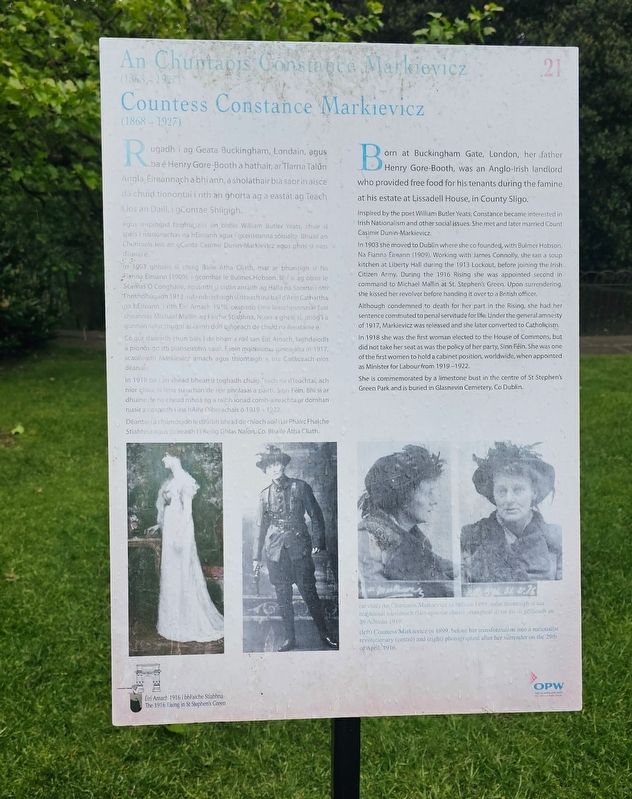
Rugadh í ag Geata Buckingham, Londain, agus ba é Henry Gore-Booth a hathair, ar Tiarna Talún Angla-Éireannach a bhí ann, a sholáthair bia saor in aisce dá chuid tionóntaí i rith an ghorta ag a eastát ag Teach Lios an Daill, i gContae Shligigh.
Agus inspioráid faighte aici ón bhfile William Butler Yeats, chuir sí spéis i náisiúnachas na hÉireann agus i gceisteanna sóisialta. Bhuail an Chuntaois leis an gCunta Casimir Dunin-Markievicz agus phós sí níos déanaí é.
In 1903 ghluais sí chuig Baile Átha Cliath, mar ar bhunaigh sí Na Fianna Éireann (1909), i gcomhar le Bulmer Hobson. Bhí sí ag obair le Séamas Ó Conghaile, agus rith sí cistin anraith ag Halla na Saoirse i rith Fhrithdhúnadh 1913, sula ndeachaigh sí isteach ina ball d’Arm Cathartha na hÉireann. I rith Éirí Amach 1916, ceapadh í ina leascheannasaí faoi cheannas Michael Mallin ag Faiche Stiabhna. Nuair a ghéill sí, phóg í a gunnán sular thug sí ar láimh don oifigeach de chuid na Breataine é.
Cé gur daoradh chun báis í de bharr a róil san Éirí Amach, laghdaíodh a pionós go dtí pianseirbhís saoil. Faoin maithiúnas ginearálta in 1917, scaoileadh
this page online
In 1918 ba í an chéad bhean a toghadh chuig Teach na dTeachtaí, ach níor ghlac sí lena suíochán de réir pholasaí a páirtí, Sinn Féin. Bhí sí ar dhuine de na chéad mhná ag a raibh ionad comh-aireachta ar domhan nuair a ceapadh í ina hAire Oibreachais ó 1919–1922.
Déantar í a chomóradh le dealbh bhrád de chloch aoil i lár Pháirc Fhaiche Stiabhna agus cuireadh í i Reilig Ghlas Naíon, Co. Bhaile Átha Cliath.
Born at Buckingham Gate, London, her father Henry Gore-Booth, was an Anglo-Irish landlord who provided free food for his tenants during the famine at his estate at Lissadell House, in County Sligo.
Inspired by the poet William Butler Yeats, Constance became interested in Irish Nationalism and other social issues. She met and later married Count Casimir Dunin-Markievicz.
In 1903 she moved to Dublin where she co founded, with Bulmer Hobson, Na Fianna Éireann (1909). Working with James Connolly, she ran a soup kitchen at Liberty Hall during the 1913 Lockout, before joining the Irish Citizen Army. During the 1916 Rising she was appointed second in
Photographed by Ian Lefkowitz, May 18, 2026
2. An Chuntaois Constance Markievicz / Countess Constance Markievicz Marker
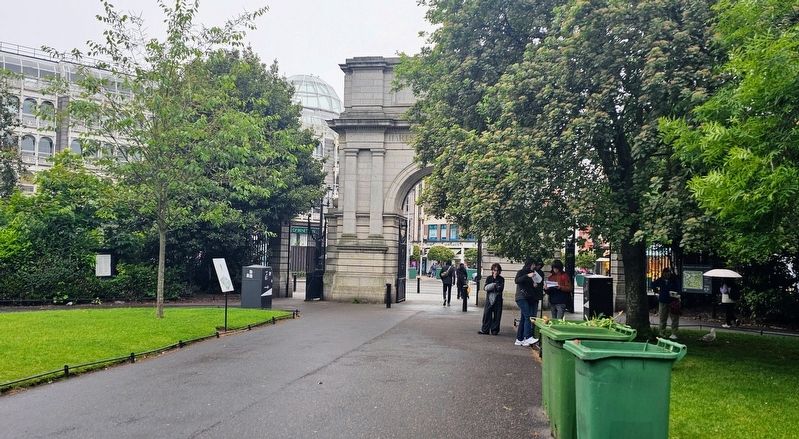
The view from the marker towards Fusilier's Arch.
Although condemned to death for her part in the Rising, she had her sentence commuted to penal servitude for life. Under the general amnesty of 1917, Markievicz was released and she later converted to Catholicism.
In 1918 she was the first woman elected to the House of Commons, but did not take her seat as was the policy of her party, Sinn Féin. She was one of the first women to hold a cabinet position, worldwide, when appointed as Minister for Labour from 1919–1922.
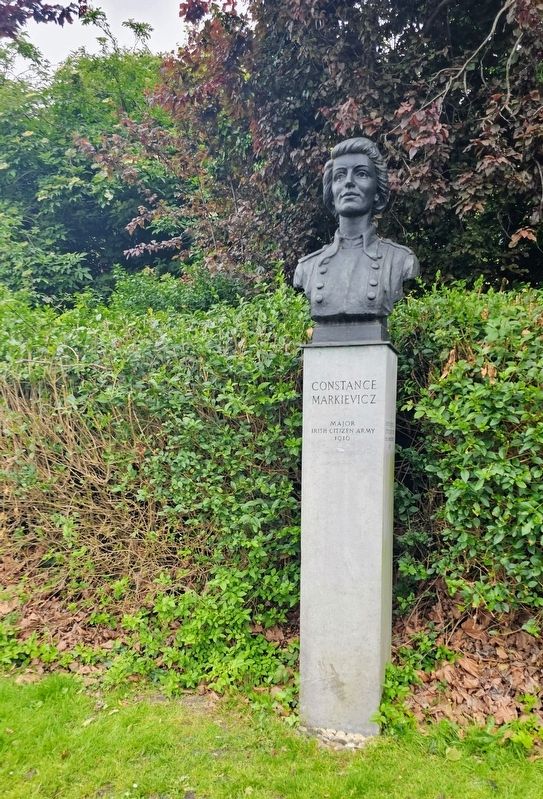
She is commemorated by a limestone bust in the centre of St Stephen’s Green Park and is buried in Glasnevin Cemetery, Co Dublin.
(Captions)
(ar chlé) An Chuntaois Markievicz sa bhliain 1899, sular thiontaigh sí ina réabhlóidí náisiúnach (lár) agus (ar dheis) grianghraf di tar éis di géilleadh an 29 Aibreán 1916.
(left) Countess Markievicz in 1899, before her transformation into a nationalist revolutionary (centre) and (right) photographed after her surrender on the 29th of April, 1916.
Erected 2016
Photographed by Ian Lefkowitz, May 18, 2026
3. Countess Constance Markievicz Statue
A bust of Countess Markievicz is found on the southern end of St. Stephen's Green.
Topics and series. This historical marker is listed in these topic lists: Parks & Recreational Areas • Patriots & Patriotism • Wars, Non-US • Women. In addition, it is included in the Ireland, Dublin: The 1916 Rising in St Stephen’s Green / Éirí Amach 1916 i bhFaiche Stiabhna series list. A significant historical date for this entry is April 29, 1916.
Location. 53° 20.362′ N, 6° 15.611′ W. Marker is in Dublin, Leinster, in County Dublin. It can be reached from Saint Stephen's Green south of King Street, on the left when traveling south. The marker is located within St. Stephen's Green. Touch for map. Marker is at or near this postal address: 8 St Stephen's Green, Dublin, Leinster, Ireland. Touch for directions.

Regionally, this marker is in the Ancient East. Globally, it is on the Atlantic Ocean, in the North Atlantic Region, in Europe, on the Island of Ireland, on the Celtic Fringe, in the European Union, in Atlantic Europe, on one of the British Isles, in the Western World, and in the Anglosphere.
Other nearby markers. At least 8 other markers are within walking distance of this marker: The United Service Club (here, next to this marker); Jeremiah O'Donovan Rossa / Ó Donnabháin Rosa (a few steps from this marker); Éirí Amach na Cásca 1916: Páirc Fhaiche Stiabhna / 1916 Easter Rising in St Stephen's Green Park (within shouting distance of this marker); An Ceannfort Michael Mallin / Commandant Michael Mallin (within shouting distance of this marker); Páirc Fhaiche Stiabhna / Saint Stephen's Green Park (within shouting distance of this marker); Fusiliers’ Arch (within shouting distance of this marker); Ag Cosaint Pháirc Fhaiche Stiabhna / Defending St Stephen's Green Park (within shouting distance of this marker); Robert Emmet (within shouting distance of this marker). Touch for a list and map of all markers in Dublin.
Related markers. Click here for a list of markers that are related to this marker.
Also see . . .
1. 1916 Exhibition (St. Stephen's Green Park). (Submitted on August 1, 2026, by Ian Lefkowitz of New York, New York.)
2. Markievicz, Constance Georgine (Senia Paseta, Dictionary of Irish Biography).
Markievicz was known for her advocacy of armed rebellion against British authority. She welcomed the Easter rising, acting as second-in-command of a troop of Citizen Army combatants at St Stephen's Green. As British troops occupied buildings surrounding the park, it became a deathtrap for the Citizen Army who were forced to seek refuge in the College of Surgeons. After a week of heavy fire, Markievicz and her fellow rebels surrendered.(Submitted on August 1, 2026, by Ian Lefkowitz of New York, New York.)
Credits. This page was last revised on August 2, 2026. It was originally submitted on August 1, 2026, by Ian Lefkowitz of New York, New York. This page has been viewed 20 times since then. Photos: 1, 2, 3. submitted on August 1, 2026, by Ian Lefkowitz of New York, New York. • Andrew Ruppenstein was the editor who published this page.
