Christiana Hundred in Wilmington in New Castle County, Delaware — The American Northeast (Mid-Atlantic)
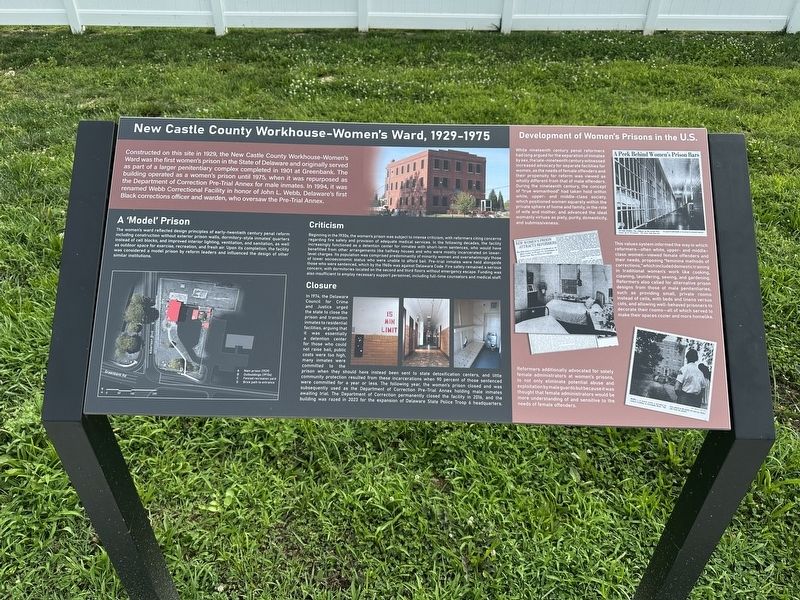
New Castle County Workhouse-Women's Ward, 1929-1975
Photographed by Pete Skillman, August 12, 2026
1. New Castle County Workhouse-Women's Ward, 1929-1975 Marker
A 'Model' Prison
The women's ward reflected design principles of early-twentieth century penal reform including construction without exterior prison walls, dormitory-style inmates' quarters instead of cell blocks, and improved interior lighting, ventilation, and sanitation, as well as outdoor space for exercise, recreation, and fresh air. Upon its completion, the facility was considered a model prison by reform leaders and influenced the design of other similar institutions.
Criticism
Beginning in the 1930s, the women's prison was subject to intense criticism, with reformers citing
this page online
Closure
In 1974, the Delaware Council for Crime and Justice urged the state to close the prison and transition inmates to residential facilities, arguing that it was essentially a detention center for those who could not raise bail, public costs were too high, many inmates were committed to the prison when they should
Photographed by Pete Skillman, August 12, 2026
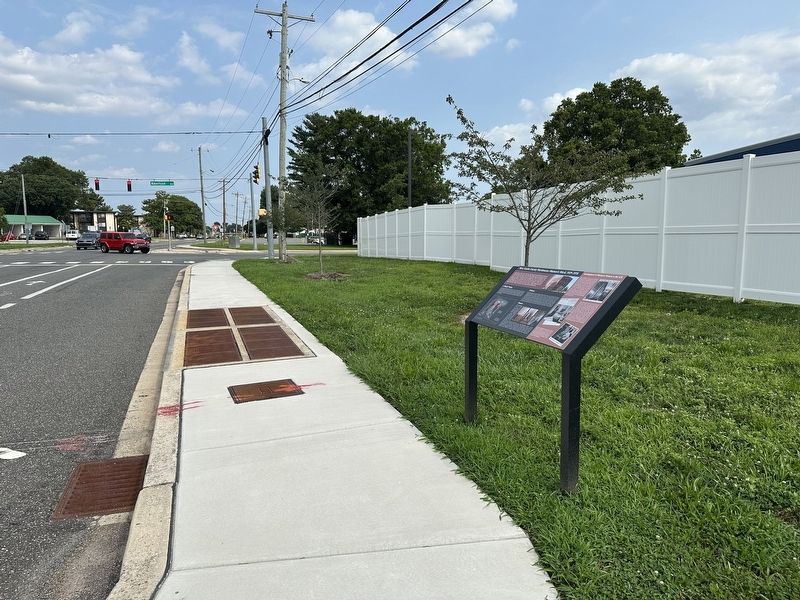
2. New Castle County Workhouse-Women's Ward, 1929-1975 Marker - wide view
Development of Women's Prisons in the U.S.
While nineteenth century penal reformers had long argued for the separation of inmates by sex, the late-nineteenth century witnessed increased advocacy for separate facilities for women, as the needs of female offenders and their propensity for reform was viewed as wholly different from that of male offenders. During the nineteenth century, the concept of "true womanhood" had taken hold within white, upper- and middle-class society, which positioned women squarely within the private sphere of home and family, in the role of wife and mother, and advanced the ideal womanly virtues as piety, purity, domesticity, and submissiveness.
This values system informed the way in which reformers--often white, upper- and middle-class women--viewed female offenders and their needs, proposing "feminine methods of corrections," which included domestic training in traditional women's work like cooking, cleaning, laundering, sewing, and gardening. Reformers also called for alternative prison designs from those of male penitentiaries, such as providing small, private rooms instead of cells, with beds and linens versus cots, and allowing well-behaved prisoners to decorate their rooms--all of which served to make their spaces cozier and more homelike.
Reformers additionally advocated for solely female administrators at women's prisons, to not only eliminate potential abuse and exploitation by male guards but because it was thought that female administrators would be more understanding of and sensitive to the needs of the female offenders.
Topics. This historical marker is listed in these topic lists: Civil Rights • Law Enforcement • Women. A significant historical year for this entry is 1929.
Location. 39° 44.323′ N, 75° 37.656′ W. Marker is in Wilmington, Delaware, in New Castle County. It is in Christiana Hundred. It is on Greenbank Road, on the right when traveling east. Touch for map. Marker is at or near this postal address: 205 Greenbank Rd, Wilmington DE 19808, United States of America. Touch for directions.

Regionally, this marker is in Greater Philadelphia. It is also in the American Mid-Atlantic, on the Delmarva Peninsula, and on the Eastern Seaboard. Globally, it is in the North Atlantic Region, North America, the Western Hemisphere, the Western World, and the Anglosphere. Historically, it finds itself in what was once New Netherland and also one of the original Thirteen Colonies.
Other nearby markers. At least 8 other markers are within walking distance of this marker: The "Annie Oakleys": First Female Prison Guards in the United States (about 500 feet away, measured in a direct line); The Lynching of George White (approx. 0.2 miles away); What Is This? (approx. ¼ mile away); How a Steam Locomotive Works (approx. ¼ mile away); Wilmington & Western Railroad (approx. ¼ mile away); Greenbank Mill (approx. 0.3 miles away); The Delaware Continentals (approx. ¾ mile away); The Home of William Julius "Judy" Johnson (approx. 0.8 miles away). Touch for a list and map of all markers in Wilmington.
Credits. This page was last revised on August 13, 2026. It was originally submitted on August 12, 2026, by Pete Skillman of Wilmington, Delaware. This page has been viewed 23 times since then. Photos: 1, 2. submitted on August 12, 2026, by Pete Skillman of Wilmington, Delaware.
