Naperville in Will County, Illinois — The American Midwest (Great Lakes)
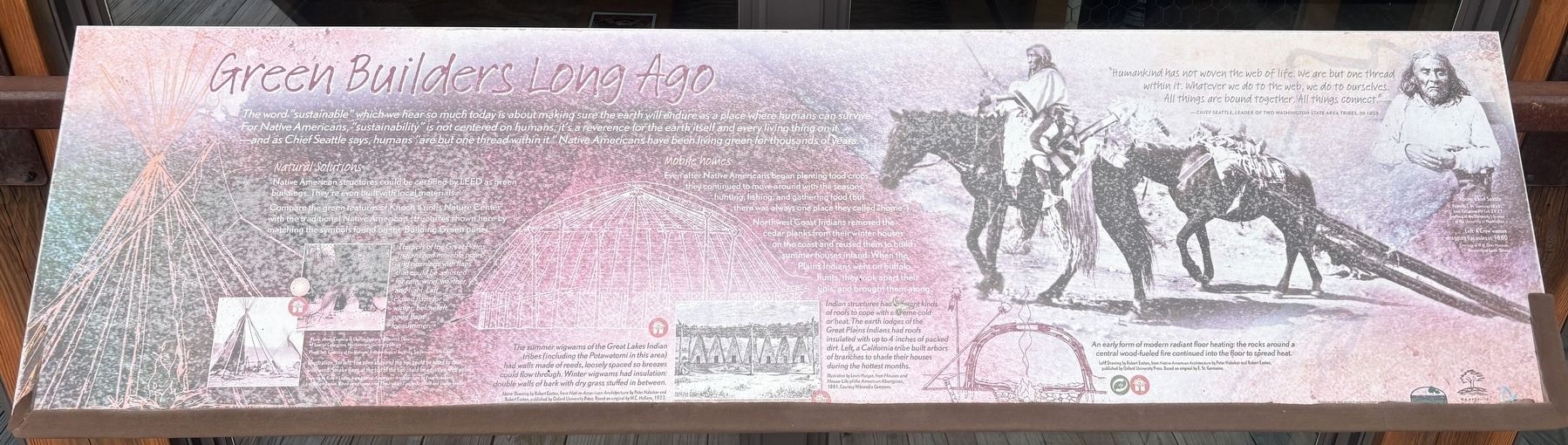
Green Builders Long Ago
Photographed by Sean P. Flynn, August 18, 2026
1. Green Builders Long Ago Marker
Natural Solutions
Native American structures could be certified by LEFD as green buildings. They're even built with local materials.
Compare the green features of Knoch Knolls Nature Center with the traditional Native American structures shown here by matching the symbols found on the Building Green panel.
[Captions beside photos:] The tipis of the Great Piains Indians had movable poles and openings with flaps that could be adjusted for rain, wind, weather, and light. Left, closed flaps for winter; below left, open flaps for summer.
The cone shape of the tipi could be tilted to deal with wind. Smoke flaps at the top of the tipi could be adjusted with poles.
Mobile homes
Even after Native Americans began planting food
this page online
[Captions beside photos:] The summer wigwams of the Great Lakes Indian tribes (including the Potawatomi in this area) had walls made of reeds, loosely spaced so breezes could flow through. Winter wigwams had insulation: double walls of bark with dry grass stuffed in between.
Indian structures had different kinds of roofs to cope with extreme cold or heat. The earth lodges of the Great Plains Indians had roofs insulated with up to 4 inches of packed dirt, Left, a California tribe built arbors of branches to shade their houses during the hottest months.
An early form of modern radiant floor heating: the rocks around a central wood-fueled fire continued into the floor to spread heat.
[Quote in upper right corner:] "Humankind has not woven the web of life. We are but one thread within it. Whatever we do to the web, we do to ourselves. All things are bound together. All things connect."
Chief Seattle, leader of two Washington State area tribes, in 1855
Erected by Naperville

Photographed by Sean P. Flynn, August 18, 2026
2. Markers on the back deck of the Knoch Knolls Nature Center
Topics. This historical marker is listed in these topic lists: Agriculture • Environment • Indigenous Peoples and Communities. A significant historical year for this entry is 1855.
Location. 41° 42.838′ N, 88° 8.475′ W. Marker is in Naperville, Illinois, in Will County. It is on Knoch Knolls Road 1.3 miles east of 95th Street, on the right when traveling east. The marker is affixed to the wall of the Knoch Knolls Park Nature Center, in the rear on the deck. Touch for map. Marker is at or near this postal address: 320 Knoch Knolls Road, Naperville IL 60565, United States of America. Touch for directions.

Regionally, this marker is in Greater Chicago. It is also in the American Midwest. Globally, it is in North America, on the Great Lakes, in the Western Hemisphere, in the Western World, and in the Anglosphere. Historically, it finds itself in what was once the territory of the Mississippian Culture and also the Northwest Territory.
Other nearby markers. At least 8 other markers are within walking distance of this marker: Native Landscape Restoration at Knoch Knolls Park (here, next to this marker);
Photographed by Sean P. Flynn, August 18, 2026
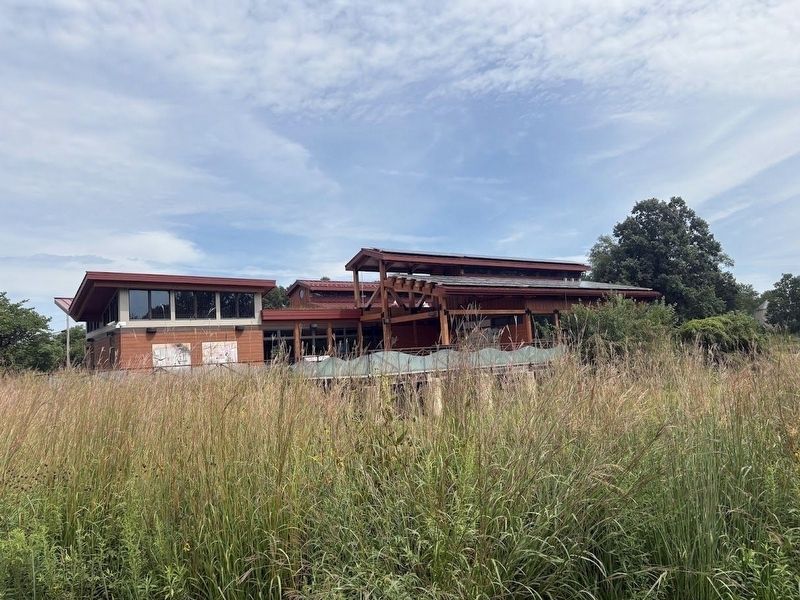
3. Knoch Knolls Nature Center
More about this marker. This marker has some signs of decay, perhaps from direct exposure to the sun. However, it was mostly readable when visited in August 2026.
Also see . . . Knoch Knolls Nature Center. From the Naperville Park District. (Submitted on August 21, 2026, by Sean P. Flynn of Oak Park, Illinois.)
Credits. This page was last revised on August 21, 2026. It was originally submitted on August 21, 2026, by Sean P. Flynn of Oak Park, Illinois. This page has been viewed 12 times since then. Photos: 1, 2. submitted on August 21, 2026, by Sean P. Flynn of Oak Park, Illinois. 3. submitted on August 20, 2026, by Sean P. Flynn of Oak Park, Illinois.
