Palatka in Putnam County, Florida — The American South (South Atlantic)
A. Phillip Randolph Transportation Hub
Photographed by Stephen Thomas White, February 10, 2026
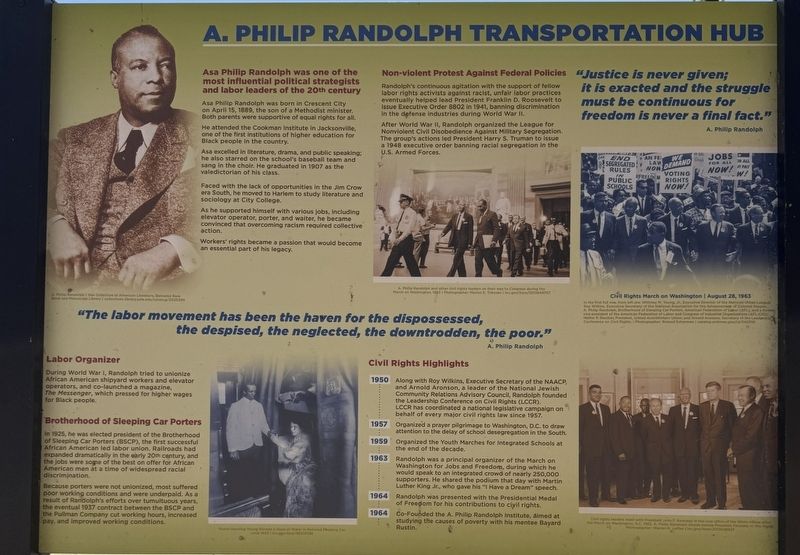
1. A. Phillip Randolph Transportation Hub Marker
Asa Philip Randolph was one of the most influential political strategists and labor leaders of the 20th century
Asa Philip Randolph was born in Crescent City on April 15, 1889, the son of a Methodist minister. Both parents were supportive of equal rights for all.
He attended the Cookman Institute in Jacksonville, one of the first institutions of higher education for Black people in the country.
Asa excelled in literature, drama, and public speaking; he also starred on the school's baseball team and sang in the choir. He graduated in 1907 as the valedictorian of his class.
Faced with the lack of opportunities in the Jim Crow era South, he moved to Harlem to study literature and sociology at City College.
As he supported himself with various jobs, including elevator operator, porter, and waiter, he became convinced that overcoming racism required collective action.
Workers' rights became a passion that would become an essential part of his legacy.
Non-violent Protest Against Federal Policies
Randolph's continuous agitation with the support of fellow labor rights activists against racist, unfair labor practices
this page online
After World War II, Randolph organized the League for Nonviolent Civil Disobedience Against Military Segregation. The group's actions led President Harry S. Truman to issue a 1948 executive order banning racial segregation in the U.S. Armed Forces.
“Justice is never given; it is exacted and the struggle must be continuous for freedom is never a final fact."
A. Philip Randolph
“The labor movement has been the haven for the dispossessed, the despised, the neglected, the downtrodden , the poor."
A. Philip Randolph
Labor Organizer
During World War I, Randolph tried to unionize African American shipyard workers and elevator operators, and co-launched a magazine, The Messenger, which pressed for higher wages for Black people.
Brotherhood of Sleeping Car Porters
In 1925, he was elected president of the Brotherhood of Sleeping Car Porters (BSCP), the first successful African American led labor union. Railroads had expanded dramatically in the early 20th century,
Photographed by Stephen Thomas White, February 10, 2026
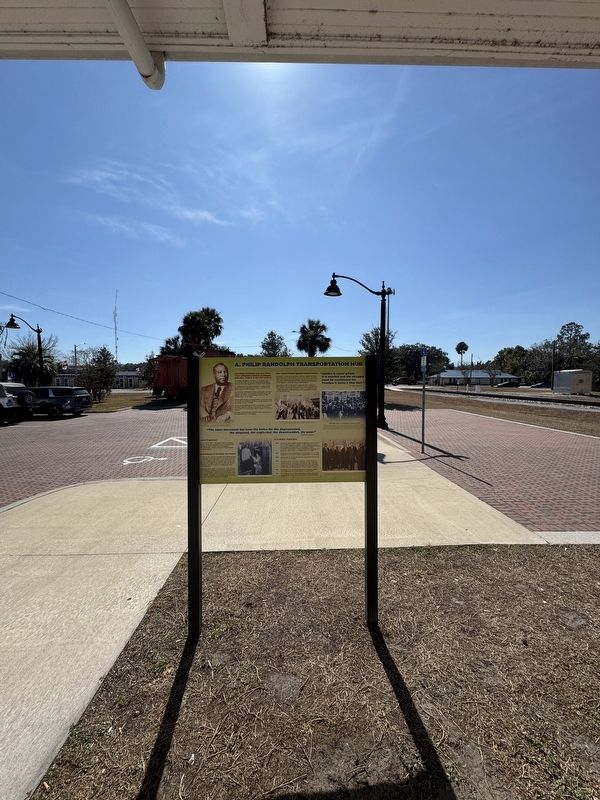
2. A. Phillip Randolph Transportation Hub Marker
Because porters were not unionized, most suffered poor working conditions and were underpaid. As a result of Randolph's efforts over tumultuous years, the eventual 1937 contract between the BSCP and the Pullman Company cut working hours, increased pay, and improved working conditions.
Civil Rights Highlights
1950 Along with Roy Wilkins, Executive Secretary of the NAACP, and Arnold Aronson, a leader of the National Jewish Community Relations Advisory Council, Randolph founded the Leadership Conference on Civil Rights (LCCR).
LCCR has coordinated a national legislative campaign on behalf of every major civil rights law since 1957.
1957 Organized a prayer pilgrimage to Washington, D.C. to draw attention to the delay of school desegregation in the South.
1959 Organized the Youth Marches for Integrated Schools at the end of the decade.
1963 Randolph was a principal organizer of the March on Washington for Jobs and Freedom, during which he would speak to an integrated crowd of nearly 250,000 supporters. He shared
Photographed by Wikimedia
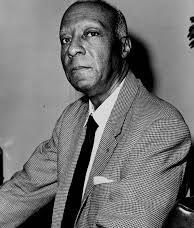
3. A. Phillip Randolph
1964 Randolph was presented with the Presidential Medal of Freedom for his contributions to civil rights.
1964 Co-Founded the A. Philip Randolph Institute, aimed at studying the causes of poverty with his mentee Bayard Rustin.
(captions)
A. Philip Randolph | Yale Collection of American Literature, Beinecke Rare Book and Manuscript Library collections.library.yale.edu/catalog/2020399
A. Philip Randolph and other civil rights leaders on their way to Congress during the March on Washington, 1963 | Photographer: Marion S. Trikosko | loc.gov/item/2013649707
Civil Rights March on Washington | August 28, 1963
In the first full row, from left are: Whitney M. Young, Jr., Executive Director of the National Urban League; Roy Wilkins, Executive Secretary of the National Association for the Advancement of Colored People; A. Philip Randolph, Brotherhood of Sleeping Car Porters, American Federation of Labor (AFL), and a former vice president of the American Federation of Labor and Congress of Industrial Organizations (AFL-CIO); Water P. Reuther, President. United AutoWorkers Union; and Arnold Aronson, Secretary of the Leadership Conference on Civil Rights. | Photographer: Roland Scherman | catalog.archives.gov/id/542010
Porter Handing Young Woman a Glass of Water in Railroad Sleeping Car, circa 1905 | loc.gov/item/96510256
Civil rights leaders meet with President John F. Kennedy in the oval office of the White House after the March on Washington, D.C. 1963, A. Philip Randolph stands beside President Kennedy in this image. Photographer: Warren K. Leffler| loc.gov/item/2013648833
Erected by Florida Department of Transportation .
Topics. This historical marker is listed in these topic lists: African Americans • Civil Rights • Labor Unions • Roads & Vehicles. A significant historical year for this entry is 1963.
Location. 29° 38.977′ N, 81° 38.438′ W. Marker is in Palatka, Florida, in Putnam County. It is on North 11th Street north of Reid Street, on the left when traveling north. The marker is located in front of the David Browning Rail Museum. Touch for map. Marker is at or near this postal address: 222 N 11th St, Palatka FL 32177, United States of America. Touch for directions.

Regionally, this marker is in Florida’s First Coast. It is also in the American South. Globally, it is in the North Atlantic Region, North America, a Gulf of Mexico state, the Western Hemisphere, the Western World, and the Anglosphere. Historically, it finds itself in what was once New Spain, the territory of the Mississippian Culture, one of the Confederate States of America, and the Antebellum South.
Other nearby markers. At least 8 other markers are within walking distance of this marker: Atlantic Coast Line (within shouting distance of this marker); Palatka (about 300 feet away, measured in a direct line); Central Academy School (approx. 0.4 miles away); Putnam County Persian Gulf War (Operation Desert Storm) Memorial (approx. half a mile away); Putnam County WW II Memorial (approx. half a mile away); Putnam County Confederate Memorial (approx. half a mile away); Putnam County WW I Memorial (approx. half a mile away); Putnam County Korean War Memorial (approx. half a mile away). Touch for a list and map of all markers in Palatka.
Also see . . .
1. Opinion A. Phillip Randolph- the link between transportation and civil rights. (Submitted on September 15, 2026, by Stephen Thomas White of Norfolk, Virginia.)
2. A. Phillip Randolph. (Submitted on September 15, 2026, by Stephen Thomas White of Norfolk, Virginia.)
3. A. Phillip Randolph . (Submitted on September 15, 2026, by Stephen Thomas White of Norfolk, Virginia.)
4. . (Submitted on September 15, 2026, by Stephen Thomas White of Norfolk, Virginia.)
Credits. This page was last revised on September 15, 2026. It was originally submitted on September 15, 2026, by Stephen Thomas White of Norfolk, Virginia. This page has been viewed 7 times since then. Photos: 1, 2, 3. submitted on September 15, 2026, by Stephen Thomas White of Norfolk, Virginia. • Bernard Fisher was the editor who published this page.
